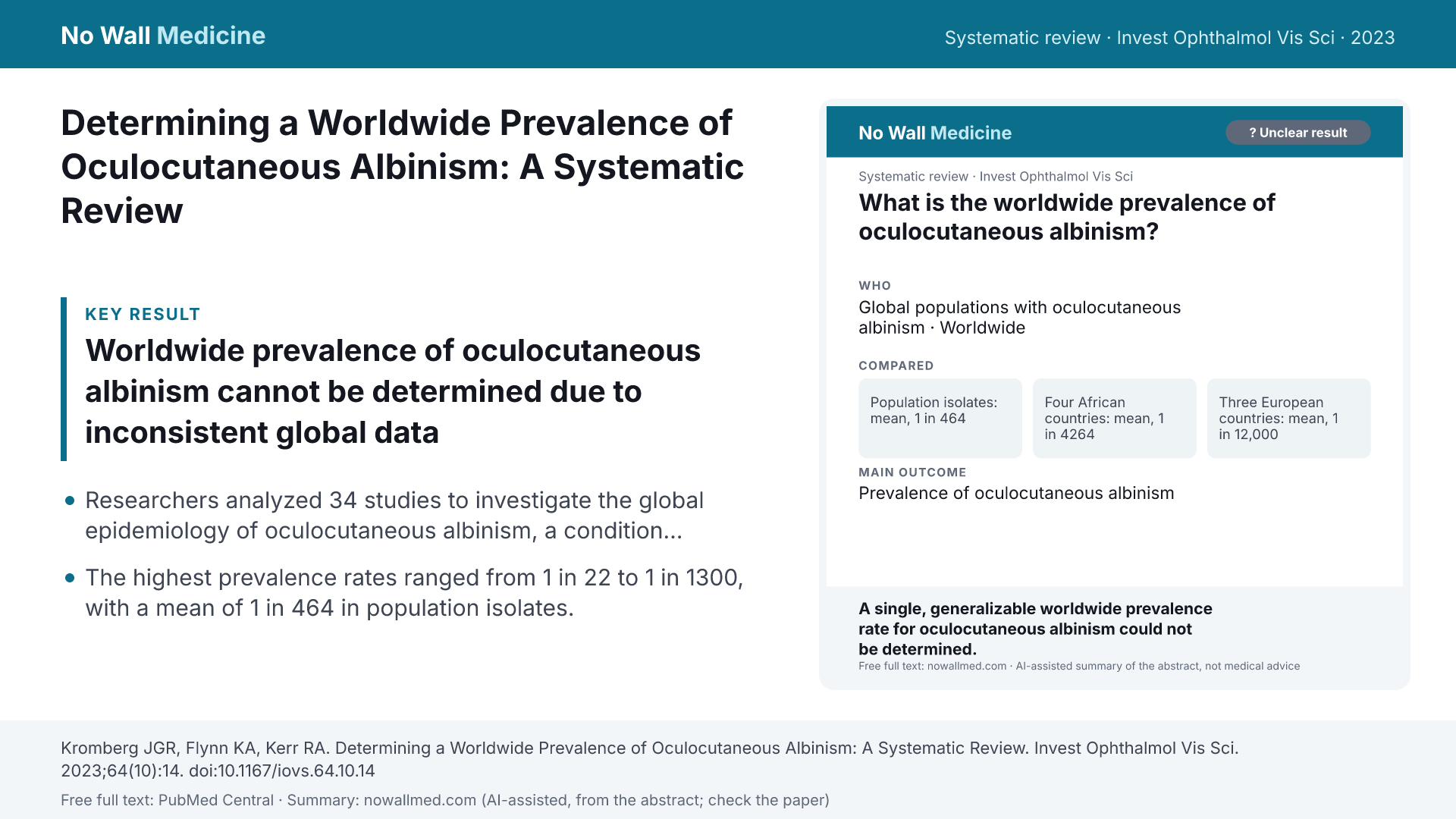
Worldwide prevalence of oculocutaneous albinism cannot be determined due to inconsistent global data
Determining a Worldwide Prevalence of Oculocutaneous Albinism: A Systematic Review
Systematic reviewUnclear result
What is the worldwide prevalence of oculocutaneous albinism?
Who
Global populations with oculocutaneous albinism · Worldwide
Compared
Population isolates: mean, 1 in 464
Four African countries: mean, 1 in 4264
Three European countries: mean, 1 in 12,000
Main outcome
Prevalence of oculocutaneous albinism
Bottom line: A single, generalizable worldwide prevalence rate for oculocutaneous albinism could not be determined.
Limitation: Most data were outdated and few studies had sound methodology or large population samples.
Invest Ophthalmol Vis Sci · 2023-07-13Download image
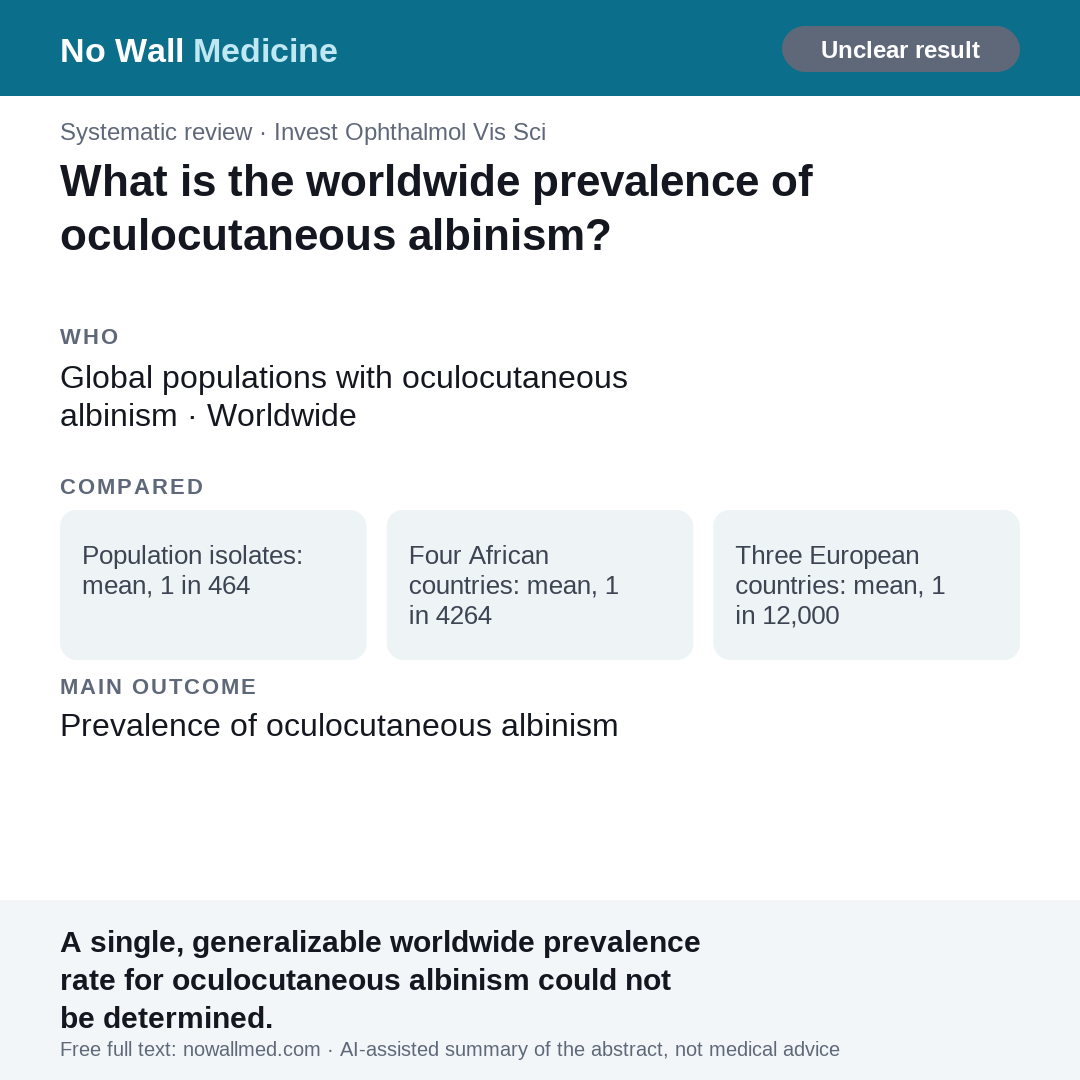
Clinical question: What is the worldwide prevalence of oculocutaneous albinism?
Why it matters: It is unknown if a single, generalizable worldwide prevalence rate exists for oculocutaneous albinism due to varying local factors and limited data.
Key points
- Researchers analyzed 34 studies to investigate the global epidemiology of oculocutaneous albinism, a condition affecting pigmentation of the skin, eyes, and hair.
- The highest prevalence rates ranged from 1 in 22 to 1 in 1300, with a mean of 1 in 464 in population isolates.
- Only 13% of the 193 countries studied had produced prevalence figures, and 44% of the included studies were from Africa.
Limitation the authors note: Most available data were outdated, with only 18% of the included articles published after 2010.
Headline and key points written with AI from the paper’s abstract, with every number checked against it. Read the paper before relying on them.
Was this summary helpful?
Subject terms
Cite this article
Kromberg JGR, Flynn KA, Kerr RA. Determining a Worldwide Prevalence of Oculocutaneous Albinism: A Systematic Review. Invest Ophthalmol Vis Sci. 2023. doi:10.1167/iovs.64.10.14
Spotted a mistake? Suggest a correction