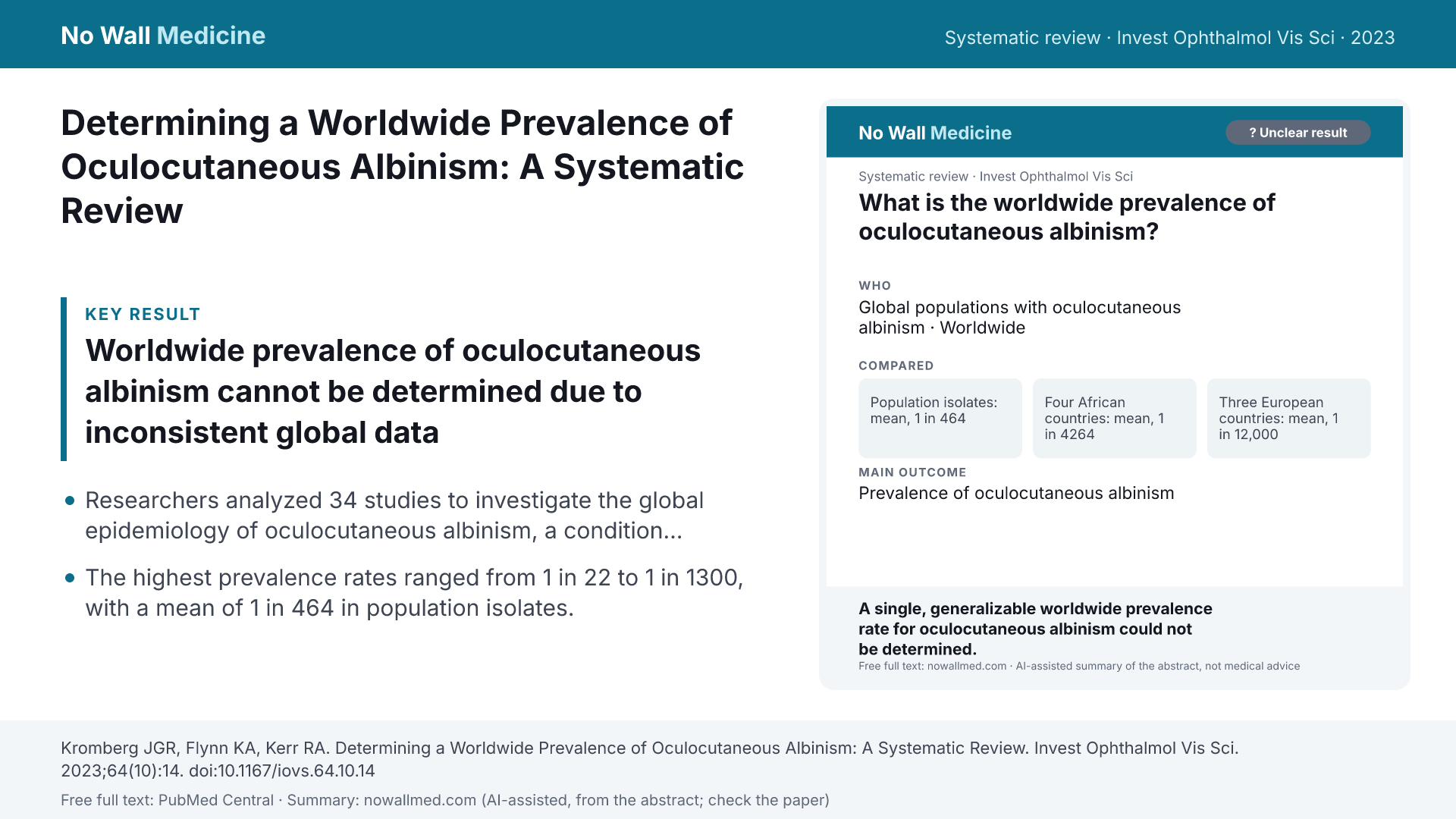
Determining a Worldwide Prevalence of Oculocutaneous Albinism: A Systematic Review
Key result: Worldwide prevalence of oculocutaneous albinism cannot be determined due to inconsistent global data
Systematic reviewUnclear result
What is the worldwide prevalence of oculocutaneous albinism?
Who
Global populations with oculocutaneous albinism · Worldwide
Compared
Population isolates: mean, 1 in 464
Four African countries: mean, 1 in 4264
Three European countries: mean, 1 in 12,000
Main outcome
Prevalence of oculocutaneous albinism
Bottom line: A single, generalizable worldwide prevalence rate for oculocutaneous albinism could not be determined.
Limitation: Most data were outdated and few studies had sound methodology or large population samples.
Invest Ophthalmol Vis Sci · 2023-07-13
Key points
- Researchers analyzed 34 studies to investigate the global epidemiology of oculocutaneous albinism, a condition affecting pigmentation of the skin, eyes, and hair.
- The highest prevalence rates ranged from 1 in 22 to 1 in 1300, with a mean of 1 in 464 in population isolates.
- Only 13% of the 193 countries studied had produced prevalence figures, and 44% of the included studies were from Africa.
Limitation the authors note: Most available data were outdated, with only 18% of the included articles published after 2010.
Discussion prompts
- Would these patients look like yours? Who was left out?
- Is the main outcome one that matters to patients?
- Is the difference large enough to change what you do?
Cite: Kromberg JGR, Flynn KA, Kerr RA. Determining a Worldwide Prevalence of Oculocutaneous Albinism: A Systematic Review. Invest Ophthalmol Vis Sci. 2023;64(10):14. doi:10.1167/iovs.64.10.14
Free full text: PubMed Central · Summary and visual abstract: nowallmed.com/a/determining-a-worldwide-prevalence-of-oculocutaneous-albinism-a-1nt9rx3/ (AI-assisted from the abstract; check the paper before relying on it).