Smoking and genetic alleles influence different stages of rheumatoid arthritis development
Determining in which pre-arthritis stage HLA-shared epitope alleles and smoking exert their effect on the development of rheumatoid arthritis
Meta-analysisMixed results
When do HLA-shared epitope alleles and smoking affect rheumatoid arthritis development?
Who
Asymptomatic population, clinically suspect arthralgia, and clinical inflammatory arthritis patients
Compared
Asymptomatic ACPA positivity: HLA-SE: OR 1.06 (95% CI:0.69 to 1.64)
Asymptomatic ACPA positivity: smoking: OR 1.37 (95% CI: 1.15 to 1.63)
CSA onset ACPA positivity: HLA-SE: OR 2.08 (95% CI: 1.24 to 3.49)
CSA onset ACPA positivity: smoking: OR 2.41 (95% CI: 1.31 to 4.43)
Main outcome
Autoantibody positivity, symptoms, and progression to clinical inflammatory arthritis
Result: HLA-SE associated with inflammatory arthritis development HR 1.86 (95% CI: 1.23 to 2.82)
Bottom line: Smoking confers risk for anti-citrullinated protein antibodies and symptoms, while HLA-shared epitope alleles mediate symptoms and inflammatory arthritis development.
Ann Rheum Dis · 2021-07-20Download image
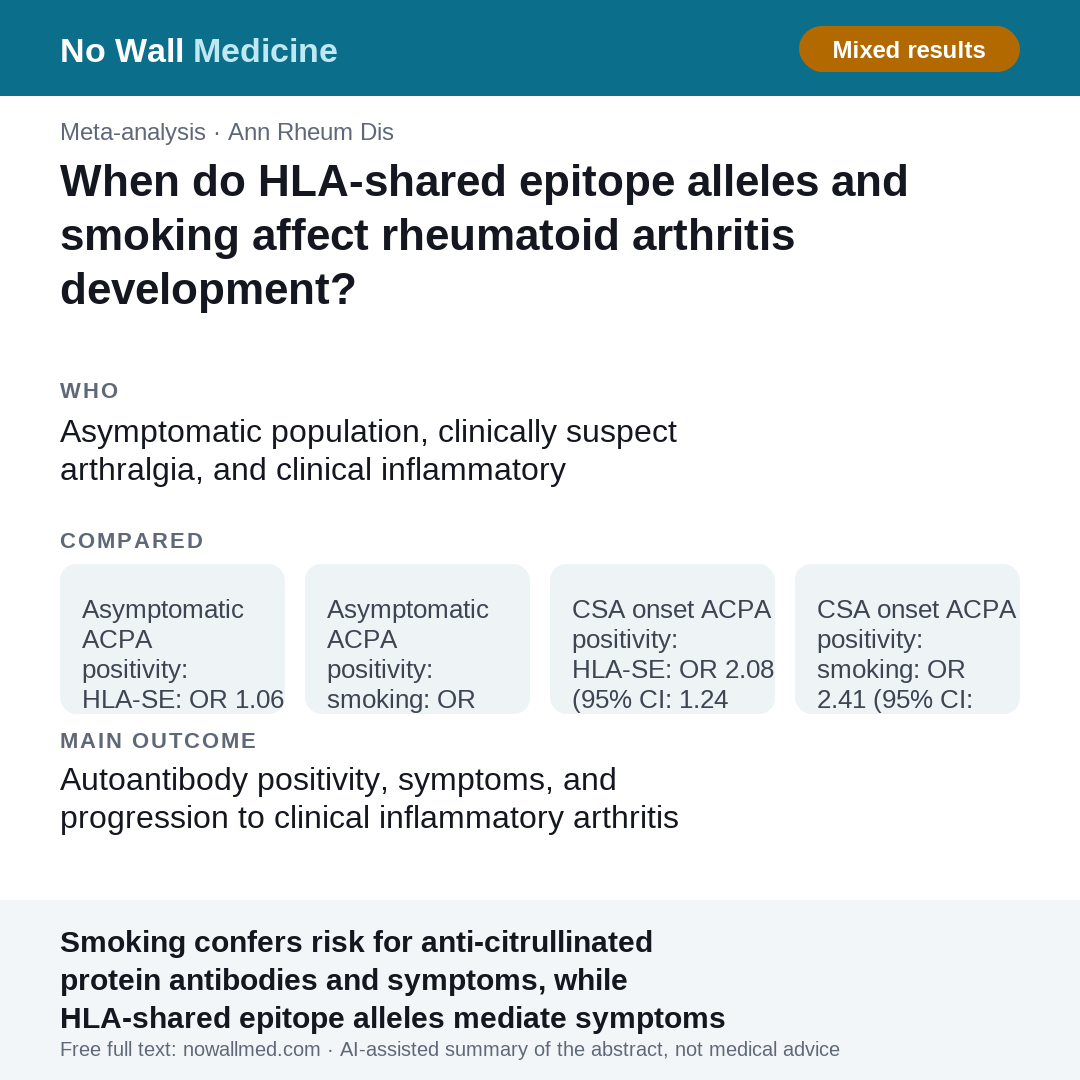
Clinical question: When do HLA-shared epitope alleles and smoking affect rheumatoid arthritis development?
Why it matters: It is unknown whether genetic risk factors and smoking influence the onset of autoantibodies, the appearance of joint pain symptoms, or the progression to clinical arthritis.
Key points
- Researchers performed meta-analyses to examine how smoking and human leukocyte antigen-shared epitope (HLA-SE) alleles relate to autoantibody presence and progression to inflammatory arthritis.
- Smoking was associated with anti-citrullinated protein antibody (ACPA) positivity in asymptomatic people, while HLA-SE was associated with ACPA positivity once clinically suspect arthralgia symptoms began.
- HLA-SE was associated with the development of inflammatory arthritis during follow-up, with a hazard ratio of 1.86 (95% CI: 1.23 to 2.82).
Headline and key points written with AI from the paper’s abstract, with every number checked against it. Read the paper before relying on them.
Was this summary helpful?
Subject terms
Cite this article
Wouters F, Maurits MP, van Boheemen L, Verstappen M, Mankia K, Matthijssen XME. Determining in which pre-arthritis stage HLA-shared epitope alleles and smoking exert their effect on the development of rheumatoid arthritis. Ann Rheum Dis. 2021. doi:10.1136/annrheumdis-2021-220546
Spotted a mistake? Suggest a correction
Top studies every Monday
The week’s key trials and guidelines in your specialties, plus any topics you follow. By email, free.
Get the weekly digest