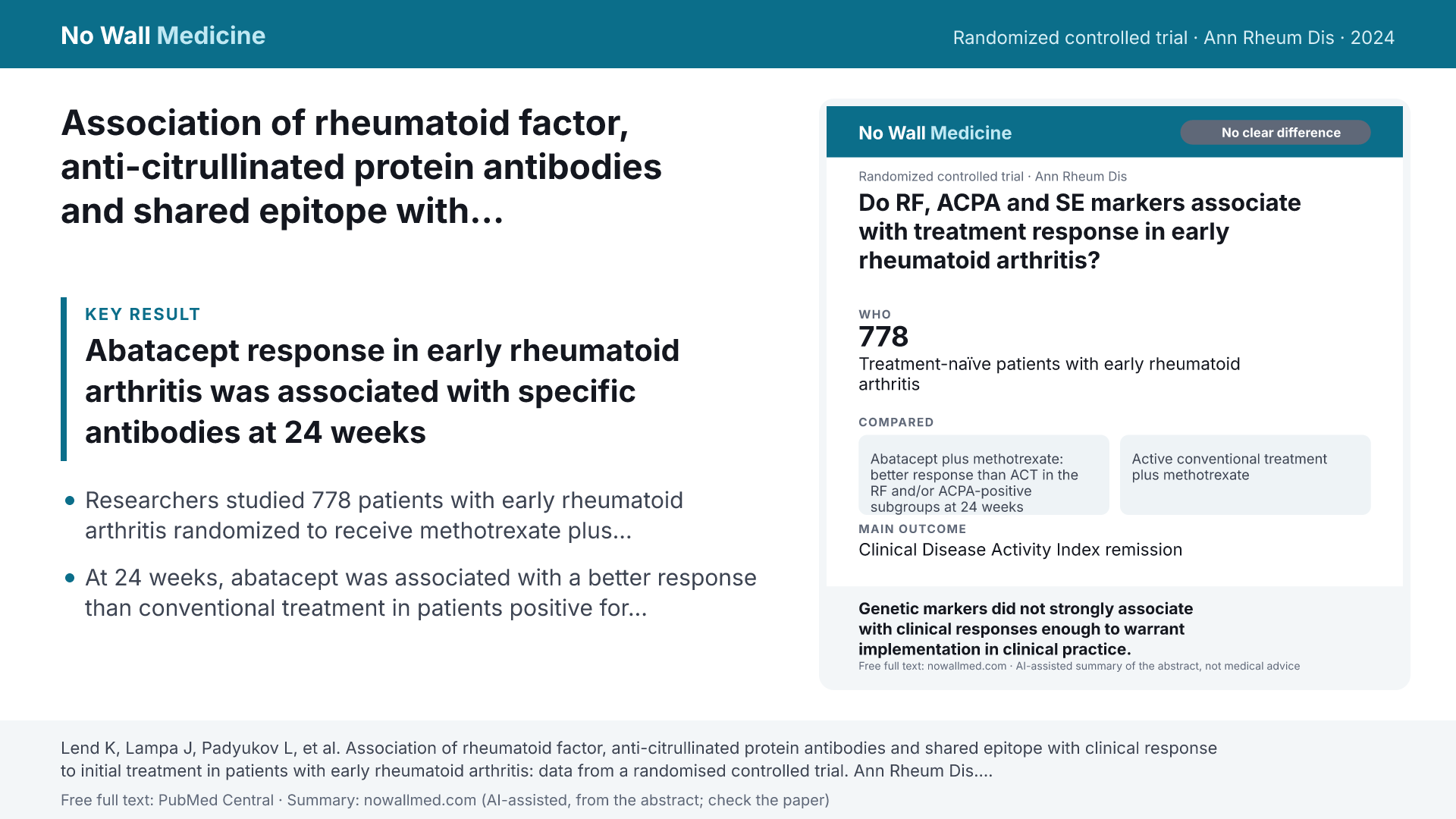
Abatacept response in early rheumatoid arthritis was associated with specific antibodies at 24 weeks
Association of rheumatoid factor, anti-citrullinated protein antibodies and shared epitope with clinical response to initial treatment in patients with early rheumatoid arthritis: data from a randomised controlled trial
Randomized controlled trialNo clear difference
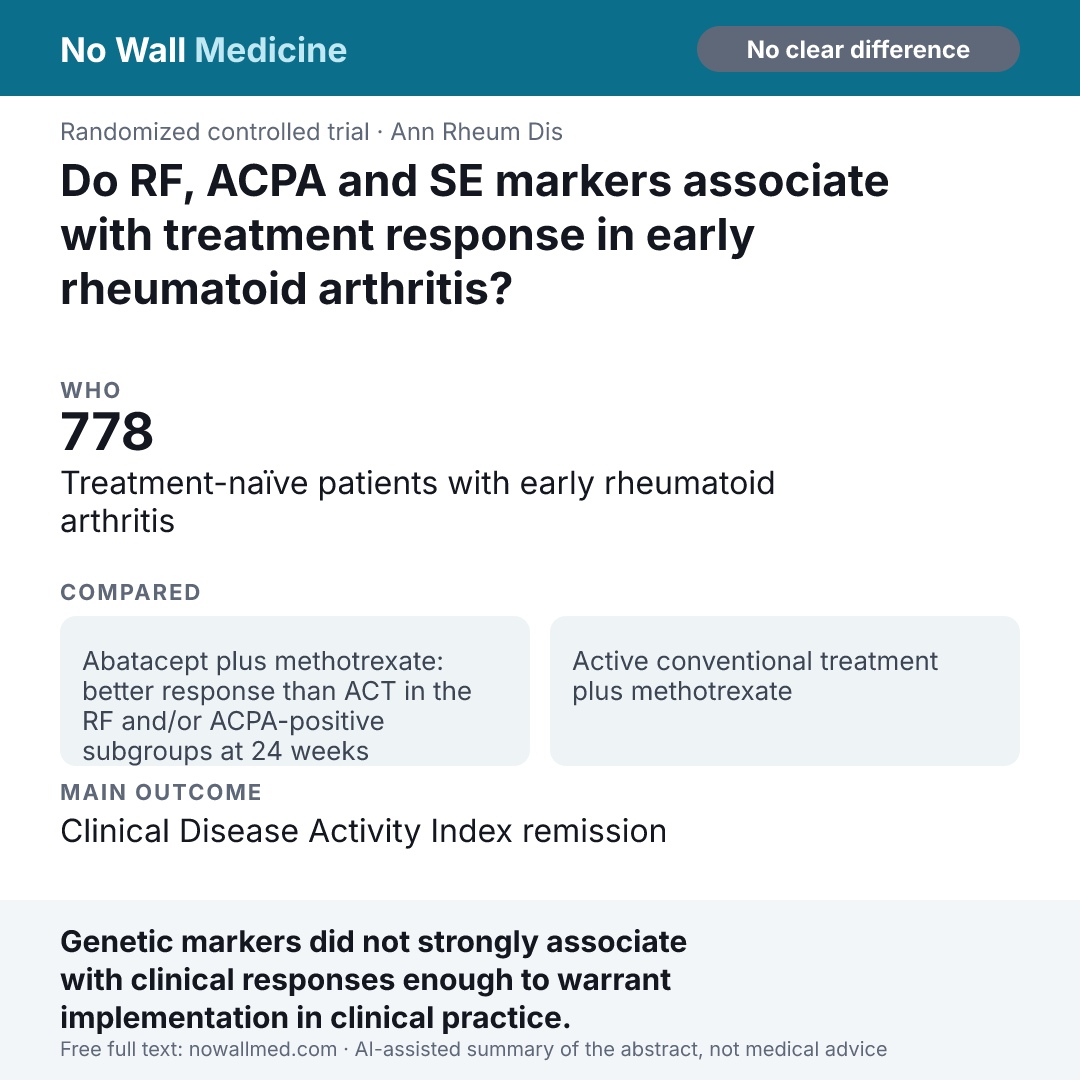
Do RF, ACPA and SE markers associate with treatment response in early rheumatoid arthritis?
Who
778
Treatment-naïve patients with early rheumatoid arthritis
Compared
Abatacept plus methotrexate: better response than ACT in the RF and/or ACPA-positive subgroups at 24 weeks
Active conventional treatment plus methotrexate
Main outcome
Clinical Disease Activity Index remission
Bottom line: Genetic markers did not strongly associate with clinical responses enough to warrant implementation in clinical practice.
Ann Rheum Dis · 2024-11-14 · Save PNG
Same trial (EudraCT2011-004720-35, NCT01491815)
Papers we list that report this registered trial, oldest first. Read a secondary analysis alongside the main results.
- Main results Mixed results
Three biological treatments compared to conventional therapy for early rheumatoid arthritis remission BMJ 2020-12 - Related analysis No clear difference
Interferon-alpha protein levels were linked to specific autoantibodies but did not predict rheumatoid arthritis remission Arthritis Res Ther 2021-07 - Related analysis
Abatacept and certolizumab pegol showed higher remission rates than conventional therapy in early rheumatoid arthritis Ann Rheum Dis 2023-07 - Related analysis Mixed results
Certain rheumatoid arthritis drugs increase urinary prostanoid levels but do not predict treatment response Arthritis Res Ther 2024-03 - Related analysis Harm found
Obesity was associated with lower likelihood of treatment response in early rheumatoid arthritis patients RMD Open 2024-04 - Related analysis No clear difference
This paper Ann Rheum Dis 2024-11 - Secondary analysis Harm found
Glucocorticoid treatment in early rheumatoid arthritis was associated with higher PCSK9 protein levels RMD Open 2025-06
Clinical question: Do RF, ACPA and SE markers associate with treatment response in early rheumatoid arthritis?
Key points
- Researchers studied 778 patients with early rheumatoid arthritis randomized to receive methotrexate plus abatacept, certolizumab pegol, tocilizumab, or active conventional treatment.
- At 24 weeks, abatacept was associated with a better response than conventional treatment in patients positive for rheumatoid factor and/or anti-citrullinated protein antibodies.
- At 48 weeks, no differences in clinical response were found across subgroups for rheumatoid factor, anti-citrullinated protein antibodies, or shared epitope genetic markers.
Headline and key points written with AI from the paper’s abstract, with every number checked against it. Read the paper before relying on them.
Was this summary helpful?
Abstract
Objectives
To investigate whether rheumatoid factor (RF), anti-citrullinated protein antibodies (ACPAs) and shared epitope (SE) allele-related genetic markers associate with treatment response to abatacept, certolizumab pegol or tocilizumab versus active conventional treatment (ACT). Methods
Patients with treatment-naïve early rheumatoid arthritis were randomised in the NORD-STAR trial to ACT, certolizumab pegol, abatacept or tocilizumab, all with methotrexate. Centralised laboratory analyses for ACPA, RF and SE were performed. Clinical Disease Activity Index remission was analysed longitudinally with logistic generalised estimating equations. Differences in treatment effect across RF, ACPA and SE subgroups were assessed with interaction terms at 24 and 48 weeks, adjusted for sex, country, age, body mass index, Disease Activity Score of 28 joints based on C-reactive protein and smoking. Results
In total, 778 patients were included. At 24 weeks, abatacept treatment showed a better response than ACT in the RF and/or ACPA-positive subgroups, but this effect was not significantly different from the negative subgroups. By 48 weeks, abatacept treatment showed better response regardless of RF/ACPA status. No differences were found across RF, ACPA, SE allele, valine at amino acid position 11 or valine-arginine-alanine haplotype subgroups for any biological treatment at 48 weeks. Conclusions
Based on this randomised controlled trial, abatacept treatment was associated with a better response than ACT in the RF and/or ACPA-positive subgroup at 24 weeks, but this was no longer seen at 48 weeks; adding SE allele-related genetic markers did not strengthen the association. Moreover, ACPA, RF and SE allele-related genotypes were not, alone or in combination, associated with clinical responses of importance sufficiently strongly to warrant implementation in clinical practice. Trial registration number
EudraCT 2011-004720-35; ClinicalTrials.gov NCT01491815.
Abstract reproduced under the article’s CC BY NC licence.
Subject terms
Headline, design, result, key points, caveat and citation as plain text.
Cite this article
Lend K, Lampa J, Padyukov L, et al. Association of rheumatoid factor, anti-citrullinated protein antibodies and shared epitope with clinical response to initial treatment in patients with early rheumatoid arthritis: data from a randomised controlled trial. Ann Rheum Dis. 2024;83(12):1657-1665. doi:10.1136/ard-2024-226024
Spotted a mistake? Suggest a correction