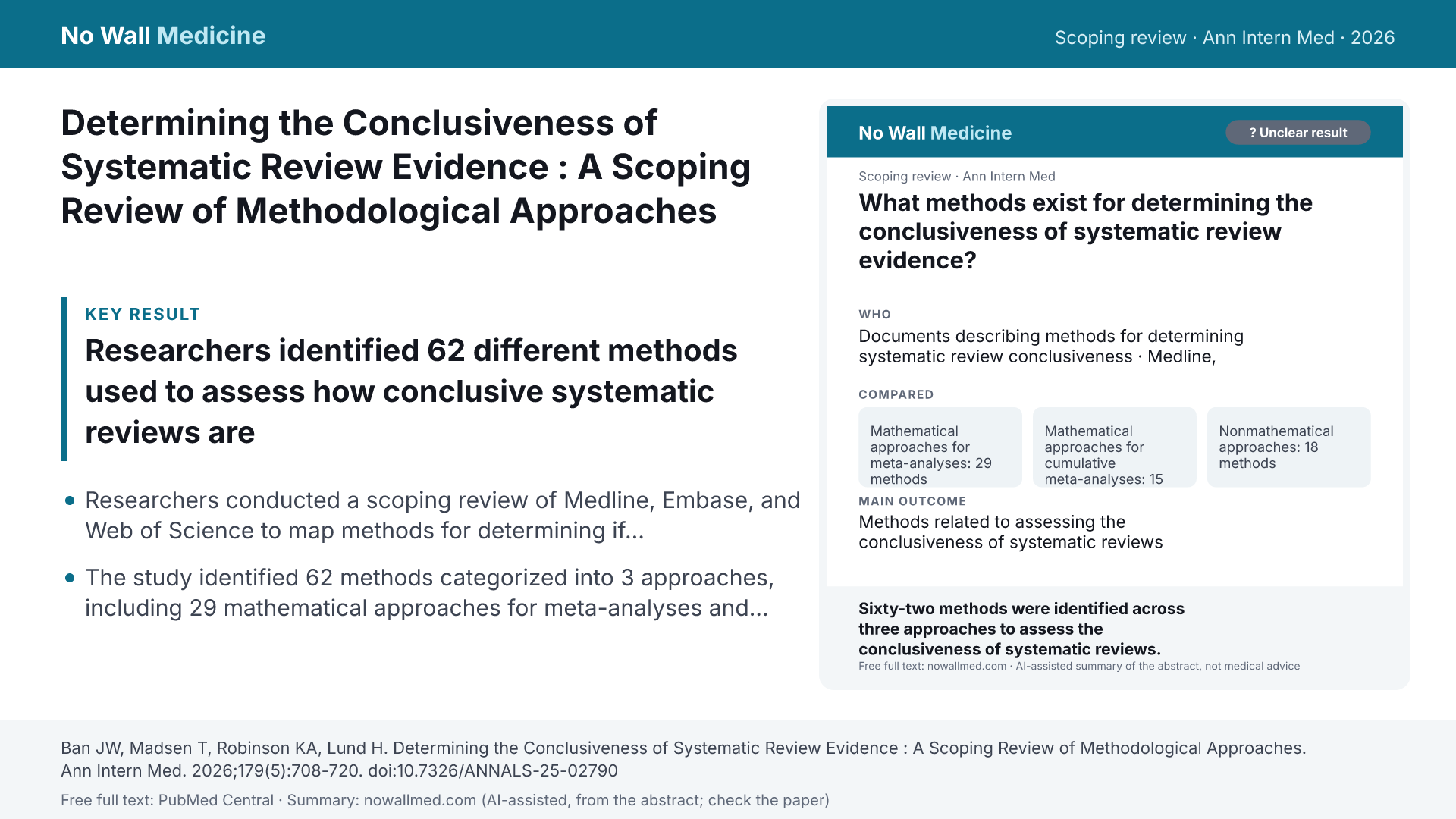
Researchers identified 62 different methods used to assess how conclusive systematic reviews are
Determining the Conclusiveness of Systematic Review Evidence : A Scoping Review of Methodological Approaches
Scoping reviewUnclear result
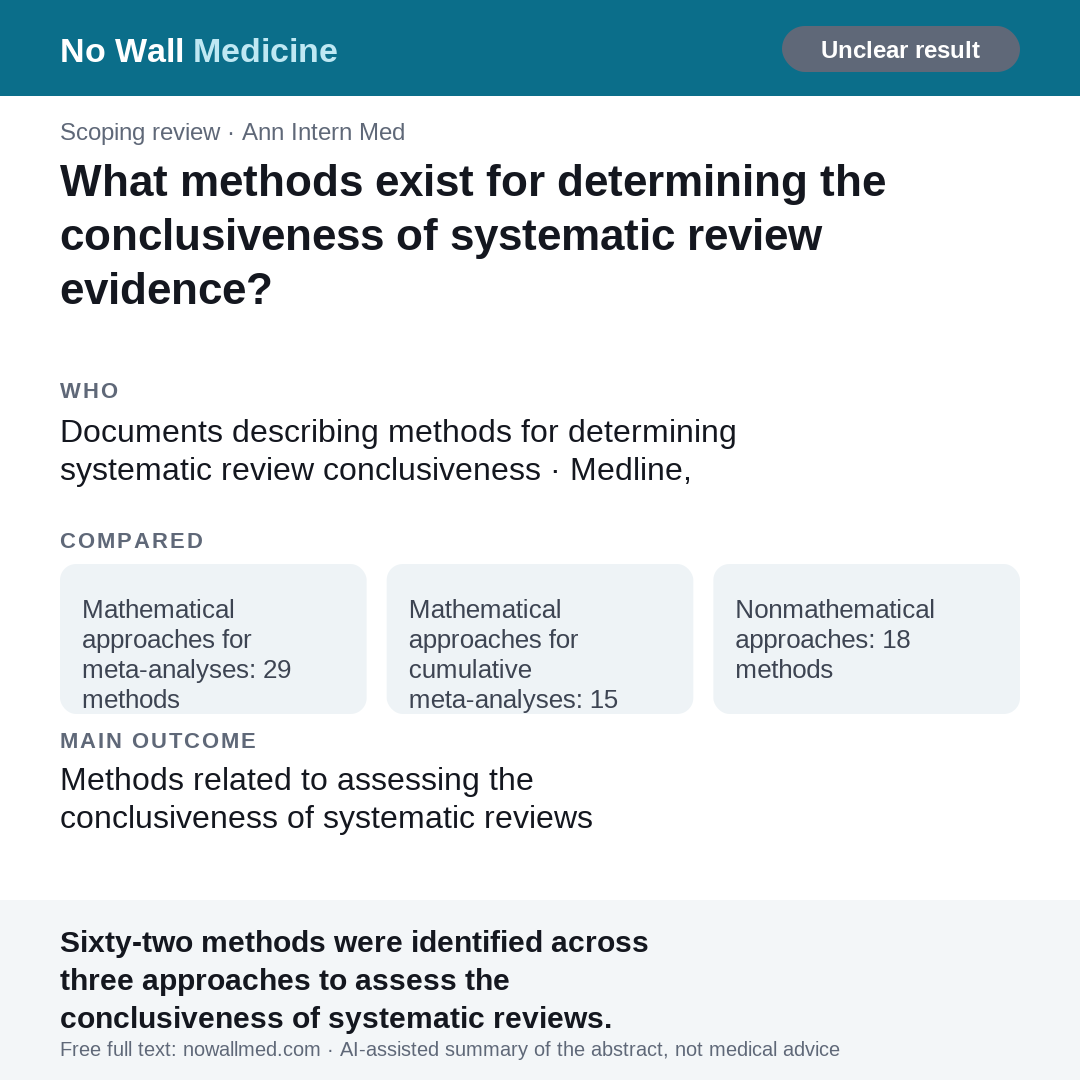
What methods exist for determining the conclusiveness of systematic review evidence?
Who
Documents describing methods for determining systematic review conclusiveness · Medline, Embase, and Web of Science
Compared
Mathematical approaches for meta-analyses: 29 methods
Mathematical approaches for cumulative meta-analyses: 15 methods
Nonmathematical approaches: 18 methods
Main outcome
Methods related to assessing the conclusiveness of systematic reviews
Bottom line: Sixty-two methods were identified across three approaches to assess the conclusiveness of systematic reviews.
Limitation: No assessment of which methods perform better and not all methods strictly aimed to determine conclusiveness.
Funded by: Western Norway University of Applied Sciences
Ann Intern Med · 2026-03-10Download image
Clinical question: What methods exist for determining the conclusiveness of systematic review evidence?
Why it matters: It is often challenging to know whether a systematic review has answered a research question conclusively.
Key points
- Researchers conducted a scoping review of Medline, Embase, and Web of Science to map methods for determining if systematic reviews answer questions conclusively.
- The study identified 62 methods categorized into 3 approaches, including 29 mathematical approaches for meta-analyses and 18 nonmathematical approaches.
- Of the 62 methods identified, 45 had at least 1 example of their application documented.
Headline and key points written with AI from the paper’s abstract, with every number checked against it. Read the paper before relying on them.
Was this summary helpful?
Subject terms
Cite this article
Ban JW, Madsen T, Robinson KA, Lund H. Determining the Conclusiveness of Systematic Review Evidence : A Scoping Review of Methodological Approaches. Ann Intern Med. 2026. doi:10.7326/ANNALS-25-02790
Spotted a mistake? Suggest a correction