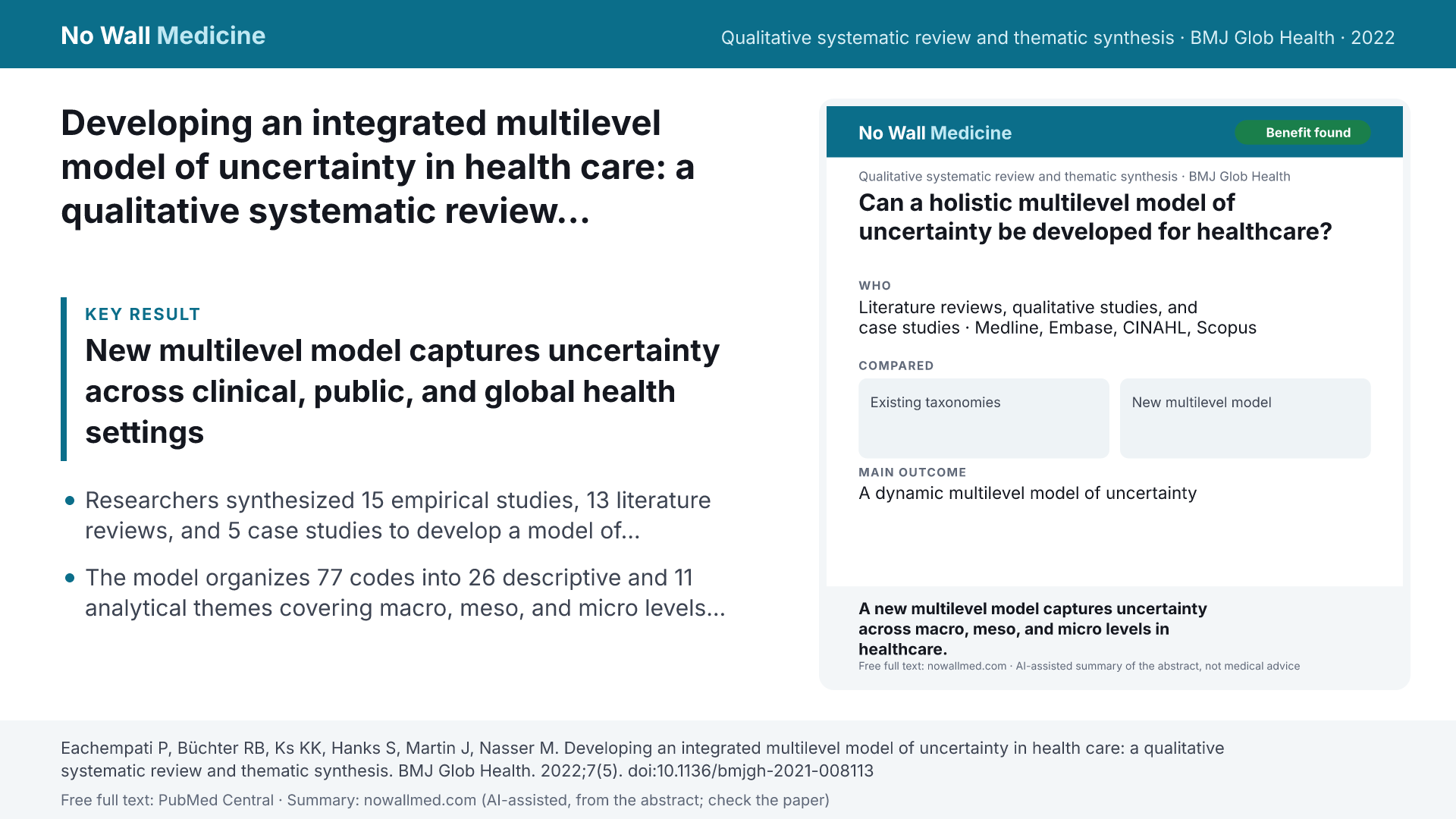
New multilevel model captures uncertainty across clinical, public, and global health settings
Developing an integrated multilevel model of uncertainty in health care: a qualitative systematic review and thematic synthesis
Qualitative systematic review and thematic synthesisBenefit found
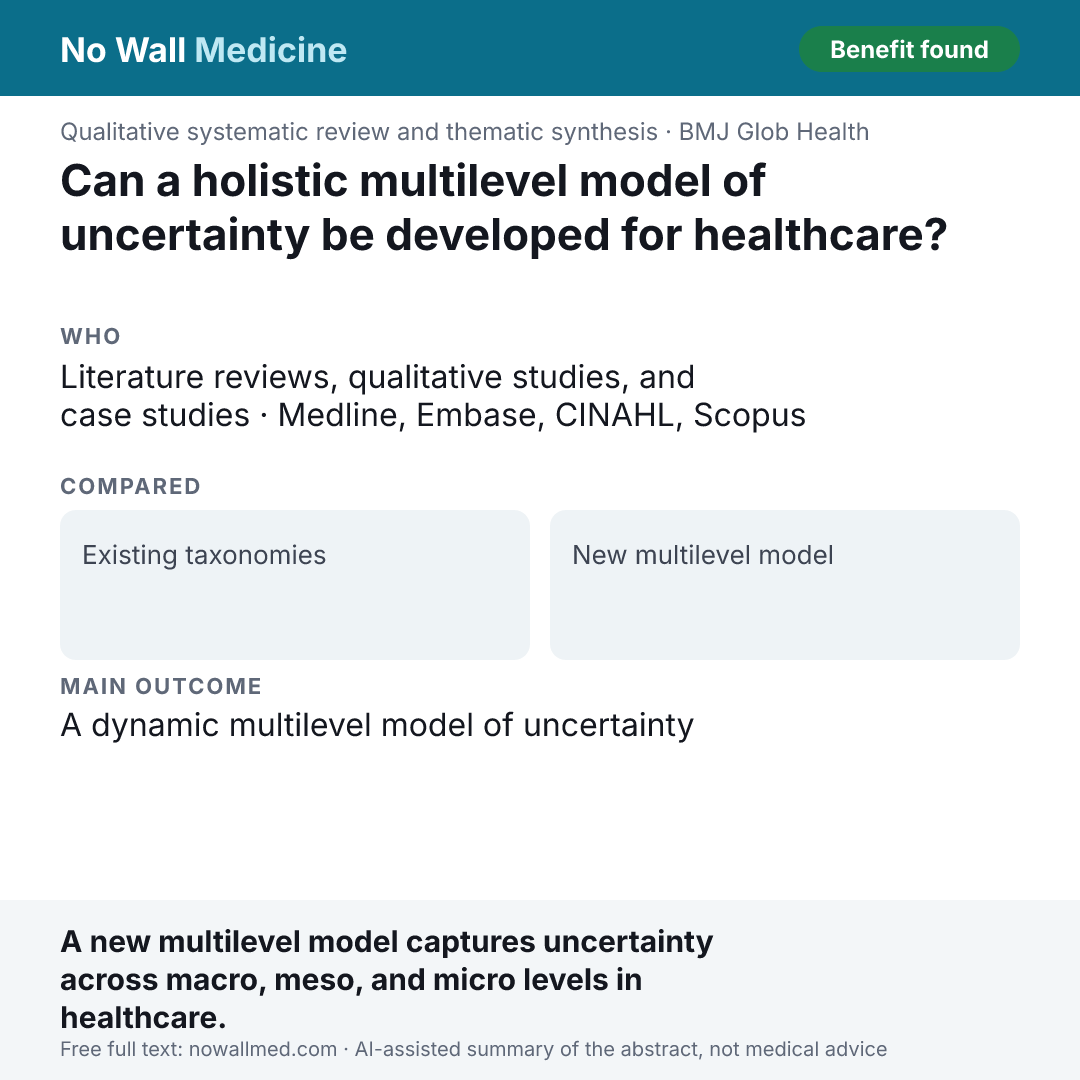
Can a holistic multilevel model of uncertainty be developed for healthcare?
Who
Literature reviews, qualitative studies, and case studies · Medline, Embase, CINAHL, Scopus and Google scholar
Compared
Existing taxonomies
New multilevel model
Main outcome
A dynamic multilevel model of uncertainty
Bottom line: A new multilevel model captures uncertainty across macro, meso, and micro levels in healthcare.
Limitation: Research input predominantly came from North America and Europe and lacks real-life testing.
BMJ Glob Health · 2022-05-02 · Save PNG
Clinical question: Can a holistic multilevel model of uncertainty be developed for healthcare?
Why it matters: Existing taxonomies of uncertainty mainly focus on decisions in clinical settings rather than including public and global health scenarios.
Key points
- Researchers synthesized 15 empirical studies, 13 literature reviews, and 5 case studies to develop a model of uncertainty in healthcare.
- The model organizes 77 codes into 26 descriptive and 11 analytical themes covering macro, meso, and micro levels of uncertainty.
- The framework includes various types of uncertainty such as ethical, relational, personal, and epistemic uncertainty.
Headline and key points written with AI from the paper’s abstract, with every number checked against it. Read the paper before relying on them.
Was this summary helpful?
Abstract
Introduction
Uncertainty is an inevitable part of healthcare and a source of confusion and challenge to decision-making. Several taxonomies of uncertainty have been developed, but mainly focus on decisions in clinical settings. Our goal was to develop a holistic model of uncertainty that can be applied to both clinical as well as public and global health scenarios. Methods
We searched Medline, Embase, CINAHL, Scopus and Google scholar in March 2021 for literature reviews, qualitative studies and case studies related to classifications or models of uncertainty in healthcare. Empirical articles were assessed for study limitations using the Critical Appraisal Skills Programme (CASP) checklist. We synthesised the literature using a thematic analysis and developed a dynamic multilevel model of uncertainty. We sought patient input to assess relatability of the model and applied it to two case examples. Results
We screened 4125 studies and included 15 empirical studies, 13 literature reviews and 5 case studies. We identified 77 codes and organised these into 26 descriptive and 11 analytical themes of uncertainty. The themes identified are global, public health, healthcare system, clinical, ethical, relational, personal, knowledge exchange, epistemic, aleatoric and parameter uncertainty. The themes were included in a model, which captures the macro, meso and microlevels and the inter-relatedness of uncertainty. We successfully piloted the model on one public health example and an environmental topic. The main limitations are that the research input into our model predominantly came from North America and Europe, and that we have not yet tested the model in a real-life setting. Conclusion
We developed a model that can comprehensively capture uncertainty in public and global health scenarios. It builds on models that focus solely on clinical settings by including social and political contexts and emphasising the dynamic interplay between different areas of uncertainty.
Abstract reproduced under the article’s CC BY NC licence.
Subject terms
Headline, design, result, key points, caveat and citation as plain text.
Cite this article
Eachempati P, Büchter RB, Ks KK, Hanks S, Martin J, Nasser M. Developing an integrated multilevel model of uncertainty in health care: a qualitative systematic review and thematic synthesis. BMJ Glob Health. 2022. doi:10.1136/bmjgh-2021-008113
Spotted a mistake? Suggest a correction