Systematic review identifies key components of person-centred care for patients with serious illness
The empirical evidence underpinning the concept and practice of person-centred care for serious illness: a systematic review
Systematic reviewUnclear result
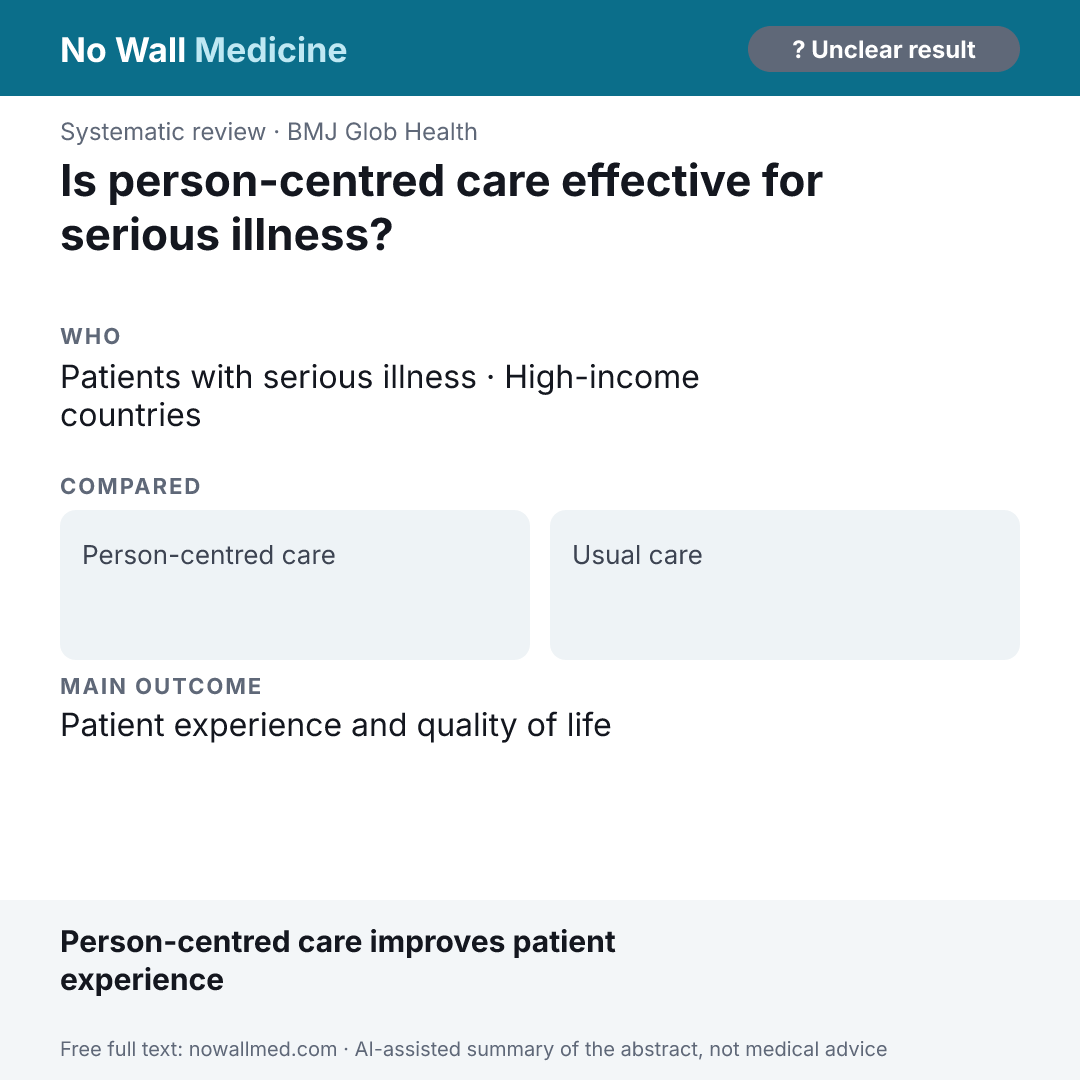
Is person-centred care effective for serious illness?
Who
Patients with serious illness · High-income countries
Compared
Person-centred care
Usual care
Main outcome
Patient experience and quality of life
Bottom line: Person-centred care improves patient experience
Limitation: Limited diversity of diagnostic groups
BMJ Glob Health · 2020-12-11 · Save PNG
Clinical question: Is person-centred care effective for serious illness?
Why it matters: The concept of person-centred care is criticized for being poorly theorized and difficult to put into practice for patients facing serious illness.
Key points
- Researchers reviewed 18 studies from high-income countries to identify how person-centred care is defined and practiced for people with serious illnesses.
- Findings suggest person-centred care involves respecting patients and families, providing complete information, and supporting physical, psychological, social, and existential needs.
- The review noted that effective care requires involving family members, maintaining patient identity, and structuring healthcare services to allow for continuity of care.
Headline and key points written with AI from the paper’s abstract, with every number checked against it. Read the paper before relying on them.
Was this summary helpful?
Abstract
Introduction
Person-centred care has become internationally recognised as a critical attribute of high-quality healthcare. However, the concept has been criticised for being poorly theorised and operationalised. Serious illness is especially aligned with the need for person-centredness, usually necessitating involvement of significant others, management of clinical uncertainty, high-quality communication and joint decision-making to deliver care concordant with patient preferences. This review aimed to identify and appraise the empirical evidence underpinning conceptualisations of 'person-centredness' for serious illness. Methods
Search strategy conducted in May 2020. Databases: CINAHL, Embase, PubMed, Ovid Global Health, MEDLINE and PsycINFO. Free text search terms related to (1) person-centredness, (2) serious illness and (3) concept/practice. Tabulation, textual description and narrative synthesis were performed, and quality appraisal conducted using QualSyst tools. Santana et al's person-centred care model (2018) was used to structure analysis. Results
PRISMA (Preferred Reporting Items for Systematic Reviews and Meta-Analyses) flow data: n=12,446 studies screened by title/abstract, n=144 full articles assessed for eligibility, n=18 studies retained. All studies (n=18) are from high-income countries, and are largely of high quality (median score 0.82). The findings suggest that person-centred care encompasses the patient and family being respected, given complete information, involved in decision-making and supported in their physical, psychological, social and existential needs. The studies highlight the importance of involving and supporting family/friends, promoting continuation of normality and self-identity, and structuring service organisation to enable care continuity. Conclusion
Person-centred healthcare must value the social network of patients, promote quality of life and reform structurally to improve patients' experience interacting with the healthcare system. Staff must be supported to flexibly adapt skills, communication, routines or environments for individual patients. There remains a need for primary data investigating the meaning and practice of PCC in a greater diversity of diagnostic groups and settings, and a need to ground potential components of PCC within broader universal values and ethical theory.
Abstract reproduced under the article’s CC BY licence.
Subject terms
Headline, design, result, key points, caveat and citation as plain text.
Cite this article
Giusti A, Nkhoma K, Petrus R, et al. The empirical evidence underpinning the concept and practice of person-centred care for serious illness: a systematic review. BMJ Glob Health. 2020;5(12). doi:10.1136/bmjgh-2020-003330
Spotted a mistake? Suggest a correction