Artificial intelligence assistance increased scan completeness during mediastinal endoscopic ultrasound examinations in a randomized trial
Development and clinical validation of a novel deep learning-based mediastinal endoscopic ultrasound navigation system for quality control: a single-center, randomized controlled trial
Single-center, randomized controlled trialBenefit found
Does an artificial intelligence system improve quality control of mediastinal endoscopic ultrasound?
Who
148
Patients requiring mediastinal endoscopic ultrasound · Single center
Compared
AI-assisted group: 1.00 [IQR, 1.00-1.00]
Control group: 0.80 [IQR, 0.60-0.80]
Main outcome
Standard station completeness
Bottom line: The artificial intelligence system significantly improved scan completeness during mediastinal endoscopic ultrasound examinations.
Int J Surg · 2025-09-22Download image
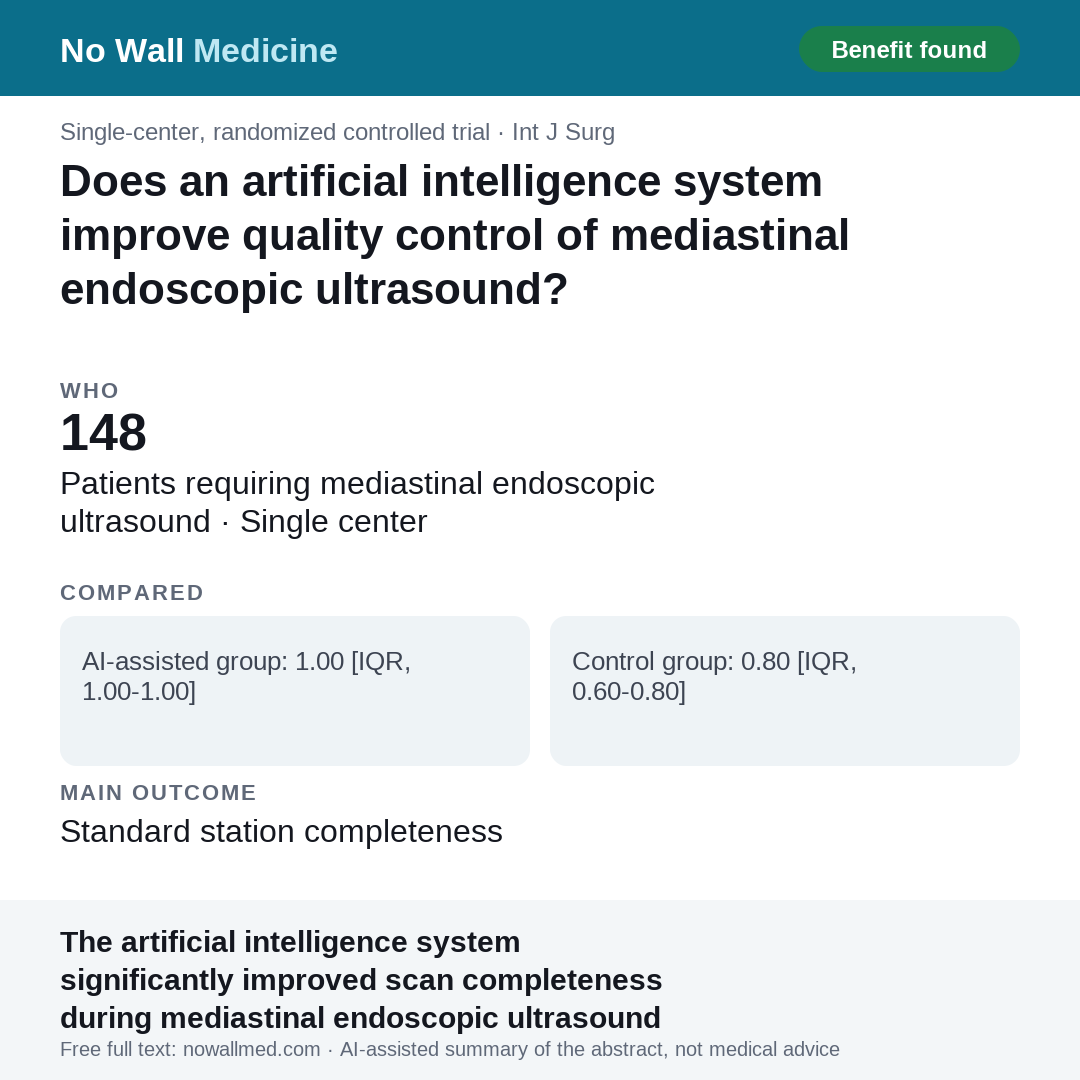
Clinical question: Does an artificial intelligence system improve quality control of mediastinal endoscopic ultrasound?
Why it matters: Mediastinal endoscopic ultrasound is important for diagnosing diseases but currently lacks effective quality control methods for ensuring thorough examinations.
Key points
- Researchers conducted a randomized controlled trial with 148 patients to compare real-time artificial intelligence feedback against a control group during endoscopic ultrasound, an imaging procedure using an endoscope.
- The artificial intelligence group had higher station completeness (1.00 [IQR, 1.00-1.00] vs. 0.80 [IQR, 0.60-0.80]) and anatomical structure completeness (1.00 [IQR, 1.00-1.00] vs. 0.85 [IQR, 0.62-0.92]) than the control group.
- No significant differences were found for average procedure time or station 2 completeness, and no adverse events were reported.
Headline and key points written with AI from the paper’s abstract, with every number checked against it. Read the paper before relying on them.
Topics
Cite this article
Huang S, Chen X, Tian L, Chen X, Yang Y, Sun Y. Development and clinical validation of a novel deep learning-based mediastinal endoscopic ultrasound navigation system for quality control: a single-center, randomized controlled trial. Int J Surg. 2025. doi:10.1097/JS9.0000000000003469
Spotted a mistake? Suggest a correction