New model predicts birth weight using information from the first prenatal visit
Development and validation of a prognostic model to predict birth weight: individual participant data meta-analysis
Obstetrics & GynecologyAdult and pediatric
Individual participant data meta-analysisBenefit found
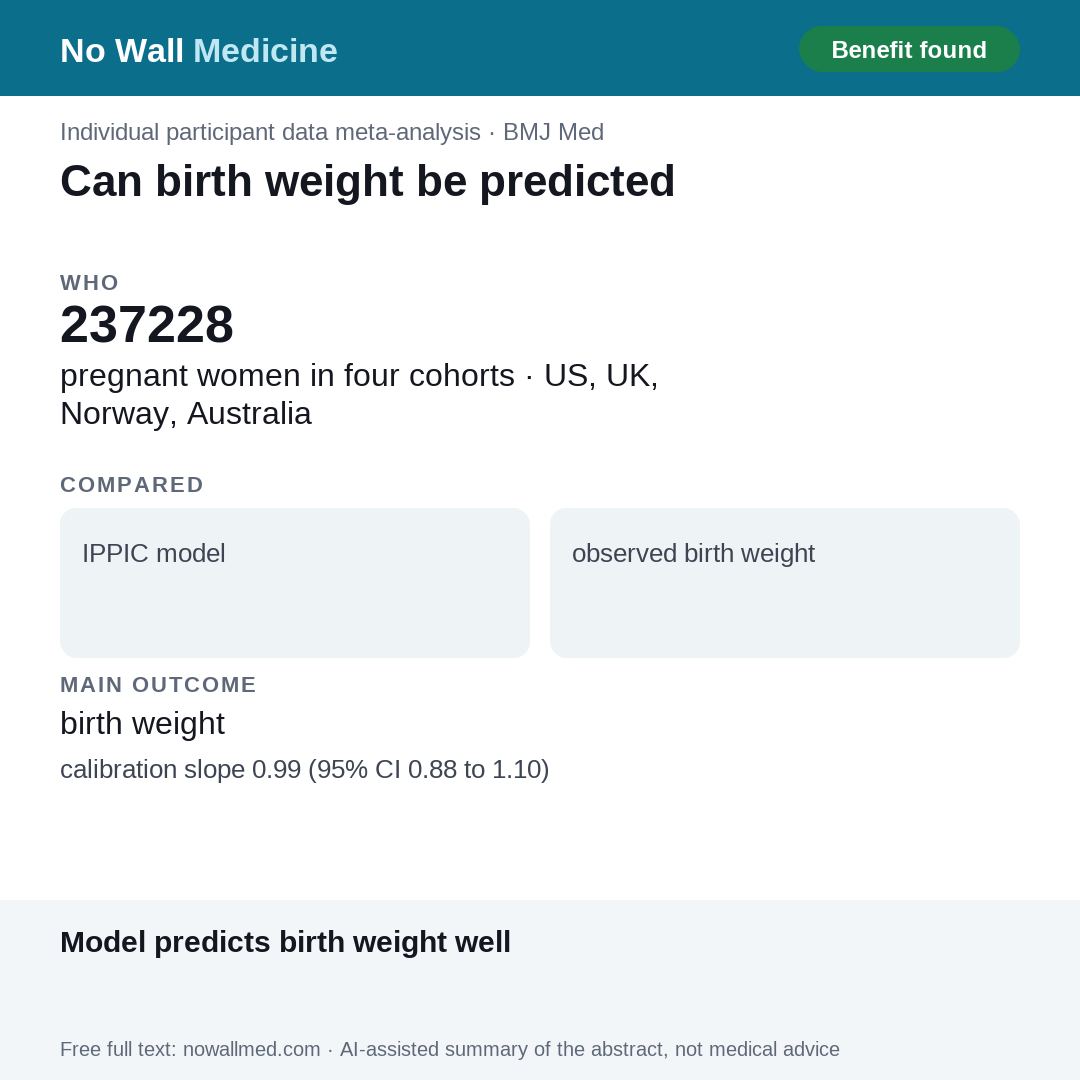
Can birth weight be predicted
Who
237228
pregnant women in four cohorts · US, UK, Norway, Australia
Compared
IPPIC model
observed birth weight
Main outcome
birth weight
Result: calibration slope 0.99 (95% CI 0.88 to 1.10)
Bottom line: Model predicts birth weight well
BMJ Med · 2024-08-14Download image
Why it matters: It was unknown how to accurately predict birth weight at various gestational ages using only data available during the first antenatal visit.
Key points
- Researchers used data from 237 228 pregnancies across four cohorts in the US, UK, Norway, and Australia to develop a birth weight prediction model.
- The model explained 46.9% of the variation in birth weight, with a ratio of 1.02 between observed and expected average birth weights.
- Predictions were more accurate at the lower end of the predicted birth weight range, which is useful for identifying fetal growth restriction.
Limitation the authors note: Further research is required to examine the generalisability of performance in other countries, settings, and subgroups.
Headline and key points written with AI from the paper’s abstract, with every number checked against it. Read the paper before relying on them.
Abstract
Objective
To predict birth weight at various potential gestational ages of delivery based on data routinely available at the first antenatal visit. Design
Individual participant data meta-analysis. Data sources
Individual participant data of four cohorts (237 228 pregnancies) from the International Prediction of Pregnancy Complications (IPPIC) network dataset. Eligibility criteria for selecting studies
Studies in the IPPIC network were identified by searching major databases for studies reporting risk factors for adverse pregnancy outcomes, such as pre-eclampsia, fetal growth restriction, and stillbirth, from database inception to August 2019. Data of four IPPIC cohorts (237 228 pregnancies) from the US (National Institute of Child Health and Human Development, 2018; 233 483 pregnancies), UK (Allen et al, 2017; 1045 pregnancies), Norway (STORK Groruddalen research programme, 2010; 823 pregnancies), and Australia (Rumbold et al, 2006; 1877 pregnancies) were included in the development of the model. Results
The IPPIC birth weight model was developed with random intercept regression models with backward elimination for variable selection. Internal-external cross validation was performed to assess the study specific and pooled performance of the model, reported as calibration slope, calibration-in-the-large, and observed versus expected average birth weight ratio. Meta-analysis showed that the apparent performance of the model had good calibration (calibration slope 0.99, 95% confidence interval (CI) 0.88 to 1.10; calibration-in-the-large 44.5 g, -18.4 to 107.3) with an observed versus expected average birth weight ratio of 1.02 (95% CI 0.97 to 1.07). The proportion of variation in birth weight explained by the model (R2) was 46.9% (range 32.7-56.1% in each cohort). On internal-external cross validation, the model showed good calibration and predictive performance when validated in three cohorts with a calibration slope of 0.90 (Allen cohort), 1.04 (STORK Groruddalen cohort), and 1.07 (Rumbold cohort), calibration-in-the-large of -22.3 g (Allen cohort), -33.42 (Rumbold cohort), and 86.4 g (STORK Groruddalen cohort), and observed versus expected ratio of 0.99 (Rumbold cohort), 1.00 (Allen cohort), and 1.03 (STORK Groruddalen cohort); respective pooled estimates were 1.00 (95% CI 0.78 to 1.23; calibration slope), 9.7 g (-154.3 to 173.8; calibration-in-the-large), and 1.00 (0.94 to 1.07; observed v expected ratio). The model predictions were more accurate (smaller mean square error) in the lower end of predicted birth weight, which is important in informing clinical decision making. Conclusions
The IPPIC birth weight model allowed birth weight predictions for a range of possible gestational ages. The model explained about 50% of individual variation in birth weights, was well calibrated (especially in babies at high risk of fetal growth restriction and its complications), and showed promising performance in four different populations included in the individual participant data meta-analysis. Further research to examine the generalisability of performance in other countries, settings, and subgroups is required. Trial registration
PROSPERO CRD42019135045.
Abstract reproduced under the article’s CC BY NC licence.
Cite this article
Allotey J, Archer L, Snell KIE, Coomar D, Massé J, Sletner L. Development and validation of a prognostic model to predict birth weight: individual participant data meta-analysis. BMJ Med. 2024. doi:10.1136/bmjmed-2023-000784
Spotted a mistake? Suggest a correction
Top studies every Monday
The week’s key trials and guidelines in your specialties, plus any topics you follow. By email, free.
Get the weekly digest