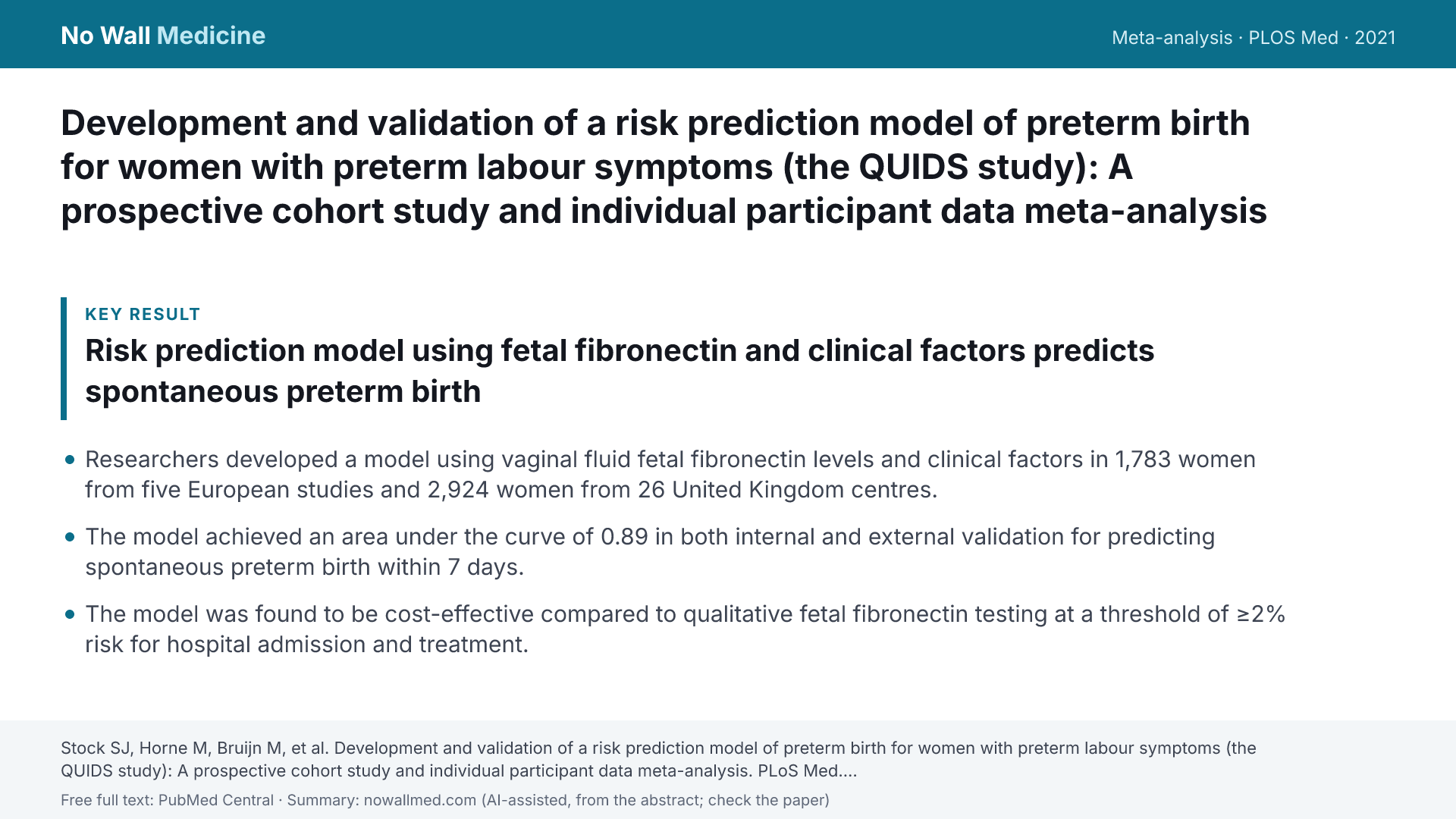
Risk prediction model using fetal fibronectin and clinical factors predicts spontaneous preterm birth
Development and validation of a risk prediction model of preterm birth for women with preterm labour symptoms (the QUIDS study): A prospective cohort study and individual participant data meta-analysis
Why it matters: Diagnosing preterm labour is difficult because signs and symptoms are often common and nonspecific.
Key points
- Researchers developed a model using vaginal fluid fetal fibronectin levels and clinical factors in 1,783 women from five European studies and 2,924 women from 26 United Kingdom centres.
- The model achieved an area under the curve of 0.89 in both internal and external validation for predicting spontaneous preterm birth within 7 days.
- The model was found to be cost-effective compared to qualitative fetal fibronectin testing at a threshold of ≥2% risk for hospital admission and treatment.
Limitation the authors note: The authors noted a limited number of participants who are not White and levels of missing data for certain variables in the development dataset.
Headline and key points written with AI from the paper’s abstract, with every number checked against it. Read the paper before relying on them.
Was this summary helpful?
Subject terms
Headline, design, result, key points, caveat and citation as plain text.
Cite this article
Stock SJ, Horne M, Bruijn M, et al. Development and validation of a risk prediction model of preterm birth for women with preterm labour symptoms (the QUIDS study): A prospective cohort study and individual participant data meta-analysis. PLoS Med. 2021;18(7):e1003686. doi:10.1371/journal.pmed.1003686
Spotted a mistake? Suggest a correction