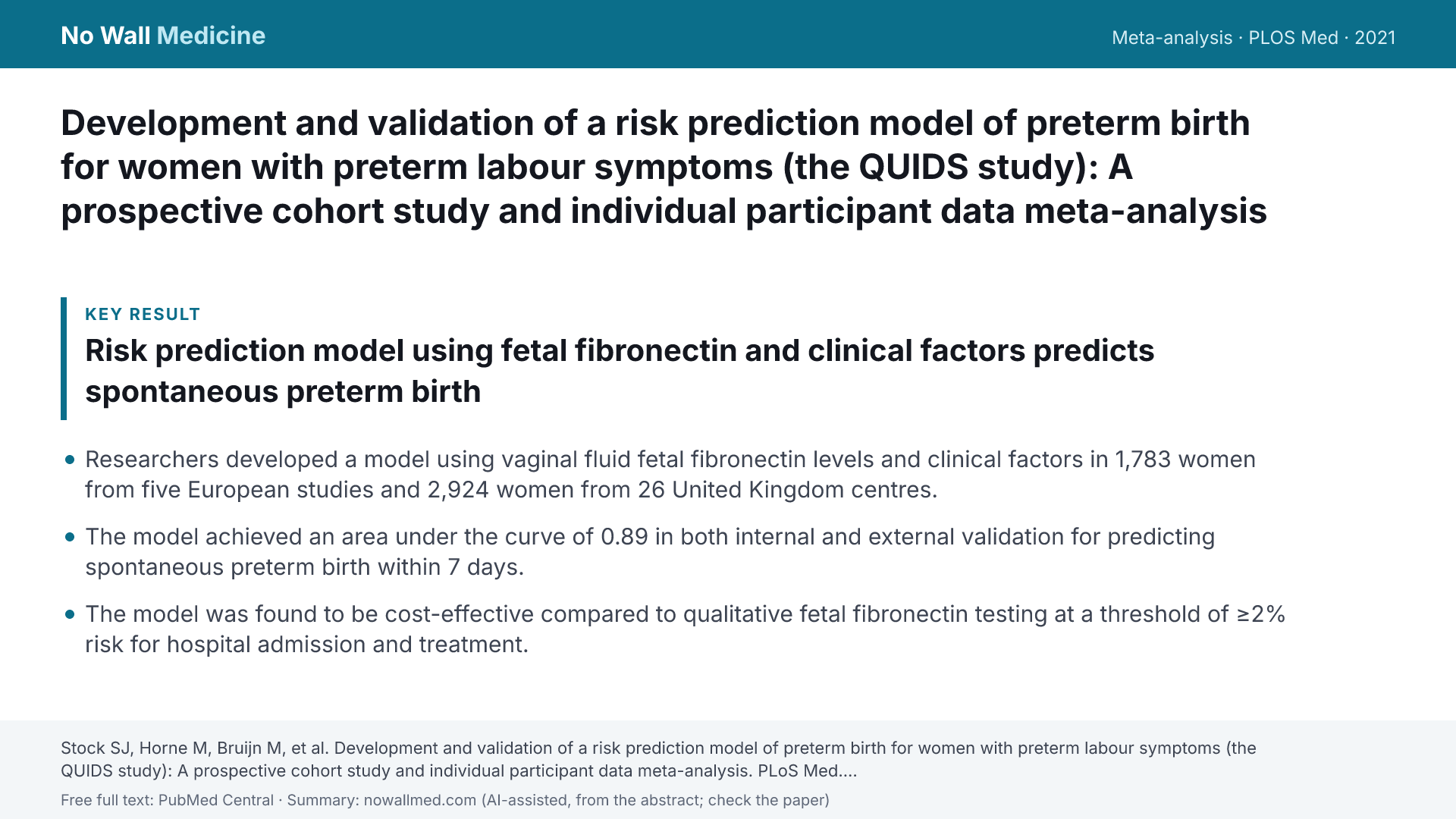
Development and validation of a risk prediction model of preterm birth for women with preterm labour symptoms (the QUIDS study): A prospective cohort study and individual participant data meta-analysis
Key result: Risk prediction model using fetal fibronectin and clinical factors predicts spontaneous preterm birth
Key points
- Researchers developed a model using vaginal fluid fetal fibronectin levels and clinical factors in 1,783 women from five European studies and 2,924 women from 26 United Kingdom centres.
- The model achieved an area under the curve of 0.89 in both internal and external validation for predicting spontaneous preterm birth within 7 days.
- The model was found to be cost-effective compared to qualitative fetal fibronectin testing at a threshold of ≥2% risk for hospital admission and treatment.
Why it matters: Diagnosing preterm labour is difficult because signs and symptoms are often common and nonspecific.
Limitation the authors note: The authors noted a limited number of participants who are not White and levels of missing data for certain variables in the development dataset.
Discussion prompts
- Would these patients look like yours? Who was left out?
- Is the main outcome one that matters to patients?
- Is the difference large enough to change what you do?
Cite: Stock SJ, Horne M, Bruijn M, et al. Development and validation of a risk prediction model of preterm birth for women with preterm labour symptoms (the QUIDS study): A prospective cohort study and individual participant data meta-analysis. PLoS Med. 2021;18(7):e1003686. doi:10.1371/journal.pmed.1003686
Free full text: PubMed Central · Summary and visual abstract: nowallmed.com/a/development-and-validation-of-a-risk-prediction-model-of-preterm-xpc9mw/ (AI-assisted from the abstract; check the paper before relying on it).