Artificial intelligence biomarker predicts which men benefit from long-term hormone therapy for prostate cancer
Development and Validation of an Artificial Intelligence Digital Pathology Biomarker to Predict Benefit of Long-Term Hormonal Therapy and Radiotherapy in Men With High-Risk Prostate Cancer Across Multiple Phase III Trials
Randomized trial validationBenefit found
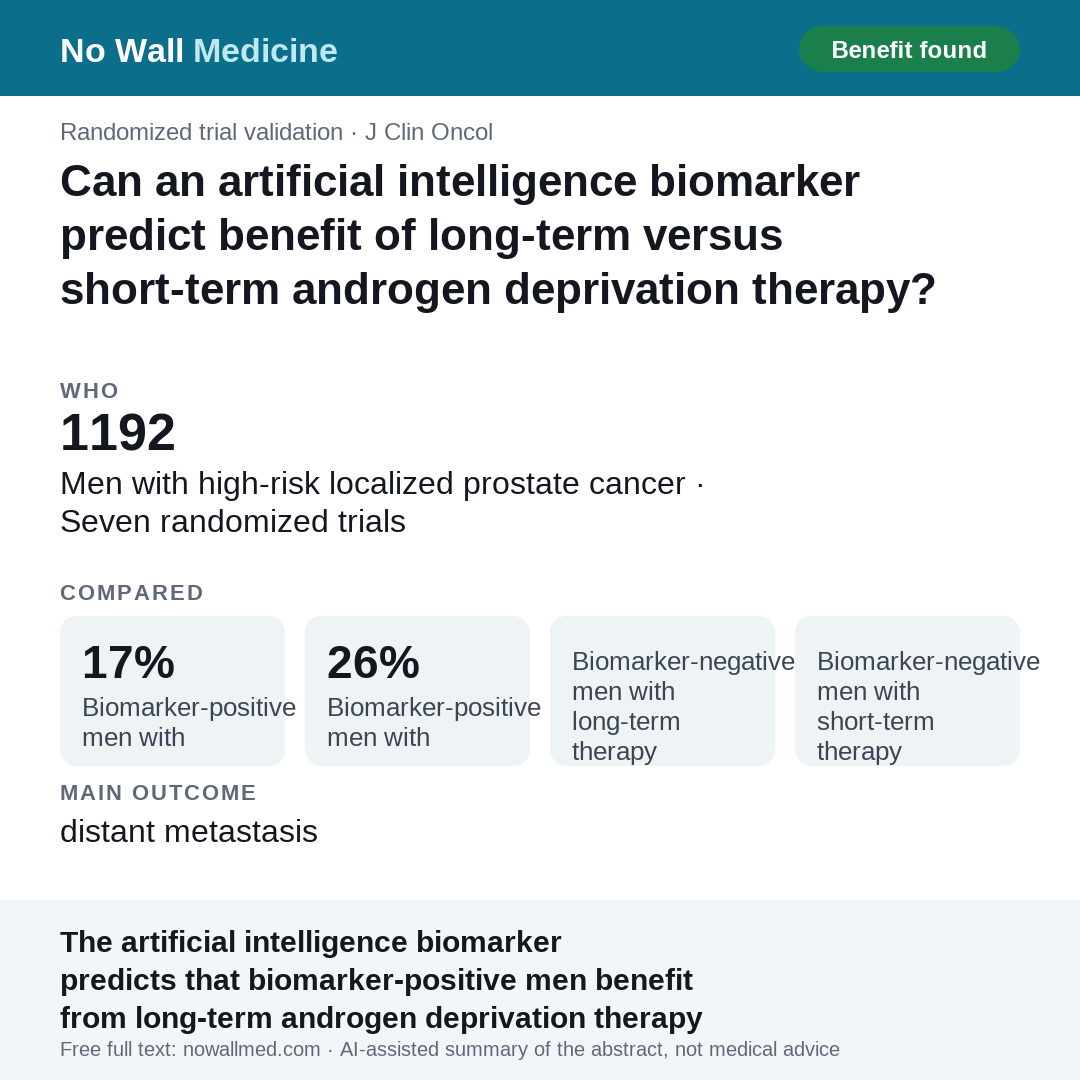
Can an artificial intelligence biomarker predict benefit of long-term versus short-term androgen deprivation therapy?
Who
1192
Men with high-risk localized prostate cancer · Seven randomized trials
Compared
17%Biomarker-positive men with long-term therapy
26%Biomarker-positive men with short-term therapy
Biomarker-negative men with long-term therapy
Biomarker-negative men with short-term therapy
Main outcome
distant metastasis
Result: subdistribution hazard ratio 0.55 (95% CI 0.41 to 0.73) for biomarker-positive men
Bottom line: The artificial intelligence biomarker predicts that biomarker-positive men benefit from long-term androgen deprivation therapy to reduce distant metastasis.
J Clin Oncol · 2025-04-16Download image
Clinical question: Can an artificial intelligence biomarker predict benefit of long-term versus short-term androgen deprivation therapy?
Why it matters: Predictive biomarkers are needed to guide the duration of androgen deprivation therapy, which is hormone therapy used to treat high-risk localized prostate cancer.
Key points
- Researchers used an artificial intelligence model trained on biopsy images and clinical data to predict outcomes in men from seven randomized radiotherapy trials.
- In the validation group of 1,192 men, long-term hormone therapy reduced distant metastasis from 26% to 17% over a median follow-up of 17.2 years.
- Men who were biomarker-positive had a 14% difference in distant metastasis risk between long-term and short-term hormone therapy, while biomarker-negative men showed 0% difference.
Headline and key points written with AI from the paper’s abstract, with every number checked against it. Read the paper before relying on them.
Topics
Cite this article
Armstrong AJ, Liu VYT, Selvaraju RR, Chen E, Simko JP, DeVries S. Development and Validation of an Artificial Intelligence Digital Pathology Biomarker to Predict Benefit of Long-Term Hormonal Therapy and Radiotherapy in Men With High-Risk Prostate Cancer Across Multiple Phase III Trials. J Clin Oncol. 2025. doi:10.1200/JCO.24.00365
Spotted a mistake? Suggest a correction
Top studies every Monday
The week’s key trials and guidelines in your specialties, by email. Free.
Get the weekly digest