Artificial intelligence model predicts which prostate cancer patients benefit from adding abiraterone to therapy
Multimodal artificial intelligence prediction of abiraterone efficacy in two STAMPEDE phase III trials of nonmetastatic very high-risk prostate cancer
Post hoc analysis of two randomized trialsBenefit found
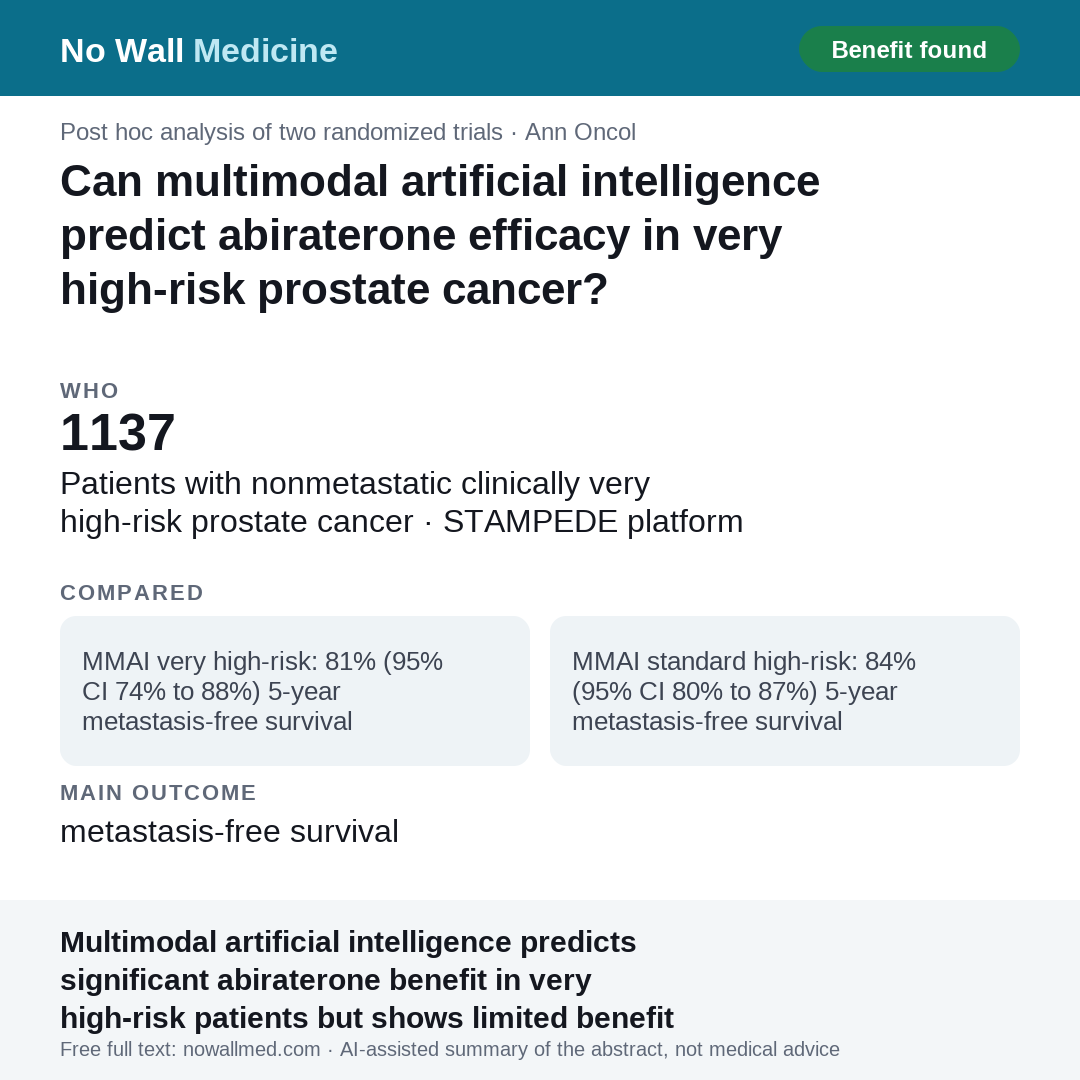
Can multimodal artificial intelligence predict abiraterone efficacy in very high-risk prostate cancer?
Who
1137
Patients with nonmetastatic clinically very high-risk prostate cancer · STAMPEDE platform protocol
Compared
MMAI very high-risk: 81% (95% CI 74% to 88%) 5-year metastasis-free survival
MMAI standard high-risk: 84% (95% CI 80% to 87%) 5-year metastasis-free survival
Main outcome
metastasis-free survival
Result: hazard ratio 0.47 (95% CI 0.31-0.70) in very high-risk group
Bottom line: Multimodal artificial intelligence predicts significant abiraterone benefit in very high-risk patients but shows limited benefit in standard high-risk patients.
Limitation: This was a post hoc study of randomized clinical trial data
Ann Oncol · 2026-06-06Download image
Clinical question: Can multimodal artificial intelligence predict abiraterone efficacy in very high-risk prostate cancer?
Why it matters: Doctors need a predictive biomarker to refine patient selection for abiraterone to avoid unnecessary toxicity and cost in very high-risk prostate cancer.
Key points
- Researchers studied 1137 patients from two clinical trials to see if an artificial intelligence model using pathology images and clinical data could predict abiraterone efficacy.
- In the very high-risk group, adding abiraterone increased 5-year metastasis-free survival from 62% to 81%, while the standard high-risk group showed limited benefit.
- The model's ability to predict treatment benefit remained consistent in subgroups with local lymph node-negative and node-positive disease.
Headline and key points written with AI from the paper’s abstract, with every number checked against it. Read the paper before relying on them.
Topics
Spotted a mistake? Suggest a correction