Automated robotic system showed higher consistency and embryo development rates than manual dish preparation
Development and validation of an automated robotic system for preparation of embryo culture dishes
Prospective randomized studyBenefit found
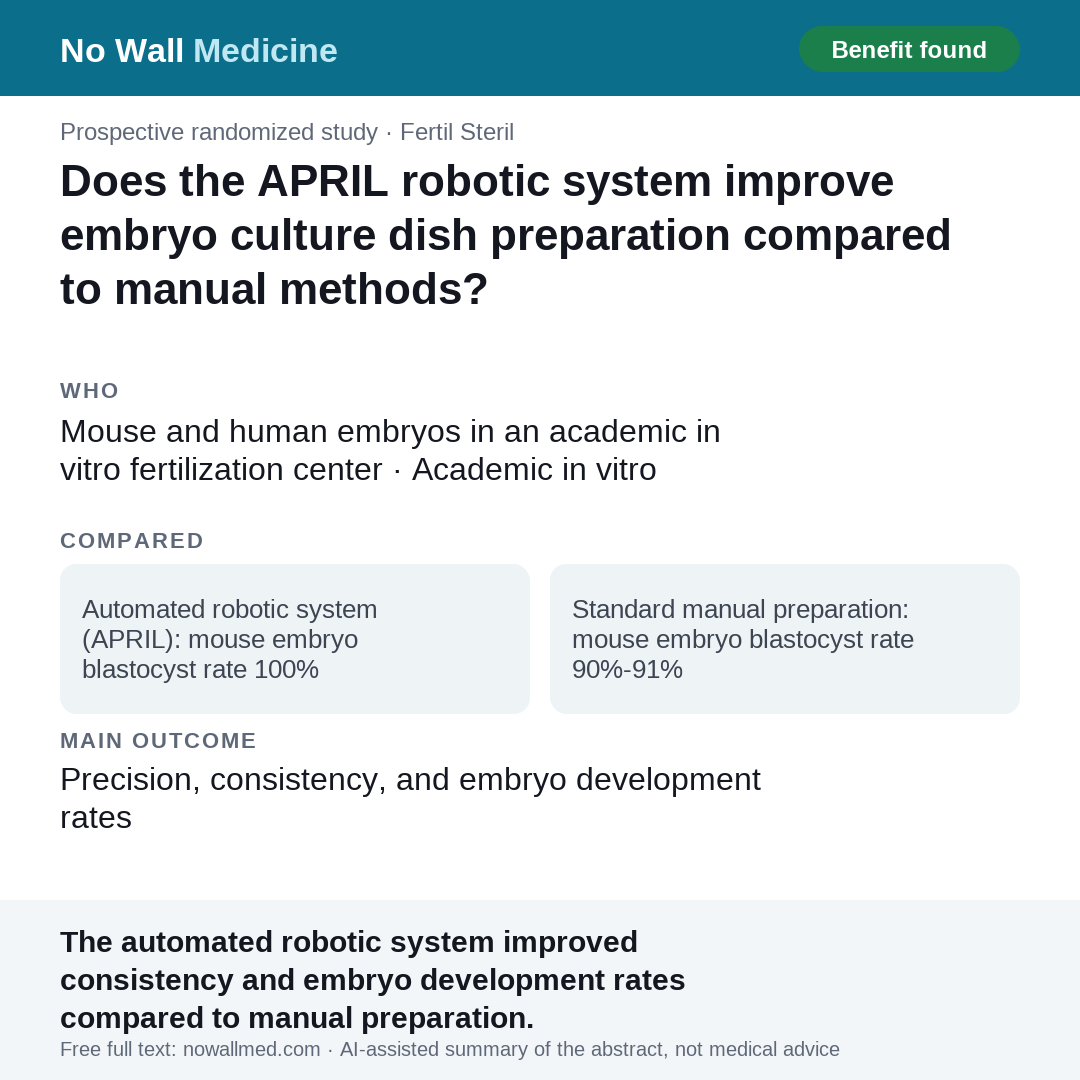
Does the APRIL robotic system improve embryo culture dish preparation compared to manual methods?
Who
Mouse and human embryos in an academic in vitro fertilization center · Academic in vitro fertilization center
Compared
Automated robotic system (APRIL): mouse embryo blastocyst rate 100%
Standard manual preparation: mouse embryo blastocyst rate 90%-91%
Main outcome
Precision, consistency, and embryo development rates
Bottom line: The automated robotic system improved consistency and embryo development rates compared to manual preparation.
Fertil Steril · 2024-04-15Download image
Clinical question: Does the APRIL robotic system improve embryo culture dish preparation compared to manual methods?
Why it matters: It is unknown if an automated robotic system can provide more precise and consistent culture dish preparation than manual methods used by embryologists.
Key points
- Researchers compared a liquid-handling robot called APRIL to manual preparation methods for embryo culture dishes in a prospective randomized study.
- The robot showed a 10-fold improvement in consistency with a coefficient of variation of 0.46% compared to 6%-7% for manual methods.
- Human embryos in robot-prepared dishes had higher day 3 development rates of 92.4% compared to 82.6% manually, but this was not statistically significant.
Headline and key points written with AI from the paper’s abstract, with every number checked against it. Read the paper before relying on them.
Topics
Cite this article
Lattin MT, Djandji AS, Kronfeld MT, Samsel T, Ling R, Ciskanik M. Development and validation of an automated robotic system for preparation of embryo culture dishes. Fertil Steril. 2024. doi:10.1016/j.fertnstert.2024.04.016
Spotted a mistake? Suggest a correction
Top studies every Monday
The week’s key trials and guidelines in your specialties, plus any topics you follow. By email, free.
Get the weekly digest