Development and validation of an international preoperative risk assessment model for postoperative delirium
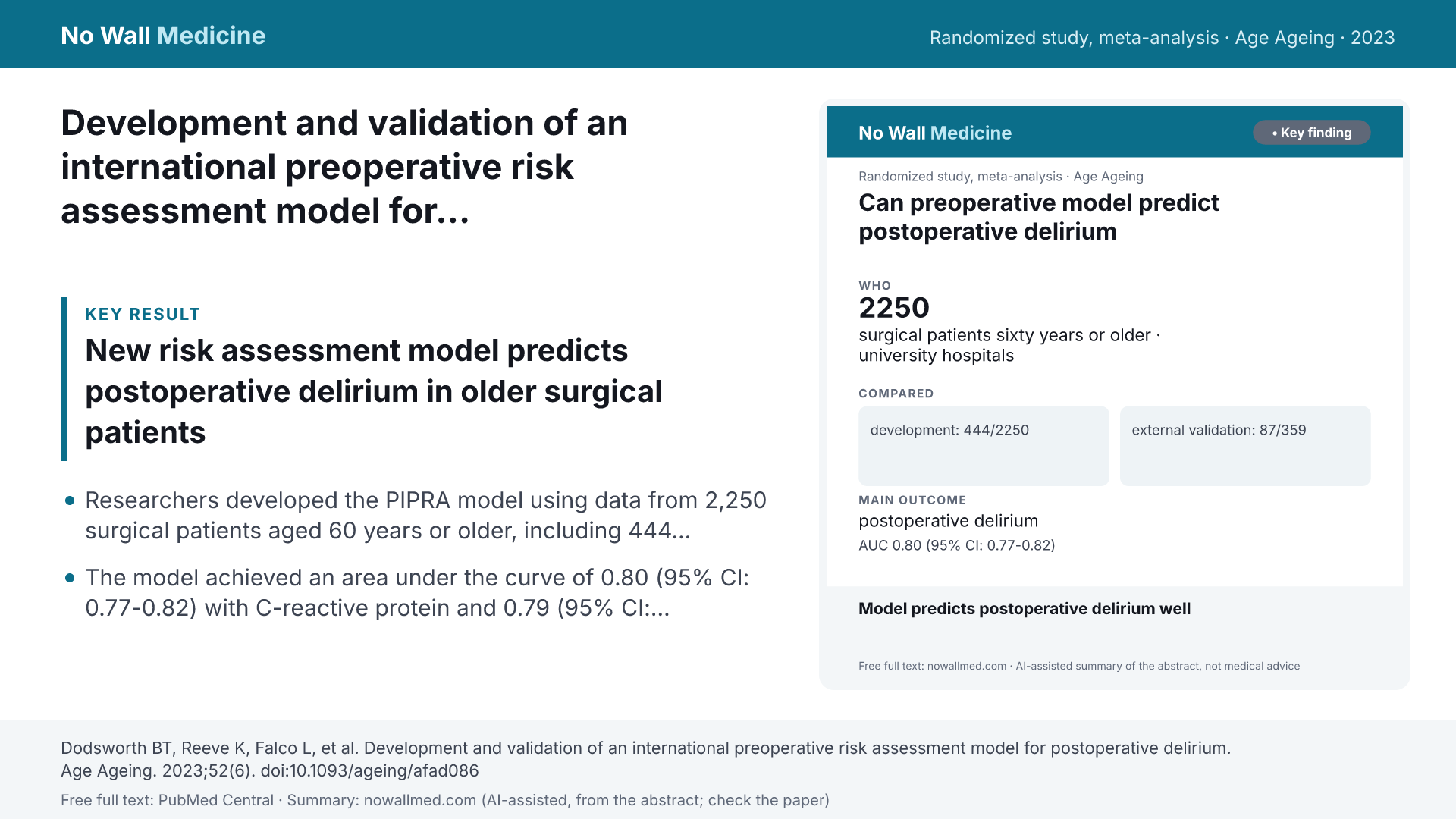
Key result: New risk assessment model predicts postoperative delirium in older surgical patients
Randomized study, meta-analysisKey finding
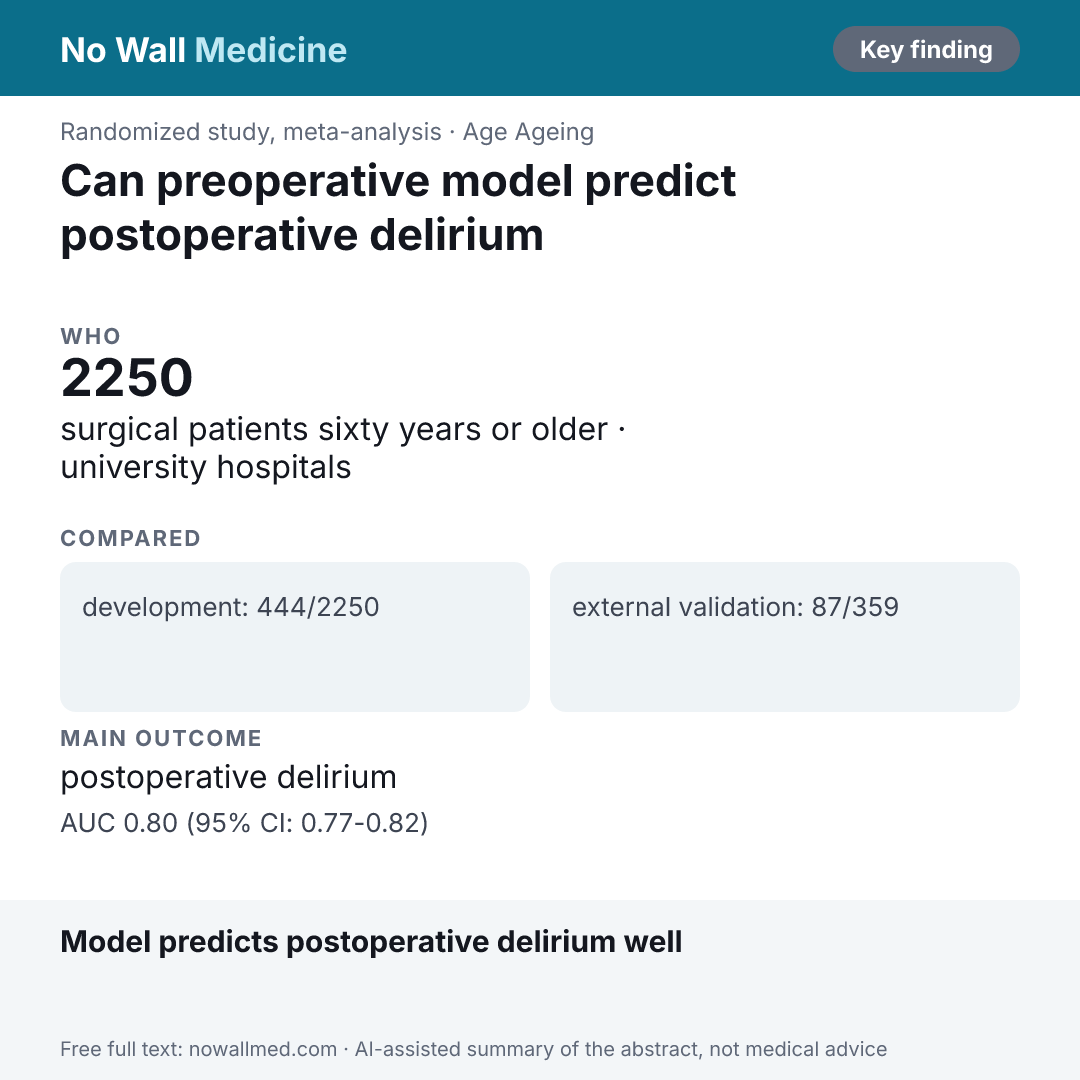
Can preoperative model predict postoperative delirium
Who
2250
surgical patients sixty years or older · university hospitals
Compared
development: 444/2250
external validation: 87/359
Main outcome
postoperative delirium
Result: AUC 0.80 (95% CI: 0.77-0.82)
Bottom line: Model predicts postoperative delirium well
Age Ageing · 2023-06-08 · Save PNG
Key points
- Researchers developed the PIPRA model using data from 2,250 surgical patients aged 60 years or older, including 444 who developed postoperative delirium.
- The model achieved an area under the curve of 0.80 (95% CI: 0.77-0.82) with C-reactive protein and 0.79 (95% CI: 0.77-0.82) without it during internal validation.
- External validation with 359 patients, including 87 who developed postoperative delirium, yielded an area under the curve of 0.74 (95% CI: 0.68-0.80).
Why it matters: Early identification of patients at risk for postoperative delirium, a condition involving disturbances in attention and cognition, is needed to aid prevention.
Discussion prompts
- Would these patients look like yours? Who was left out?
- Is the main outcome one that matters to patients?
- Is the difference large enough to change what you do?
Cite: Dodsworth BT, Reeve K, Falco L, et al. Development and validation of an international preoperative risk assessment model for postoperative delirium. Age Ageing. 2023;52(6). doi:10.1093/ageing/afad086
Free full text: PubMed Central · Summary and visual abstract: nowallmed.com/a/development-and-validation-of-an-international-preoperative-risk-hh4hre/ (AI-assisted from the abstract; check the paper before relying on it).