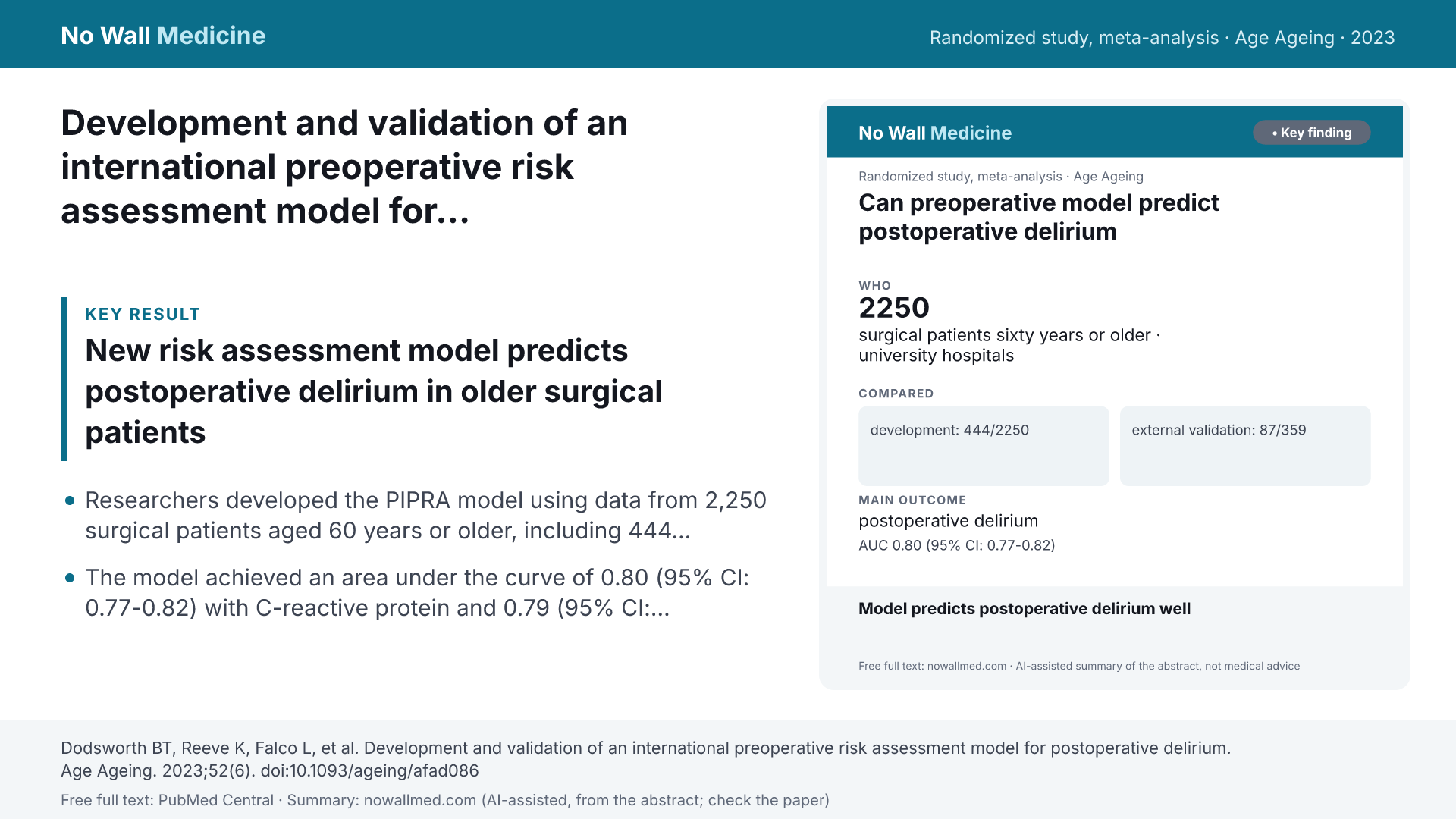
New risk assessment model predicts postoperative delirium in older surgical patients
Development and validation of an international preoperative risk assessment model for postoperative delirium
Randomized trial, meta-analysisBenefit found
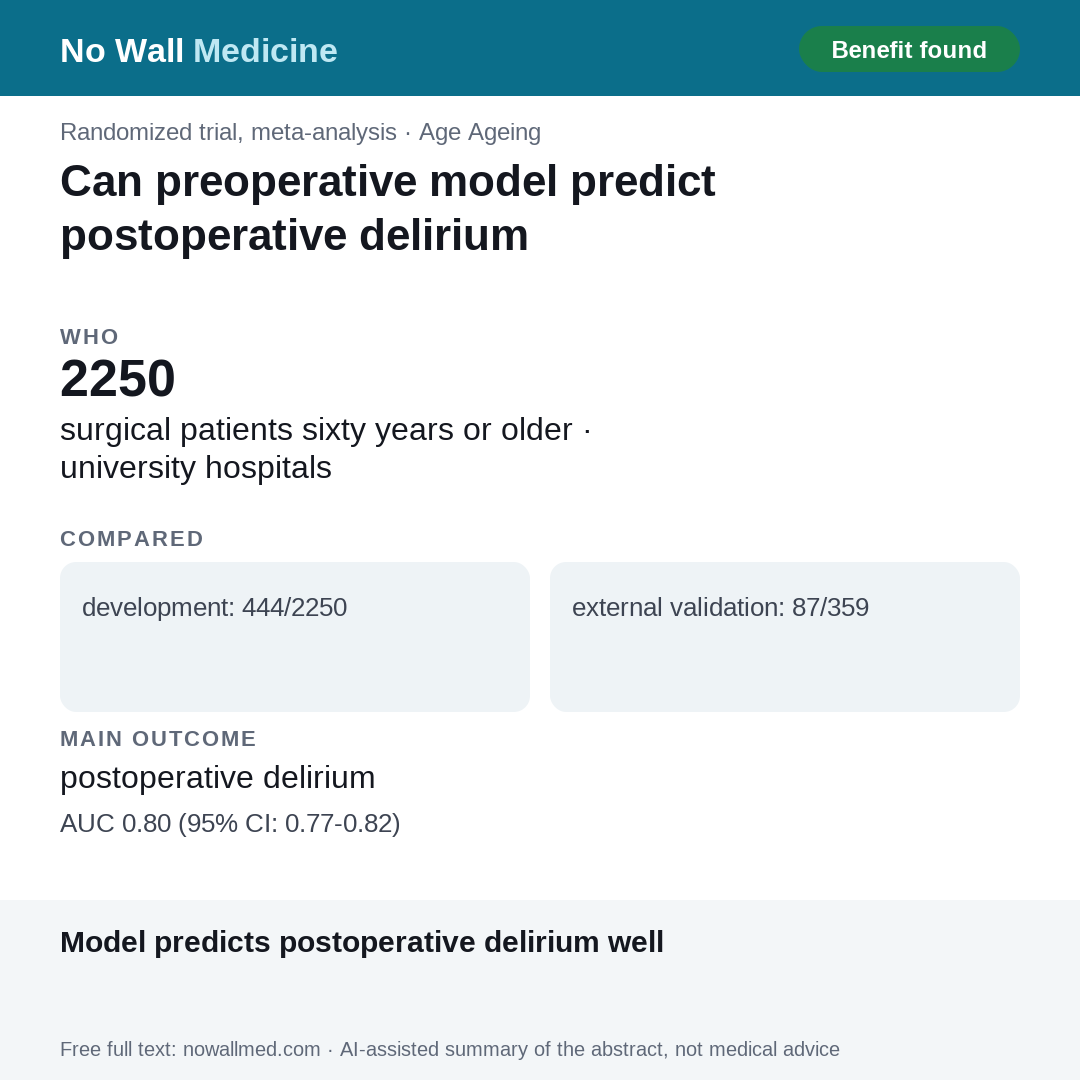
Can preoperative model predict postoperative delirium
Who
2250
surgical patients sixty years or older · university hospitals
Compared
development: 444/2250
external validation: 87/359
Main outcome
postoperative delirium
Result: AUC 0.80 (95% CI: 0.77-0.82)
Bottom line: Model predicts postoperative delirium well
Age Ageing · 2023-06-08Download image
Why it matters: Early identification of patients at risk for postoperative delirium, a condition involving disturbances in attention and cognition, is needed to aid prevention.
Key points
- Researchers developed the PIPRA model using data from 2,250 surgical patients aged 60 years or older, including 444 who developed postoperative delirium.
- The model achieved an area under the curve of 0.80 (95% CI: 0.77-0.82) with C-reactive protein and 0.79 (95% CI: 0.77-0.82) without it during internal validation.
- External validation with 359 patients, including 87 who developed postoperative delirium, yielded an area under the curve of 0.74 (95% CI: 0.68-0.80).
Headline and key points written with AI from the paper’s abstract, with every number checked against it. Read the paper before relying on them.
Was this summary helpful?
Subject terms
Cite this article
Dodsworth BT, Reeve K, Falco L, et al. Development and validation of an international preoperative risk assessment model for postoperative delirium. Age Ageing. 2023. doi:10.1093/ageing/afad086
Spotted a mistake? Suggest a correction