Artificial Intelligence-based Risk Score outperforms conventional scores for cardiac events
Development and validation of multicentre study on novel Artificial Intelligence-based Cardiovascular Risk Score (AICVD)
Multicentre development and validation studyBenefit found
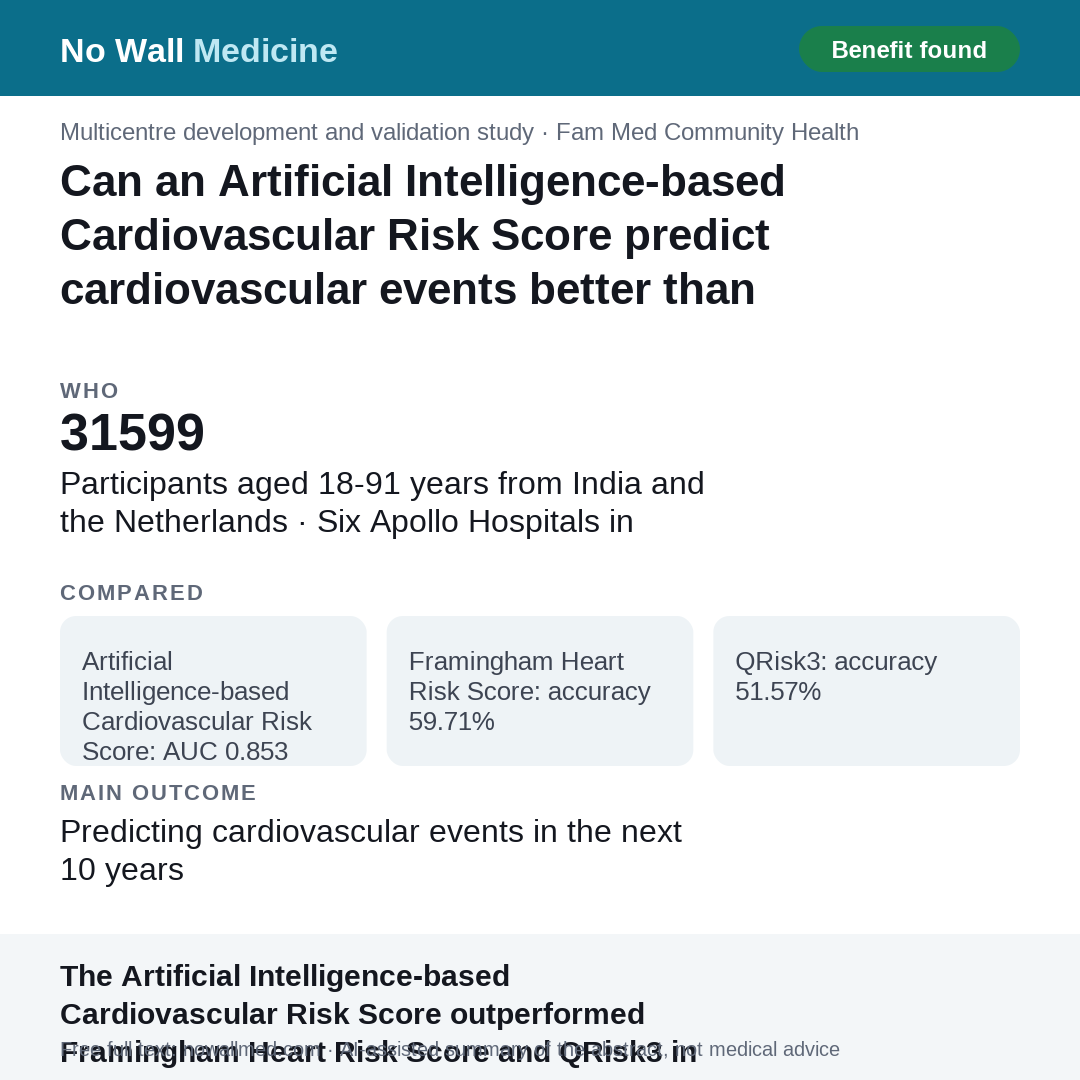
Can an Artificial Intelligence-based Cardiovascular Risk Score predict cardiovascular events better than conventional scores?
Who
31599
Participants aged 18-91 years from India and the Netherlands · Six Apollo Hospitals in India
Compared
Artificial Intelligence-based Cardiovascular Risk Score: AUC 0.853
Framingham Heart Risk Score: accuracy 59.71%
QRisk3: accuracy 51.57%
Main outcome
Predicting cardiovascular events in the next 10 years
Bottom line: The Artificial Intelligence-based Cardiovascular Risk Score outperformed Framingham Heart Risk Score and QRisk3 in predictive performance.
Fam Med Community Health · 2024-01-18Download image
Clinical question: Can an Artificial Intelligence-based Cardiovascular Risk Score predict cardiovascular events better than conventional scores?
Why it matters: Conventional risk scores have limited performance and accuracy in Indian population
Key points
- 31,599 participants aged 18-91 years were studied in India.
- The AI-based model had an area under the curve of 0.853 and 80.15% accuracy.
- It outperformed Framingham Heart Risk Score and QRisk3 in validation results.
Headline and key points written with AI from the paper’s abstract, with every number checked against it. Read the paper before relying on them.
Abstract
Objective
Cardiovascular diseases (CVD) are one of the most prevalent diseases in India amounting for nearly 30% of total deaths. A dearth of research on CVD risk scores in Indian population, limited performance of conventional risk scores and inability to reproduce the initial accuracies in randomised clinical trials has led to this study on large-scale patient data. The objective is to develop an Artificial Intelligence-based Risk Score (AICVD) to predict CVD event (eg, acute myocardial infarction/acute coronary syndrome) in the next 10 years and compare the model with the Framingham Heart Risk Score (FHRS) and QRisk3. Methods
Our study included 31 599 participants aged 18-91 years from 2009 to 2018 in six Apollo Hospitals in India. A multistep risk factors selection process using Spearman correlation coefficient and propensity score matching yielded 21 risk factors. A deep learning hazards model was built on risk factors to predict event occurrence (classification) and time to event (hazards model) using multilayered neural network. Further, the model was validated with independent retrospective cohorts of participants from India and the Netherlands and compared with FHRS and QRisk3. Results
The deep learning hazards model had a good performance (area under the curve (AUC) 0.853). Validation and comparative results showed AUCs between 0.84 and 0.92 with better positive likelihood ratio (AICVD -6.16 to FHRS -2.24 and QRisk3 -1.16) and accuracy (AICVD -80.15% to FHRS 59.71% and QRisk3 51.57%). In the Netherlands cohort, AICVD also outperformed the Framingham Heart Risk Model (AUC -0.737 vs 0.707). Conclusions
This study concludes that the novel AI-based CVD Risk Score has a higher predictive performance for cardiac events than conventional risk scores in Indian population. Trial registration number
CTRI/2019/07/020471.
Abstract reproduced under the article’s CC BY NC licence.
Topics
Cite this article
Jalepalli SK, Gupta P, Dekker ALAJ, Bermejo I, Kar S. Development and validation of multicentre study on novel Artificial Intelligence-based Cardiovascular Risk Score (AICVD). Fam Med Community Health. 2024. doi:10.1136/fmch-2023-002340
Spotted a mistake? Suggest a correction
Top studies every Monday
The week’s key trials and guidelines in your specialties, plus any topics you follow. By email, free.
Get the weekly digest