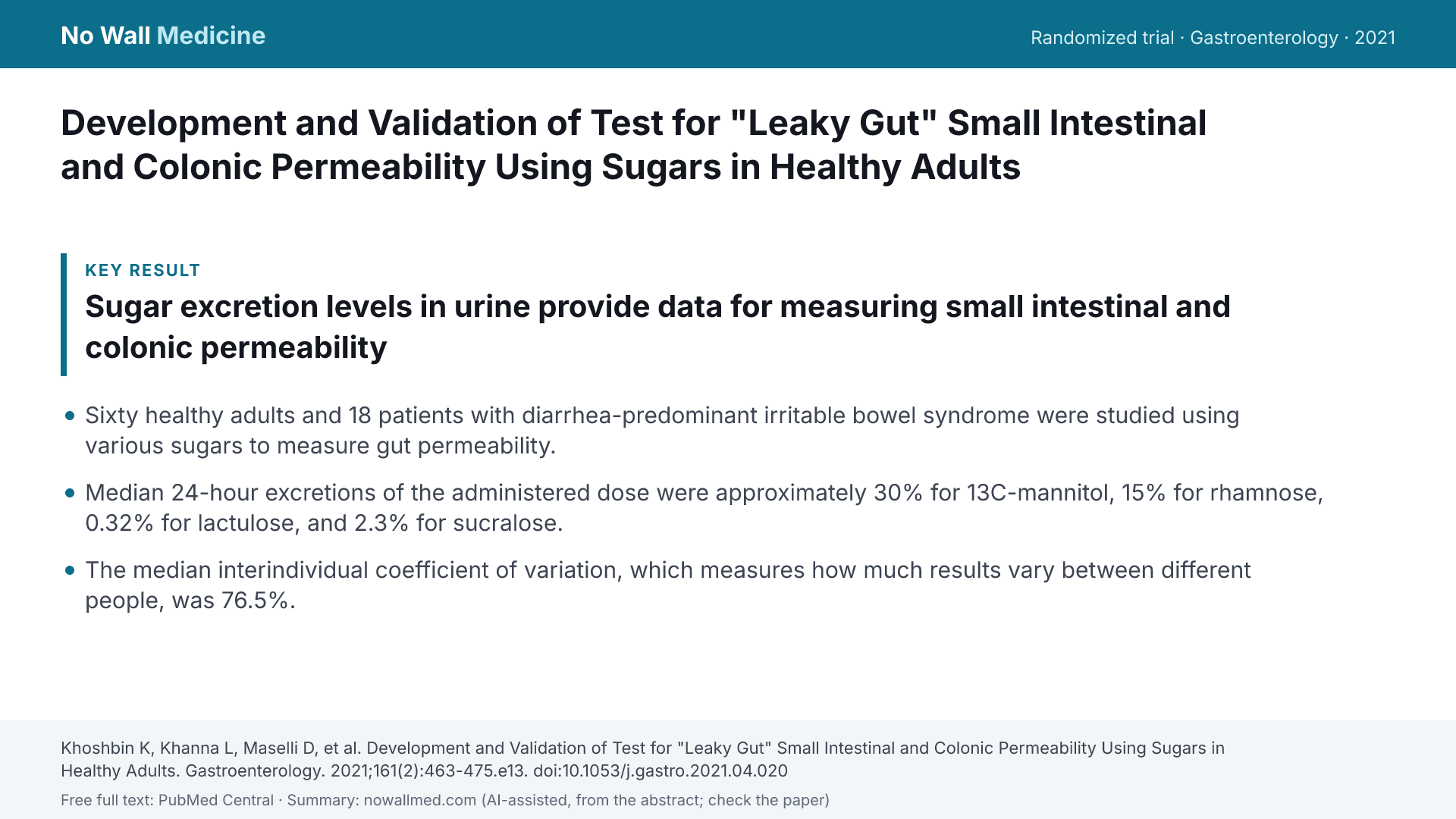
Sugar excretion levels in urine provide data for measuring small intestinal and colonic permeability
Development and Validation of Test for "Leaky Gut" Small Intestinal and Colonic Permeability Using Sugars in Healthy Adults
Why it matters: Normative data for small intestinal and colonic permeability and the influence of dietary fiber on these measurements were unknown.
Key points
- Sixty healthy adults and 18 patients with diarrhea-predominant irritable bowel syndrome were studied using various sugars to measure gut permeability.
- Median 24-hour excretions of the administered dose were approximately 30% for 13C-mannitol, 15% for rhamnose, 0.32% for lactulose, and 2.3% for sucralose.
- The median interindividual coefficient of variation, which measures how much results vary between different people, was 76.5%.
Headline and key points written with AI from the paper’s abstract, with every number checked against it. Read the paper before relying on them.
Was this summary helpful?
Subject terms
Cite this article
Khoshbin K, Khanna L, Maselli D, Atieh J, Breen-Lyles M, Arndt K. Development and Validation of Test for "Leaky Gut" Small Intestinal and Colonic Permeability Using Sugars in Healthy Adults. Gastroenterology. 2021. doi:10.1053/j.gastro.2021.04.020
Spotted a mistake? Suggest a correction
Top studies every Monday
The week’s key trials and guidelines in your specialties, plus any topics you follow. By email, free.
Get the weekly digest