Development and Validation of Test for "Leaky Gut" Small Intestinal and Colonic Permeability Using Sugars in Healthy Adults
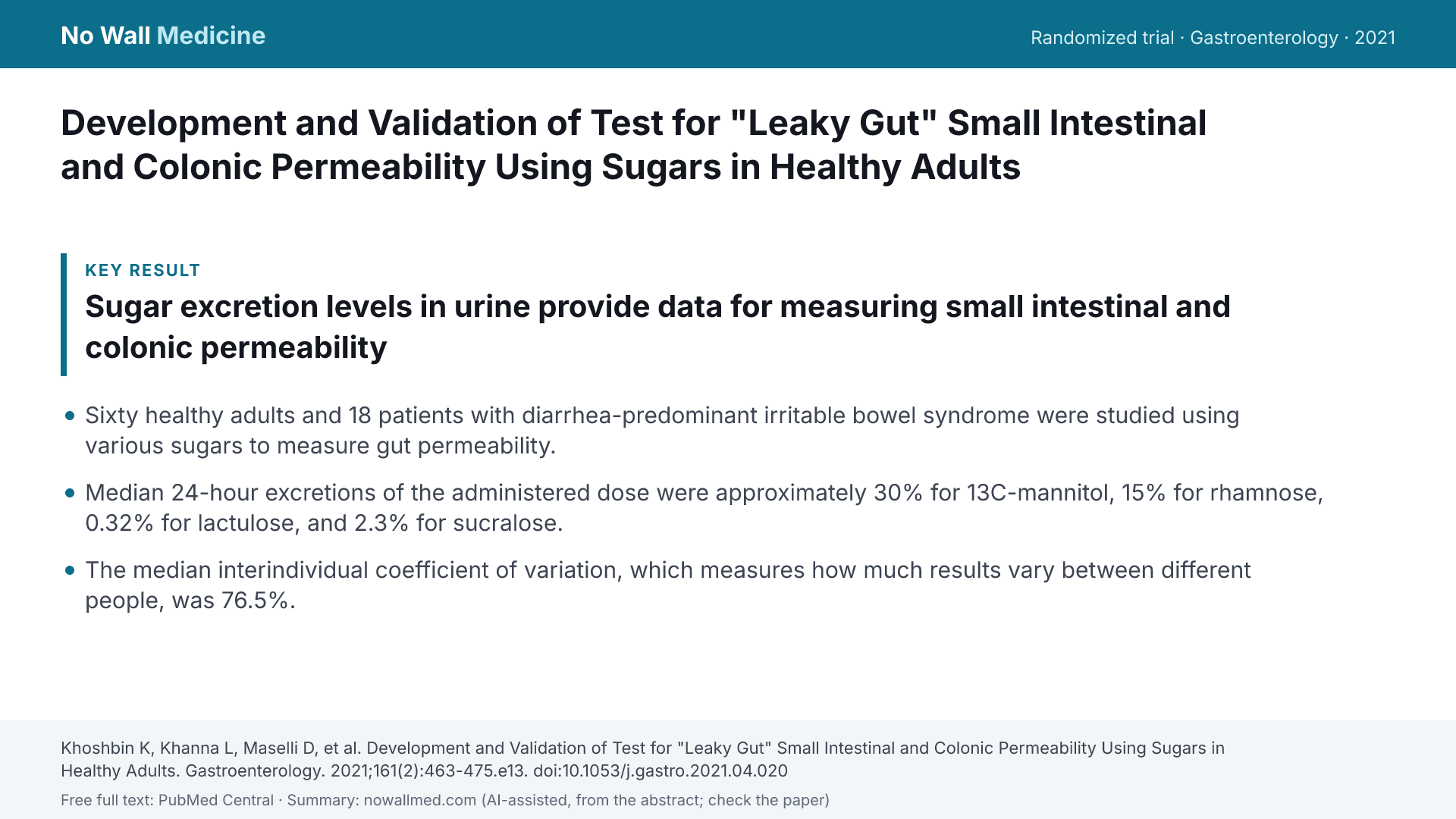
Key result: Sugar excretion levels in urine provide data for measuring small intestinal and colonic permeability
Key points
- Sixty healthy adults and 18 patients with diarrhea-predominant irritable bowel syndrome were studied using various sugars to measure gut permeability.
- Median 24-hour excretions of the administered dose were approximately 30% for 13C-mannitol, 15% for rhamnose, 0.32% for lactulose, and 2.3% for sucralose.
- The median interindividual coefficient of variation, which measures how much results vary between different people, was 76.5%.
Discussion prompts
- Would these patients look like yours? Who was left out?
- Is the main outcome one that matters to patients?
- Is the difference large enough to change what you do?
Cite: Khoshbin K, Khanna L, Maselli D, et al. Development and Validation of Test for "Leaky Gut" Small Intestinal and Colonic Permeability Using Sugars in Healthy Adults. Gastroenterology. 2021. doi:10.1053/j.gastro.2021.04.020
Free full text: PubMed Central · Summary and visual abstract: nowallmed.com/a/development-and-validation-of-test-for-leaky-gut-small-intestinal-and-zhqzsd/ (AI-assisted from the abstract; check the paper before relying on it).