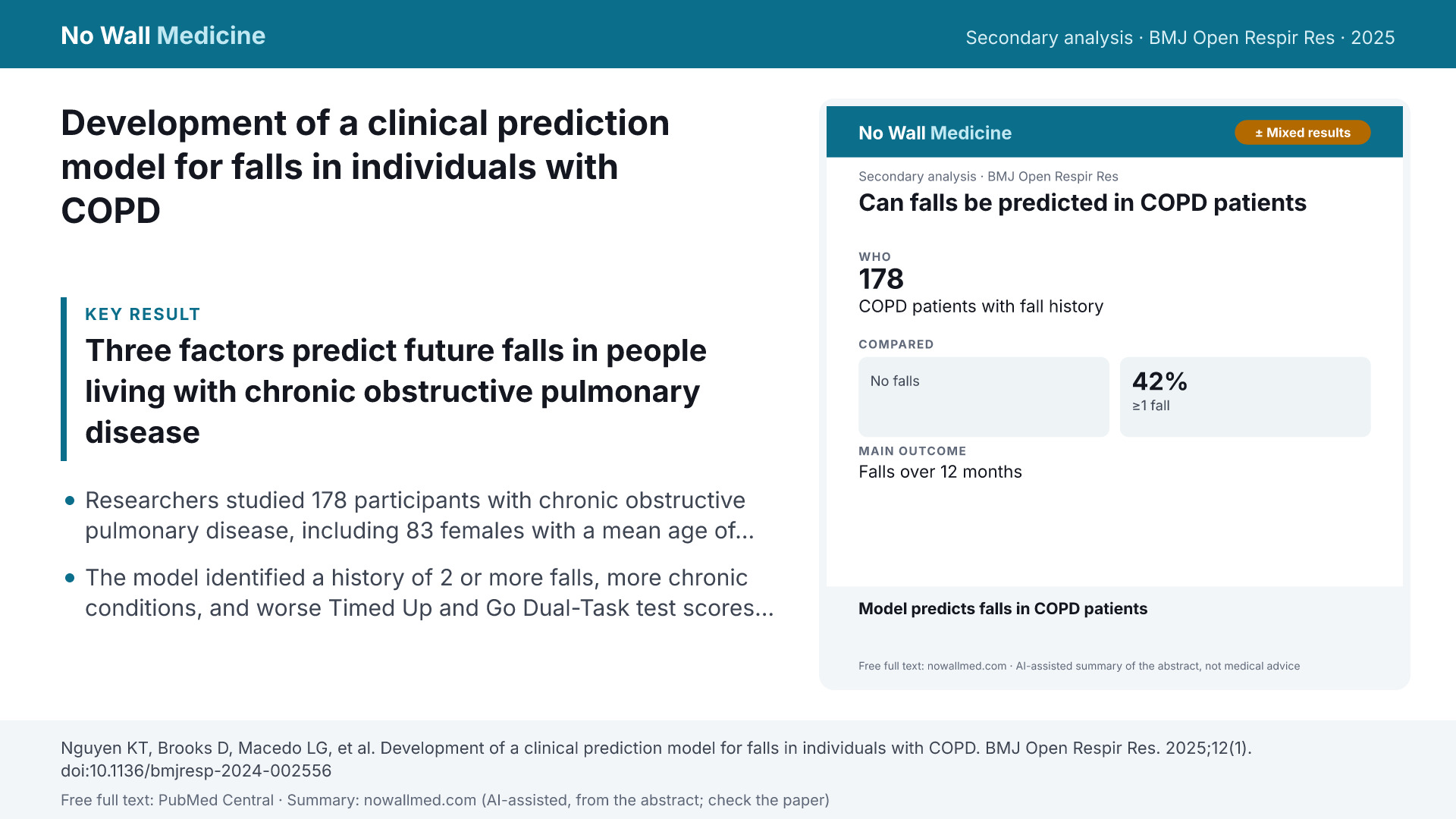
Three factors predict future falls in people living with chronic obstructive pulmonary disease
Development of a clinical prediction model for falls in individuals with COPD
Secondary analysisMixed results
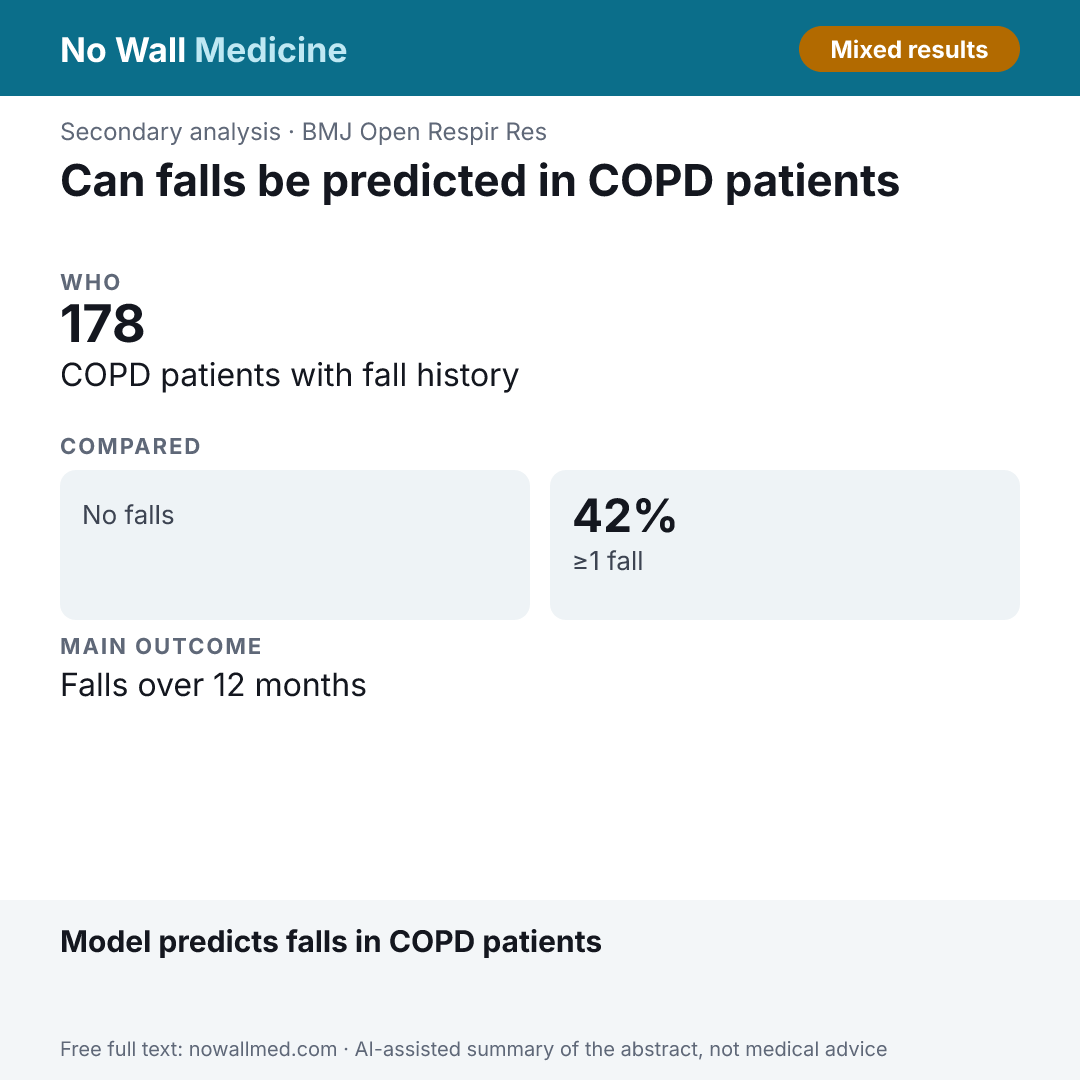
Can falls be predicted in COPD patients
Who
178
COPD patients with fall history
Compared
No falls
42%≥1 fall (74/178)
Main outcome
Falls over 12 months
Bottom line: Model predicts falls in COPD patients
Limitation: Needs external validation
BMJ Open Respir Res · 2025-12-25 · Save PNG
Why it matters: There is currently no accurate method for predicting falls in the population of individuals with chronic obstructive pulmonary disease.
Key points
- Researchers studied 178 participants with chronic obstructive pulmonary disease, including 83 females with a mean age of 73±9 years.
- The model identified a history of 2 or more falls, more chronic conditions, and worse Timed Up and Go Dual-Task test scores as predictors.
- The final prediction model achieved a concordance statistic of 0.69 and an expected to observed ratio of 1.01.
Headline and key points written with AI from the paper’s abstract, with every number checked against it. Read the paper before relying on them.
Was this summary helpful?
Abstract
Background
Chronic obstructive pulmonary disease (COPD) is linked to an increased risk of falls, however, there is no accurate method for predicting falls in this population. This study aimed to develop and internally validate a clinical prediction model for falls in individuals with COPD. Methods
A secondary analysis was conducted using data from a recent fall prevention trial. Participants with COPD who reported a 12-month history of falls, concerns with balance or recent near falls were tracked for falls over 12 months prospectively. Baseline data included demographics and measures of balance, mobility and health status. A predictive model was developed using backward-selected multivariate logistic regression with fall status (no falls versus ≥1 fall) as the dependent variable and 17 baseline candidate predictors as independent variables. Using the bootstrap resampling method for internal validation, model performance was assessed for discrimination by the concordance (c) statistic and calibration by the expected to observed (E:O) ratio, calibration in the large (CITL) and calibration slope. The final model was adjusted for optimism using the bootstrap shrinkage factor. Results
Of 178 participants (mean age 73±9 years; 83 females), 74 (42%) reported ≥1 fall over 12 months, totalling 188 falls. The predictive model identified three factors associated with 12-month future falls: reporting a 12-month history of ≥2 falls (OR=3.59, CI (1.65 to 7.82)), more chronic conditions (OR=1.14, CI (1.01 to 1.28)) and worse Timed Up and Go Dual-Task test scores (OR=1.04, CI (1.00 to 1.09)). The final prediction model achieved acceptable discrimination (c-statistic=0.69, CI (0.61 to 0.78)) and calibration (E:O ratio=1.01, CITL=-0.01 and calibration slope=0.93). Conclusions
A history of ≥2 falls, having more chronic conditions and impaired mobility under cognitive demand predicts future falls in individuals with COPD. The prediction model showed acceptable internal validation. External validation is needed to confirm these findings. Trial registration number
NCT02995681; clinicaltrials.gov.
Abstract reproduced under the article’s CC BY NC licence.
Subject terms
Headline, design, result, key points, caveat and citation as plain text.
Cite this article
Nguyen KT, Brooks D, Macedo LG, et al. Development of a clinical prediction model for falls in individuals with COPD. BMJ Open Respir Res. 2025;12(1). doi:10.1136/bmjresp-2024-002556
Spotted a mistake? Suggest a correction