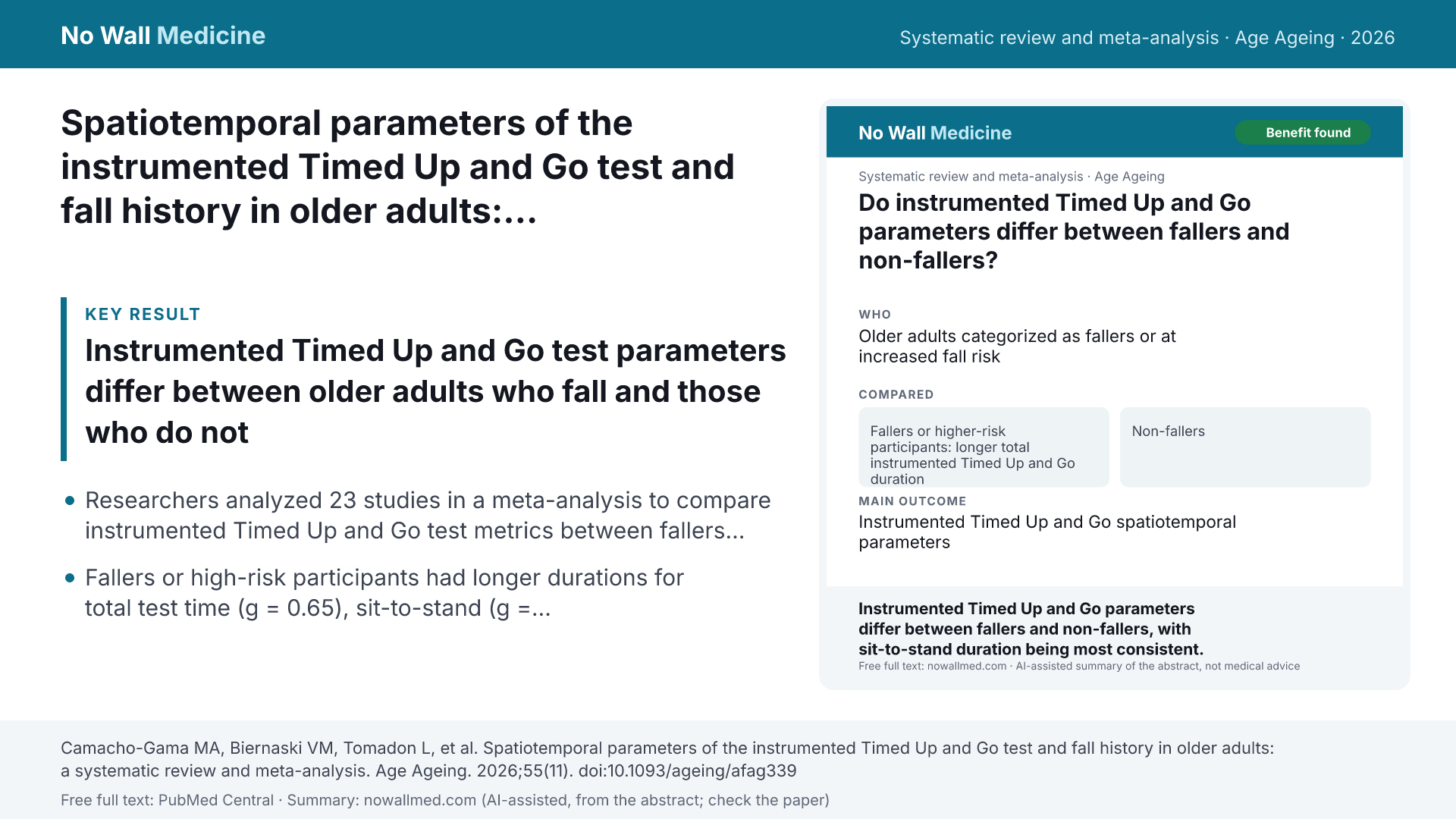
Instrumented Timed Up and Go test parameters differ between older adults who fall and those who do not
Spatiotemporal parameters of the instrumented Timed Up and Go test and fall history in older adults: a systematic review and meta-analysis
Systematic review and meta-analysisBenefit found
Do instrumented Timed Up and Go parameters differ between fallers and non-fallers?
Who
Older adults categorized as fallers or at increased fall risk
Compared
Fallers or higher-risk participants: longer total instrumented Timed Up and Go duration
Non-fallers
Main outcome
Instrumented Timed Up and Go spatiotemporal parameters
Result: Hedges' g 0.65 (95% confidence interval 0.36-0.94) for total duration
Bottom line: Instrumented Timed Up and Go parameters differ between fallers and non-fallers, with sit-to-stand duration being most consistent.
Age Ageing · 2026-11-22Download image
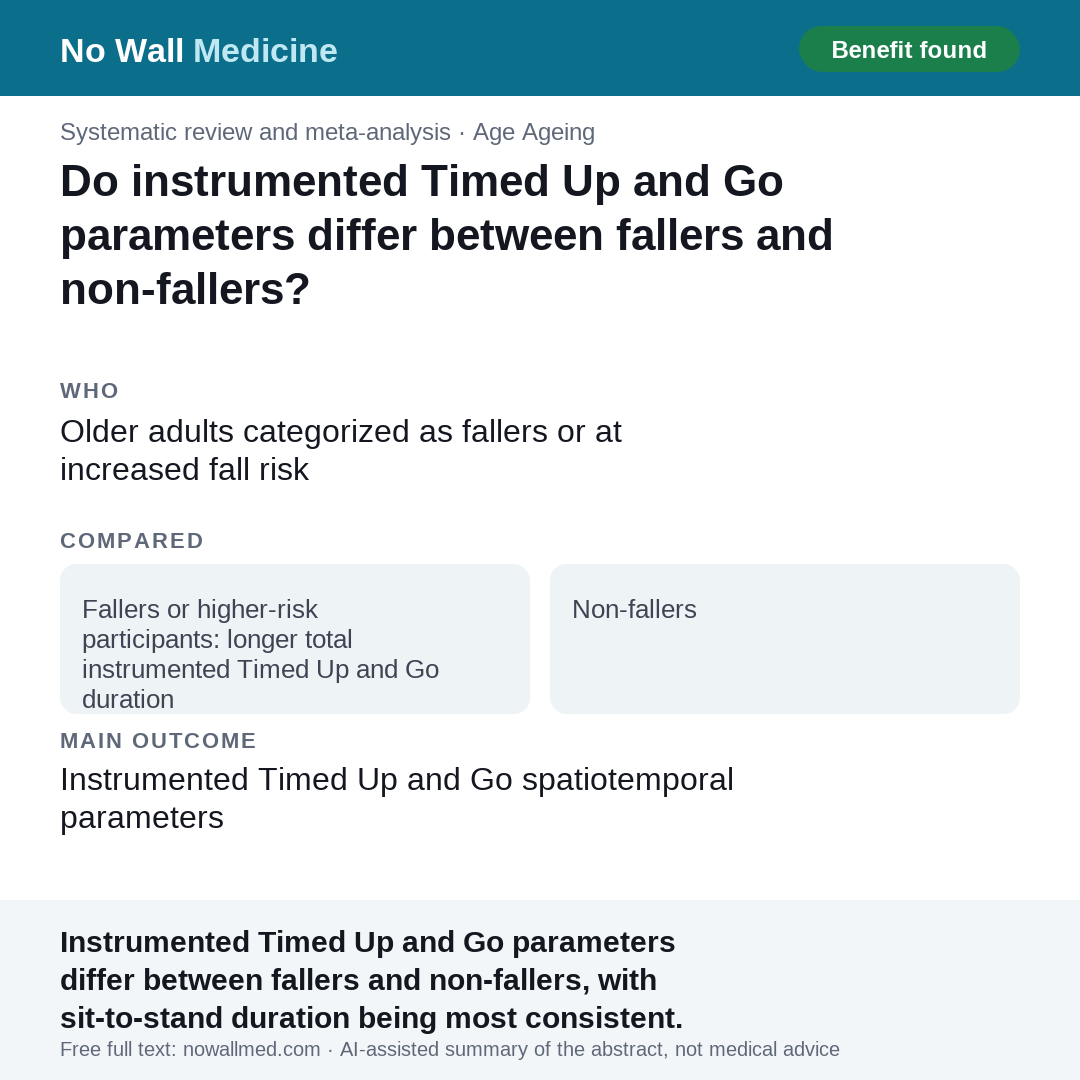
Clinical question: Do instrumented Timed Up and Go parameters differ between fallers and non-fallers?
Why it matters: Total completion time in the Timed Up and Go test may not capture specific mobility deficits that characterize fall risk in older adults.
Key points
- Researchers analyzed 23 studies in a meta-analysis to compare instrumented Timed Up and Go test metrics between fallers or high-risk individuals and non-fallers.
- Fallers or high-risk participants had longer durations for total test time (g = 0.65), sit-to-stand (g = 0.36), stand-to-sit (g = 0.32), turning (g = 0.49), and walking phases.
- Higher fall risk was also associated with longer step duration, more steps, lower gait speed, and lower step length.
Headline and key points written with AI from the paper’s abstract, with every number checked against it. Read the paper before relying on them.
Was this summary helpful?
Subject terms
Cite this article
Camacho-Gama MA, Biernaski VM, Tomadon L, et al. Spatiotemporal parameters of the instrumented Timed Up and Go test and fall history in older adults: a systematic review and meta-analysis. Age Ageing. 2026. doi:10.1093/ageing/afag339
Spotted a mistake? Suggest a correction