Spatiotemporal parameters of the instrumented Timed Up and Go test and fall history in older adults: a systematic review and meta-analysis
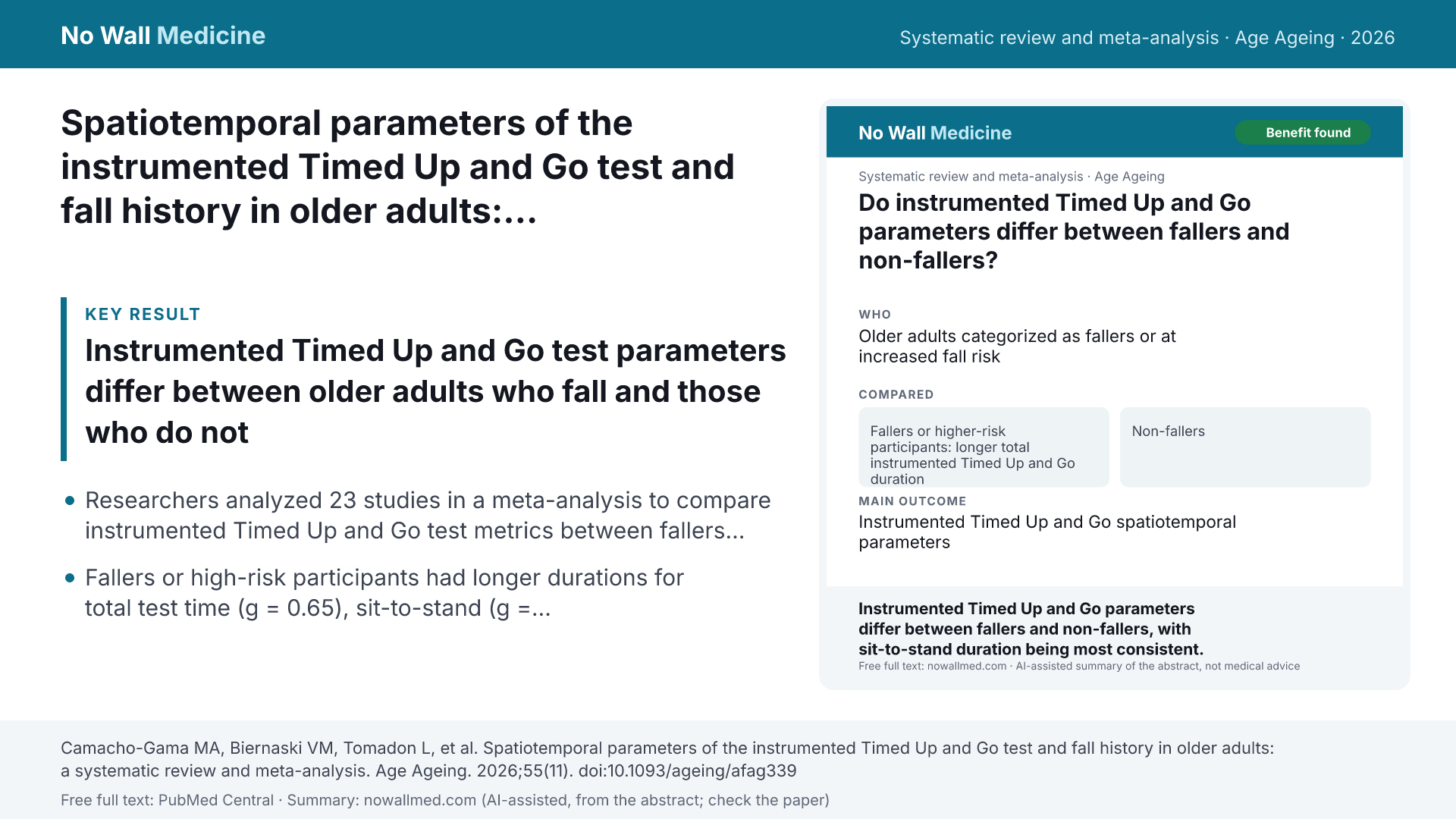
Key result: Instrumented Timed Up and Go test parameters differ between older adults who fall and those who do not
Systematic review and meta-analysisBenefit found
Do instrumented Timed Up and Go parameters differ between fallers and non-fallers?
Who
Older adults categorized as fallers or at increased fall risk
Compared
Fallers or higher-risk participants: longer total instrumented Timed Up and Go duration
Non-fallers
Main outcome
Instrumented Timed Up and Go spatiotemporal parameters
Result: Hedges' g 0.65 (95% confidence interval 0.36-0.94) for total duration
Bottom line: Instrumented Timed Up and Go parameters differ between fallers and non-fallers, with sit-to-stand duration being most consistent.
Age Ageing · 2026-11-22
Key points
- Researchers analyzed 23 studies in a meta-analysis to compare instrumented Timed Up and Go test metrics between fallers or high-risk individuals and non-fallers.
- Fallers or high-risk participants had longer durations for total test time (g = 0.65), sit-to-stand (g = 0.36), stand-to-sit (g = 0.32), turning (g = 0.49), and walking phases.
- Higher fall risk was also associated with longer step duration, more steps, lower gait speed, and lower step length.
Why it matters: Total completion time in the Timed Up and Go test may not capture specific mobility deficits that characterize fall risk in older adults.
Discussion prompts
- Would these patients look like yours? Who was left out?
- Is the main outcome one that matters to patients?
- Is the difference large enough to change what you do?
Cite: Camacho-Gama MA, Biernaski VM, Tomadon L, et al. Spatiotemporal parameters of the instrumented Timed Up and Go test and fall history in older adults: a systematic review and meta-analysis. Age Ageing. 2026;55(11). doi:10.1093/ageing/afag339
Free full text: PubMed Central · Summary and visual abstract: nowallmed.com/a/spatiotemporal-parameters-of-the-instrumented-timed-up-and-go-test-wye4fe/ (AI-assisted from the abstract; check the paper before relying on it).