Development of osteonecrosis and improved survival in B-ALL: results of Children's Oncology Group Trial AALL0232
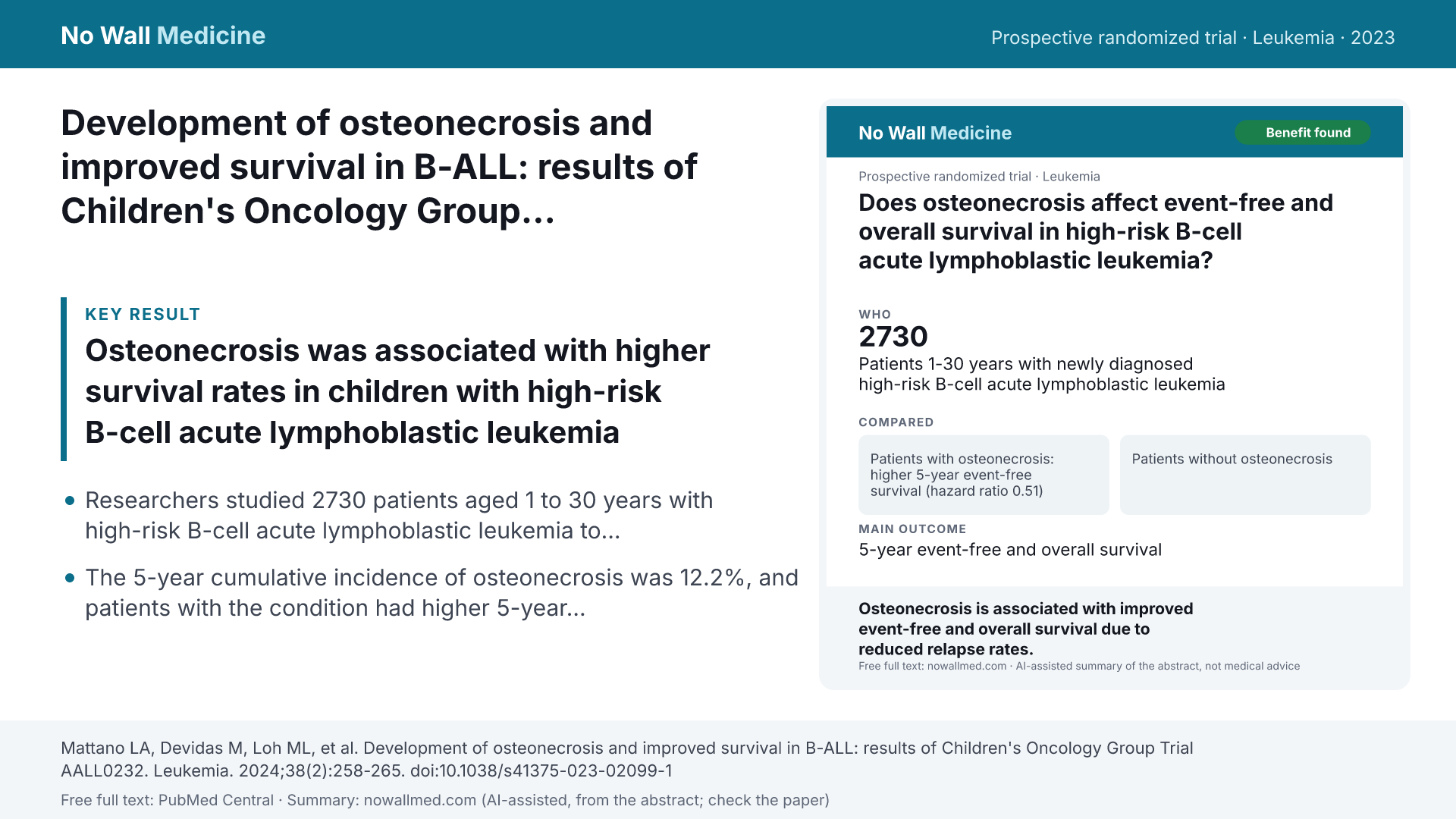
Key result: Osteonecrosis was associated with higher survival rates in children with high-risk B-cell acute lymphoblastic leukemia
Prospective randomized trialBenefit found
Does osteonecrosis affect event-free and overall survival in high-risk B-cell acute lymphoblastic leukemia?
Who
2730
Patients 1-30 years with newly diagnosed high-risk B-cell acute lymphoblastic leukemia
Compared
Patients with osteonecrosis: higher 5-year event-free survival (hazard ratio 0.51)
Patients without osteonecrosis
Main outcome
5-year event-free and overall survival
Result: hazard ratio 0.51 (P < 0.0001) for event-free survival
Bottom line: Osteonecrosis is associated with improved event-free and overall survival due to reduced relapse rates.
Leukemia · 2023-12-07
Key points
- Researchers studied 2730 patients aged 1 to 30 years with high-risk B-cell acute lymphoblastic leukemia to assess osteonecrosis, which is bone tissue death.
- The 5-year cumulative incidence of osteonecrosis was 12.2%, and patients with the condition had higher 5-year event-free survival (HR, 0.51) and overall survival (HR, 0.42).
- Higher risk of osteonecrosis was associated with being aged ≥10 years (HR, 7.23) and being female (HR, 1.37).
Discussion prompts
- Would these patients look like yours? Who was left out?
- Is the main outcome one that matters to patients?
- Is the difference large enough to change what you do?
Cite: Mattano LA, Devidas M, Loh ML, et al. Development of osteonecrosis and improved survival in B-ALL: results of Children's Oncology Group Trial AALL0232. Leukemia. 2024;38(2):258-265. doi:10.1038/s41375-023-02099-1
Free full text: PubMed Central · Summary and visual abstract: nowallmed.com/a/development-of-osteonecrosis-and-improved-survival-in-b-all-results-j76dgf/ (AI-assisted from the abstract; check the paper before relying on it).