Development, verification, and comparison of a risk stratification model integrating residual cancer burden to predict individual prognosis in early-stage breast cancer treated with neoadjuvant therapy
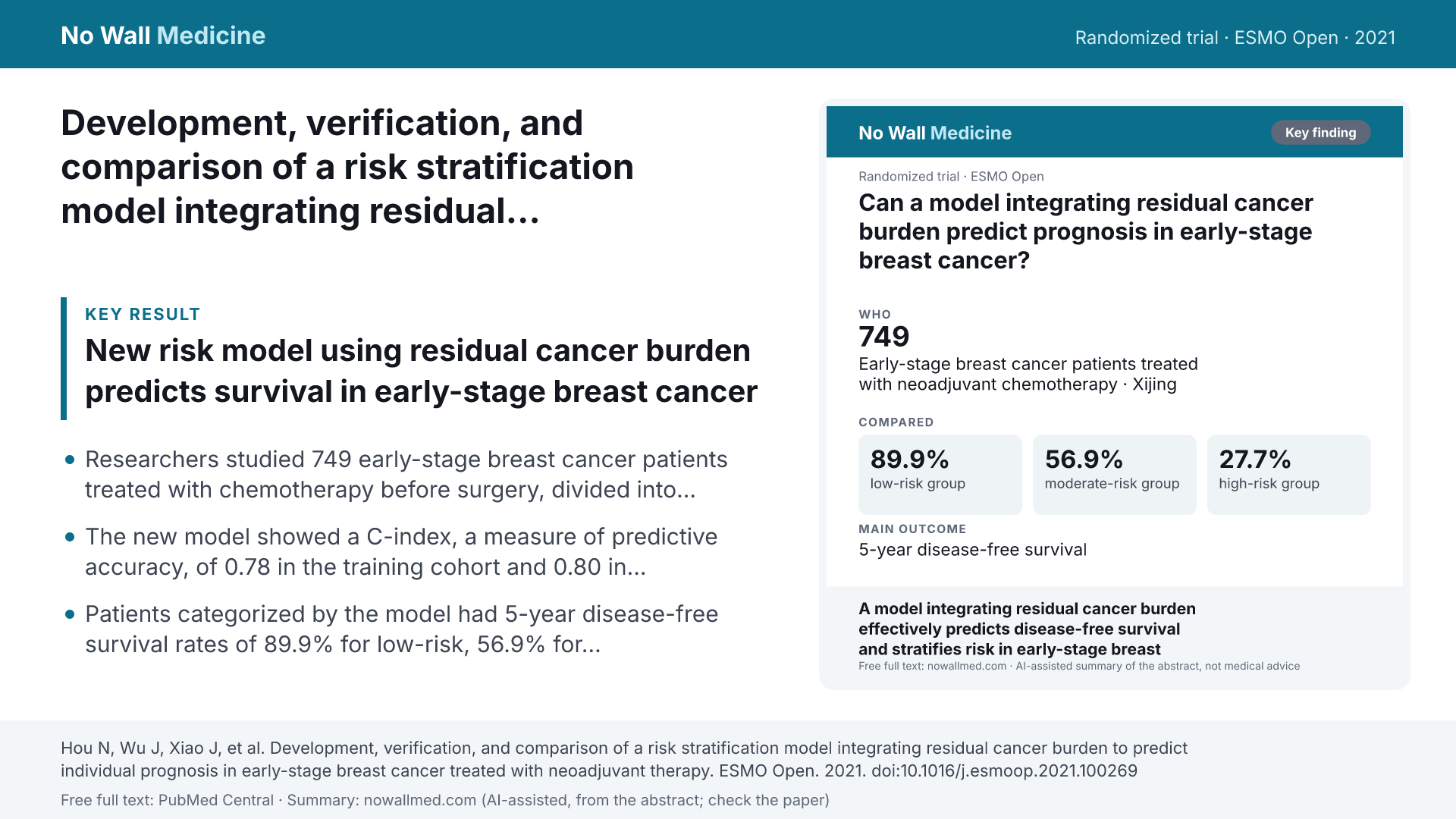
Key result: New risk model using residual cancer burden predicts survival in early-stage breast cancer
Key points
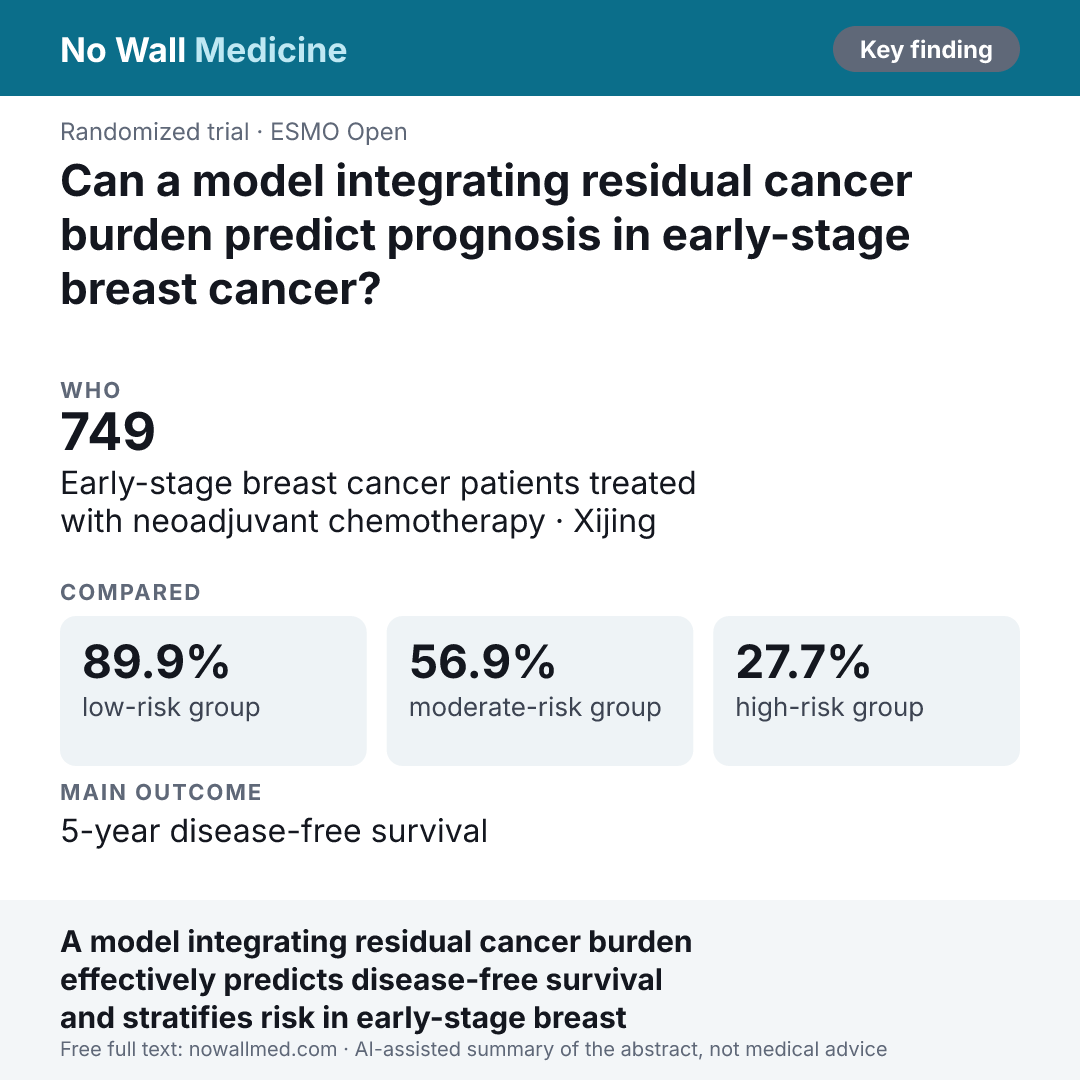
- Researchers studied 749 early-stage breast cancer patients treated with chemotherapy before surgery, divided into a training group of 563 and a validation group of 186.
- The new model showed a C-index, a measure of predictive accuracy, of 0.78 in the training cohort and 0.80 in the independent cohort.
- Patients categorized by the model had 5-year disease-free survival rates of 89.9% for low-risk, 56.9% for moderate-risk, and 27.7% for high-risk groups.
Why it matters: A model for predicting disease-free survival and stratifying prognostic risk in breast cancer patients treated with chemotherapy before surgery is lacking.
Discussion prompts
- Would these patients look like yours? Who was left out?
- Is the main outcome one that matters to patients?
- Is the difference large enough to change what you do?
Cite: Hou N, Wu J, Xiao J, et al. Development, verification, and comparison of a risk stratification model integrating residual cancer burden to predict individual prognosis in early-stage breast cancer treated with neoadjuvant therapy. ESMO Open. 2021. doi:10.1016/j.esmoop.2021.100269
Free full text: PubMed Central · Summary and visual abstract: nowallmed.com/a/development-verification-and-comparison-of-a-risk-stratification-1eejgy1/ (AI-assisted from the abstract; check the paper before relying on it).