New risk model using residual cancer burden predicts survival in early-stage breast cancer
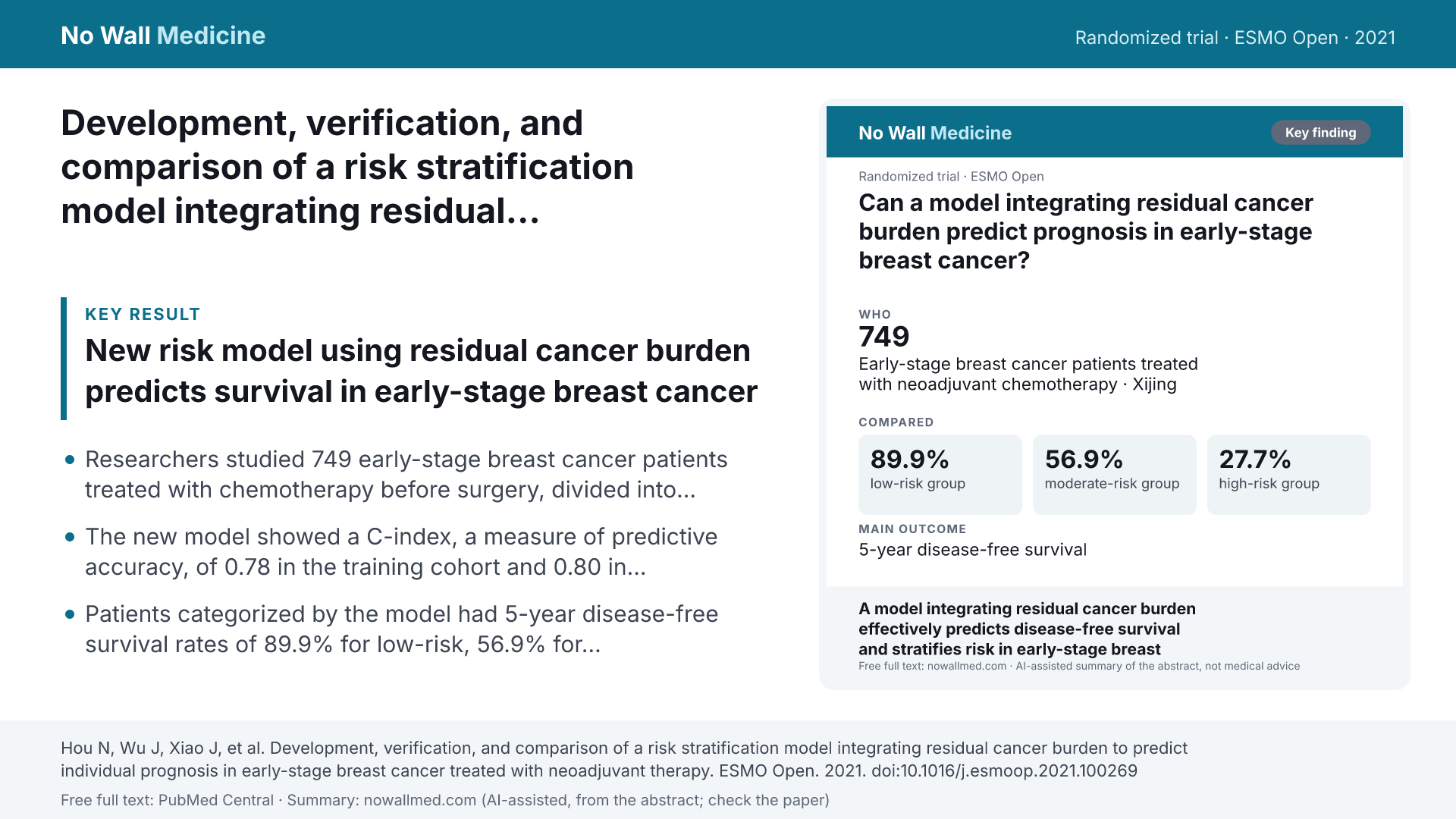
Development, verification, and comparison of a risk stratification model integrating residual cancer burden to predict individual prognosis in early-stage breast cancer treated with neoadjuvant therapy
Randomized trialKey finding
Can a model integrating residual cancer burden predict prognosis in early-stage breast cancer?
Who
749
Early-stage breast cancer patients treated with neoadjuvant chemotherapy · Xijing hospital
Compared
89.9%low-risk group
56.9%moderate-risk group
27.7%high-risk group
Main outcome
5-year disease-free survival
Bottom line: A model integrating residual cancer burden effectively predicts disease-free survival and stratifies risk in early-stage breast cancer.
ESMO Open · 2021-09-16 · Save PNG
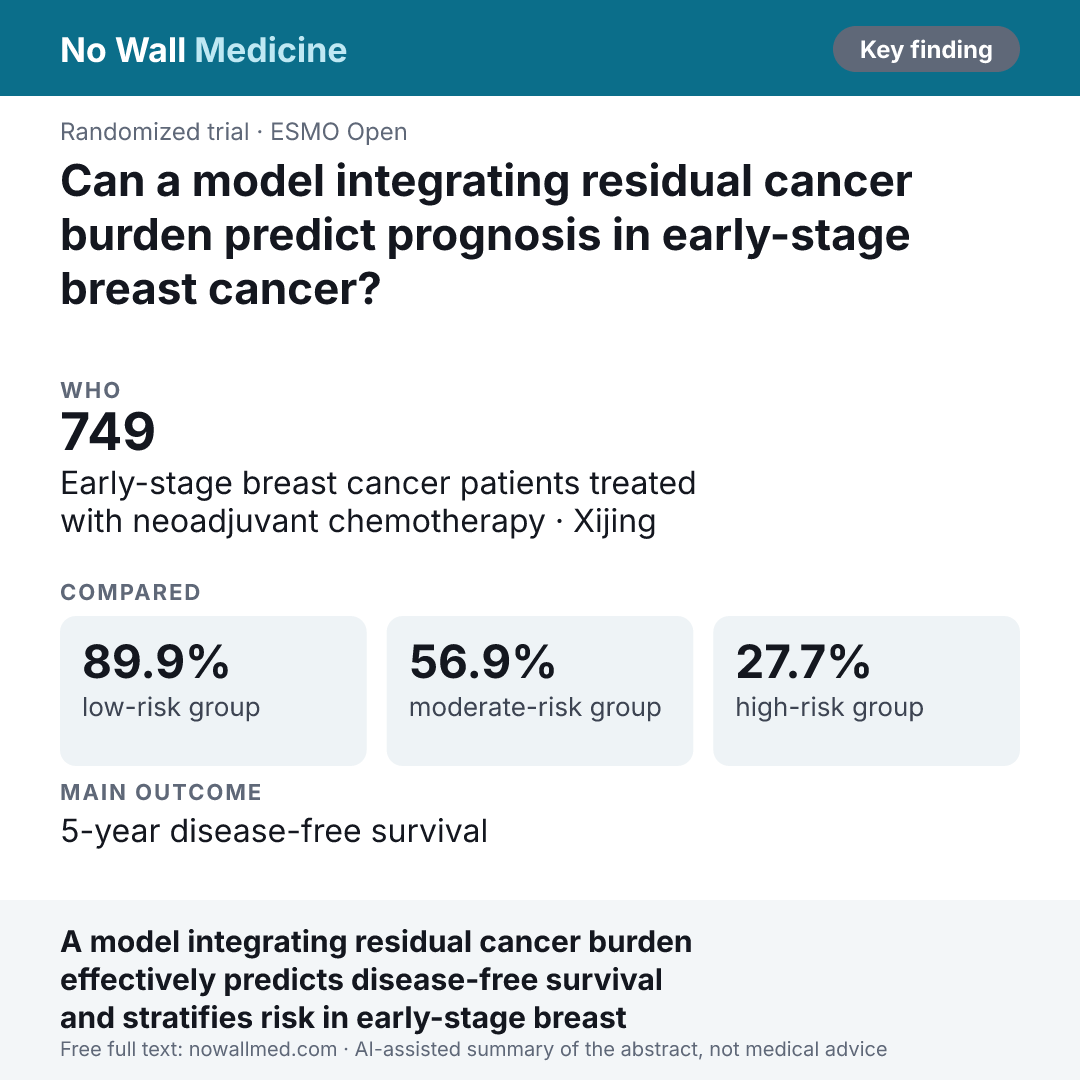
Clinical question: Can a model integrating residual cancer burden predict prognosis in early-stage breast cancer?
Why it matters: A model for predicting disease-free survival and stratifying prognostic risk in breast cancer patients treated with chemotherapy before surgery is lacking.
Key points
- Researchers studied 749 early-stage breast cancer patients treated with chemotherapy before surgery, divided into a training group of 563 and a validation group of 186.
- The new model showed a C-index, a measure of predictive accuracy, of 0.78 in the training cohort and 0.80 in the independent cohort.
- Patients categorized by the model had 5-year disease-free survival rates of 89.9% for low-risk, 56.9% for moderate-risk, and 27.7% for high-risk groups.
Headline and key points written with AI from the paper’s abstract, with every number checked against it. Read the paper before relying on them.
Was this summary helpful?
Subject terms
Headline, design, result, key points, caveat and citation as plain text.
Cite this article
Hou N, Wu J, Xiao J, et al. Development, verification, and comparison of a risk stratification model integrating residual cancer burden to predict individual prognosis in early-stage breast cancer treated with neoadjuvant therapy. ESMO Open. 2021. doi:10.1016/j.esmoop.2021.100269
Spotted a mistake? Suggest a correction