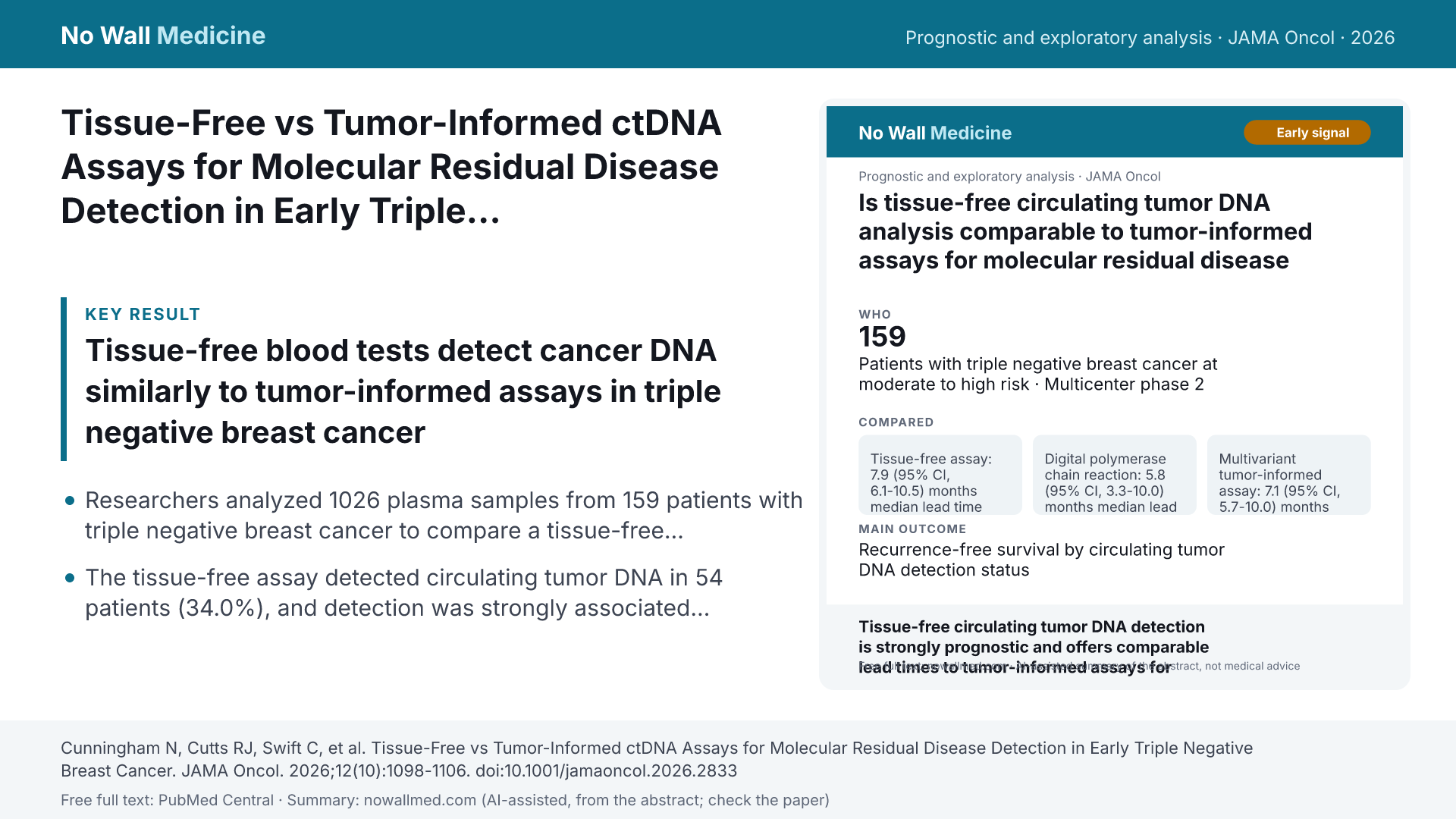
Tissue-free blood tests detect cancer DNA similarly to tumor-informed assays in triple negative breast cancer
Tissue-Free vs Tumor-Informed ctDNA Assays for Molecular Residual Disease Detection in Early Triple Negative Breast Cancer
Prognostic and exploratory analysisEarly signal
Is tissue-free circulating tumor DNA analysis comparable to tumor-informed assays for molecular residual disease detection?
Who
159
Patients with triple negative breast cancer at moderate to high risk · Multicenter phase 2 clinical study
Compared
Tissue-free assay: 7.9 (95% CI, 6.1-10.5) months median lead time
Digital polymerase chain reaction: 5.8 (95% CI, 3.3-10.0) months median lead time
Multivariant tumor-informed assay: 7.1 (95% CI, 5.7-10.0) months median lead time
Main outcome
Recurrence-free survival by circulating tumor DNA detection status
Result: hazard ratio 0.57 (95% CI, 0.34-0.95) for tissue-free vs dPCR
Bottom line: Tissue-free circulating tumor DNA detection is strongly prognostic and offers comparable lead times to tumor-informed assays for recurrence.
JAMA Oncol · 2026-08-13 · Save PNG
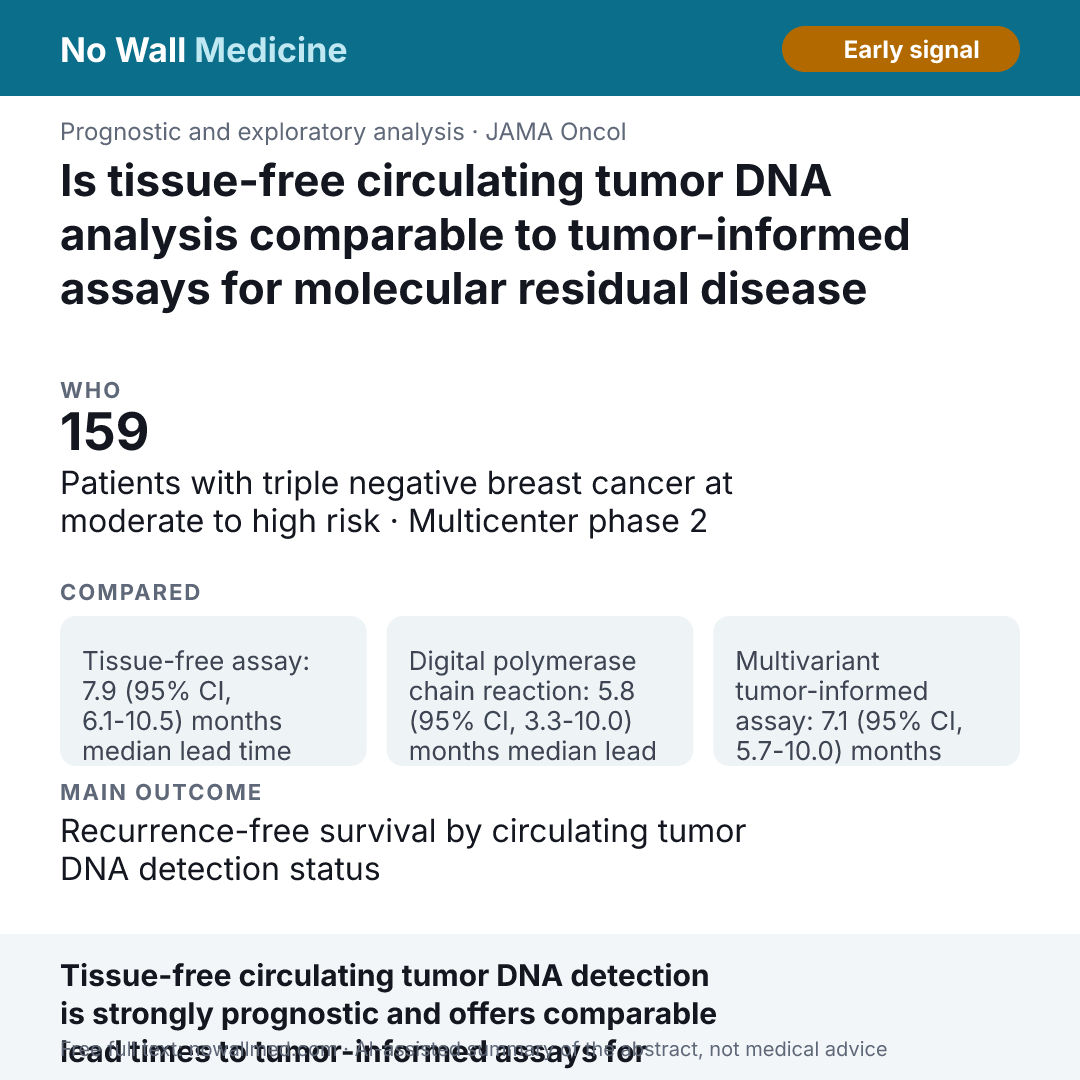
Clinical question: Is tissue-free circulating tumor DNA analysis comparable to tumor-informed assays for molecular residual disease detection?
Why it matters: Most evidence for detecting molecular residual disease comes from tumor-informed assays that require sequencing the primary tumor, which may complicate clinical workflows.
Key points
- Researchers analyzed 1026 plasma samples from 159 patients with triple negative breast cancer to compare a tissue-free assay against tumor-informed methods.
- The tissue-free assay detected circulating tumor DNA in 54 patients (34.0%), and detection was strongly associated with the risk of cancer recurrence.
- The tissue-free assay showed a median lead time to recurrence of 7.6 months compared to 7.1 months for the multivariant tumor-informed assay.
Headline and key points written with AI from the paper’s abstract, with every number checked against it. Read the paper before relying on them.
Was this summary helpful?
Subject terms
Headline, design, result, key points, caveat and citation as plain text.
Cite this article
Cunningham N, Cutts RJ, Swift C, et al. Tissue-Free vs Tumor-Informed ctDNA Assays for Molecular Residual Disease Detection in Early Triple Negative Breast Cancer. JAMA Oncol. 2026;12(10):1098-1106. doi:10.1001/jamaoncol.2026.2833
Spotted a mistake? Suggest a correction