Artificial intelligence shows high accuracy in detecting oral cancer and potentially malignant disorders
Diagnostic accuracy of artificial intelligence assisted clinical imaging in the detection of oral potentially malignant disorders and oral cancer: a systematic review and meta-analysis
Systematic review and meta-analysisBenefit found
How accurate is artificial intelligence in detecting oral potentially malignant disorders and oral cancer?
Who
Patients with oral potentially malignant disorders and oral cancerous lesions
Compared
Artificial intelligence screening: sensitivity 89.9% (95% CI 0.866-0.925)
Normal mucosa
Main outcome
Diagnostic accuracy of artificial intelligence algorithms
Result: diagnostic odds ratio 68.438 (95% CI 39.484-118.623)
Bottom line: Artificial intelligence shows excellent diagnostic performance for detecting oral potentially malignant disorders and oral cancer.
Int J Surg · 2024-08-01Download image
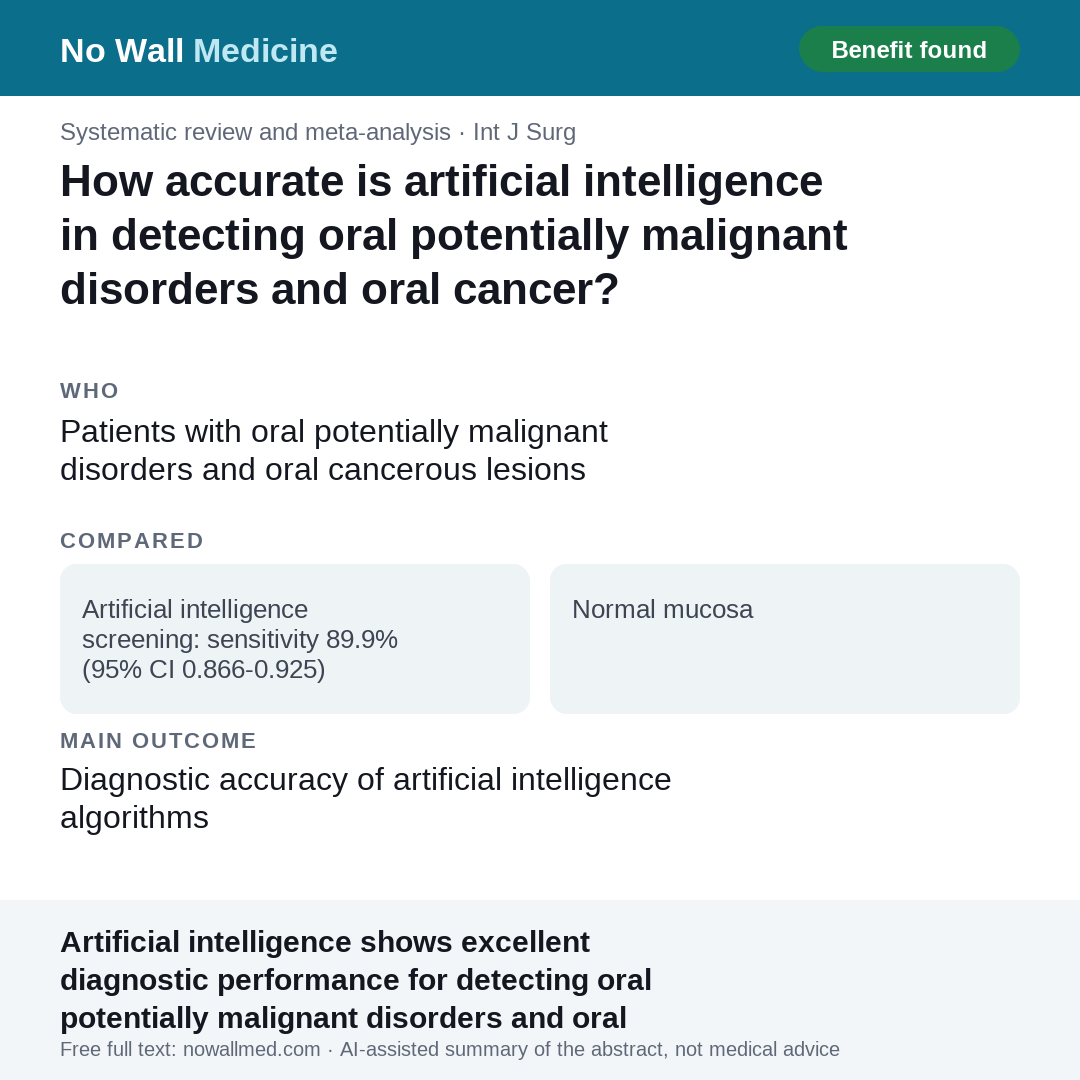
Clinical question: How accurate is artificial intelligence in detecting oral potentially malignant disorders and oral cancer?
Why it matters: The diagnostic accuracy of different artificial intelligence imaging tools for detecting oral potentially malignant disorders and oral cancer was not fully established.
Key points
- Researchers performed a systematic review and meta-analysis of studies using machine learning algorithms to identify oral potentially malignant disorders and oral mucosal cancerous lesions.
- The AI-assisted screening showed a sensitivity of 89.9%, a specificity of 89.2%, and a negative predictive value of 89.5%.
- Subgroup analysis indicated that clinical photography, which uses standard photos, had the highest diagnostic accuracy among the imaging tools studied.
Headline and key points written with AI from the paper’s abstract, with every number checked against it. Read the paper before relying on them.
Topics
Cite this article
Li J, Kot WY, McGrath CP, Chan BWA, Ho JWK, Zheng LW. Diagnostic accuracy of artificial intelligence assisted clinical imaging in the detection of oral potentially malignant disorders and oral cancer: a systematic review and meta-analysis. Int J Surg. 2024. doi:10.1097/JS9.0000000000001469
Spotted a mistake? Suggest a correction
Top studies every Monday
The week’s key trials and guidelines in your specialties, plus any topics you follow. By email, free.
Get the weekly digest