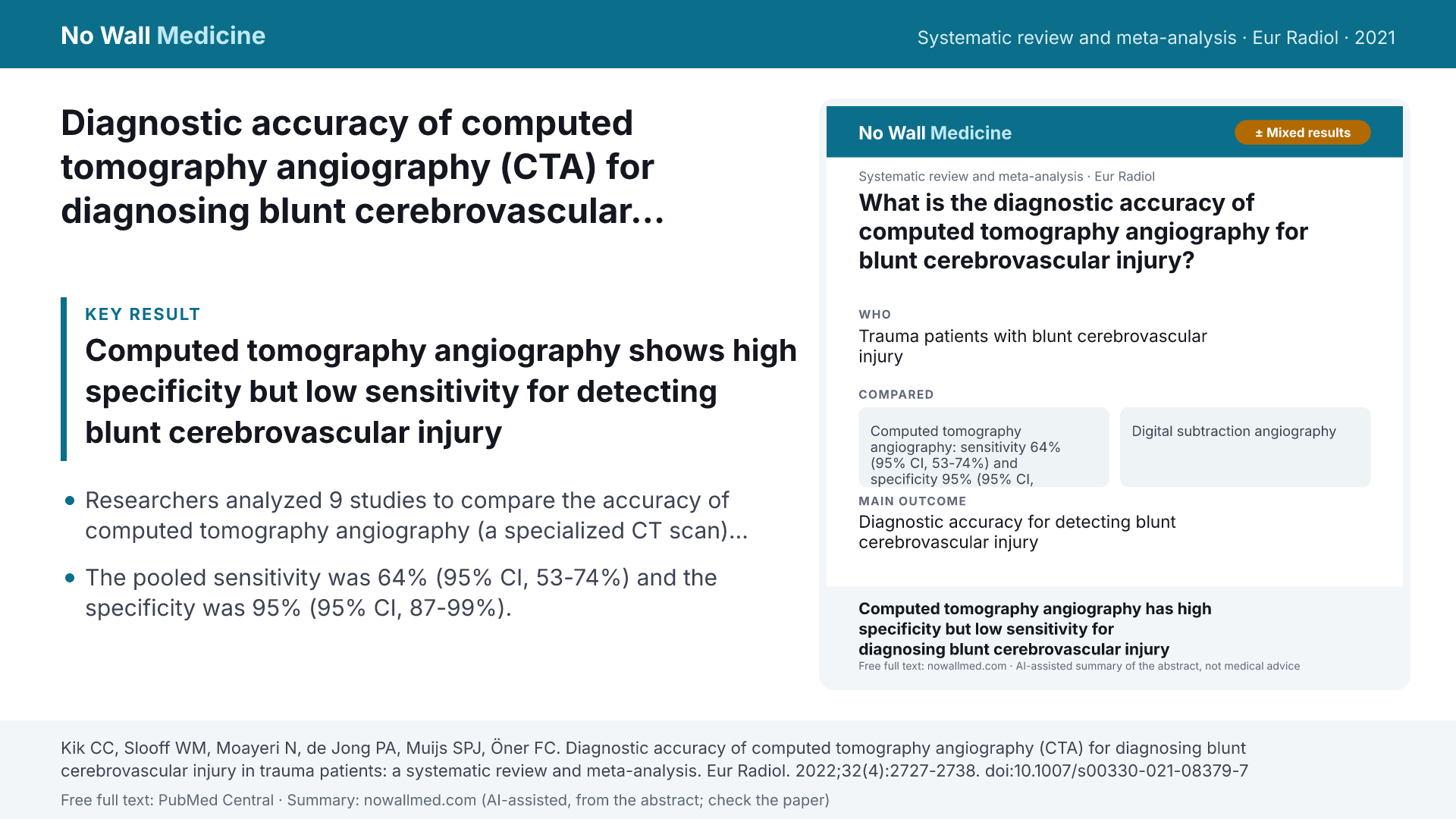
Diagnostic accuracy of computed tomography angiography (CTA) for diagnosing blunt cerebrovascular injury in trauma patients: a systematic review and meta-analysis
Key result: Computed tomography angiography shows high specificity but low sensitivity for detecting blunt cerebrovascular injury
Systematic review and meta-analysisMixed results
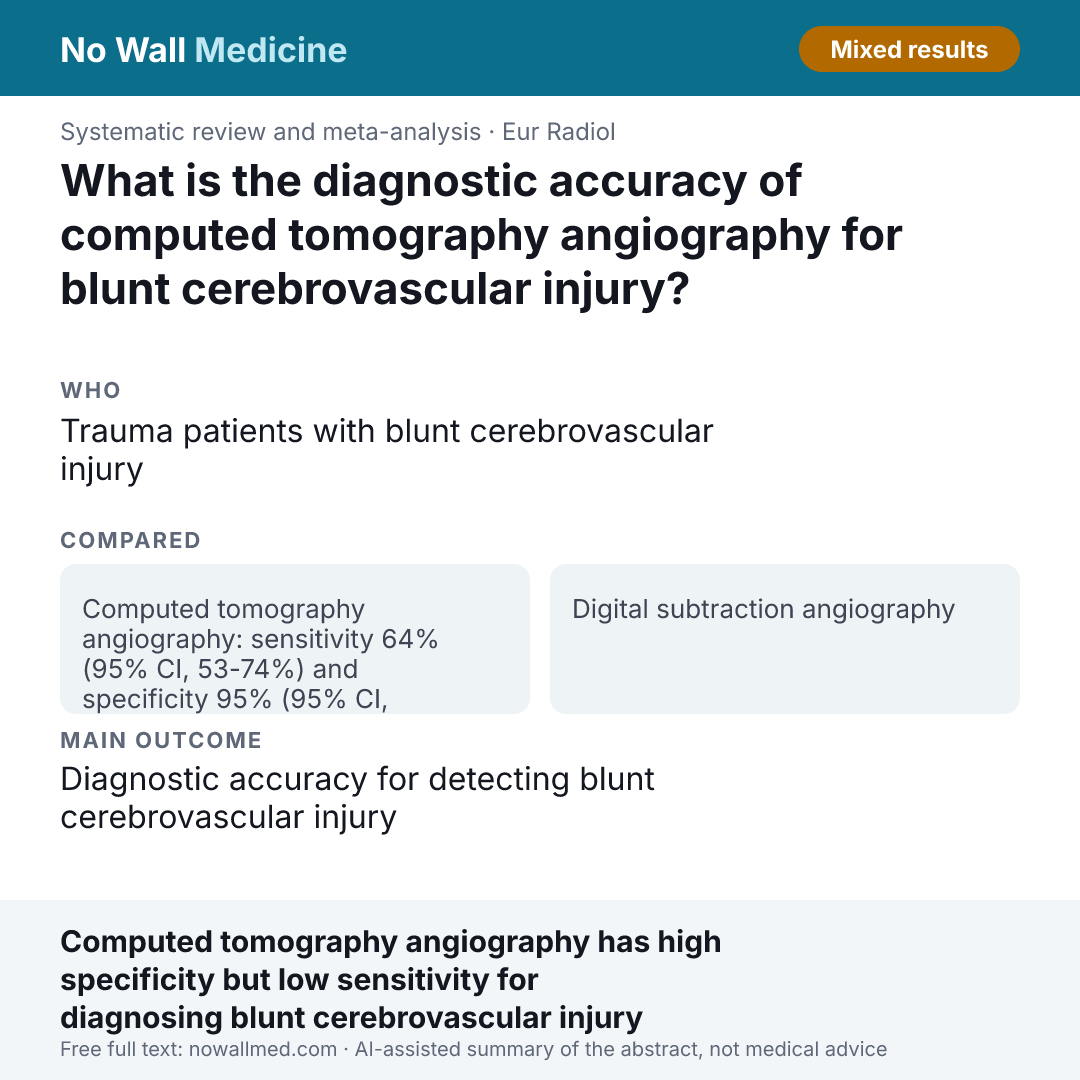
What is the diagnostic accuracy of computed tomography angiography for blunt cerebrovascular injury?
Who
Trauma patients with blunt cerebrovascular injury
Compared
Computed tomography angiography: sensitivity 64% (95% CI, 53-74%) and specificity 95% (95% CI, 87-99%)
Digital subtraction angiography
Main outcome
Diagnostic accuracy for detecting blunt cerebrovascular injury
Result: diagnostic odds ratio 31 (95%, 17-56)
Bottom line: Computed tomography angiography has high specificity but low sensitivity for diagnosing blunt cerebrovascular injury compared to digital subtraction angiography.
Eur Radiol · 2021-12-02 · Save PNG
Key points
- Researchers analyzed 9 studies to compare the accuracy of computed tomography angiography (a specialized CT scan) against digital subtraction angiography (the gold standard imaging test) for blunt cerebrovascular injury.
- The pooled sensitivity was 64% (95% CI, 53-74%) and the specificity was 95% (95% CI, 87-99%).
- Increasing the number of detector channels to 64 slices did not result in higher sensitivity for detecting these injuries.
Discussion prompts
- Would these patients look like yours? Who was left out?
- Is the main outcome one that matters to patients?
- Is the difference large enough to change what you do?
Cite: Kik CC, Slooff WM, Moayeri N, de Jong PA, Muijs SPJ, Öner FC. Diagnostic accuracy of computed tomography angiography (CTA) for diagnosing blunt cerebrovascular injury in trauma patients: a systematic review and meta-analysis. Eur Radiol. 2022;32(4):2727-2738. doi:10.1007/s00330-021-08379-7
Free full text: PubMed Central · Summary and visual abstract: nowallmed.com/a/diagnostic-accuracy-of-computed-tomography-angiography-cta-for-6tz6cu/ (AI-assisted from the abstract; check the paper before relying on it).