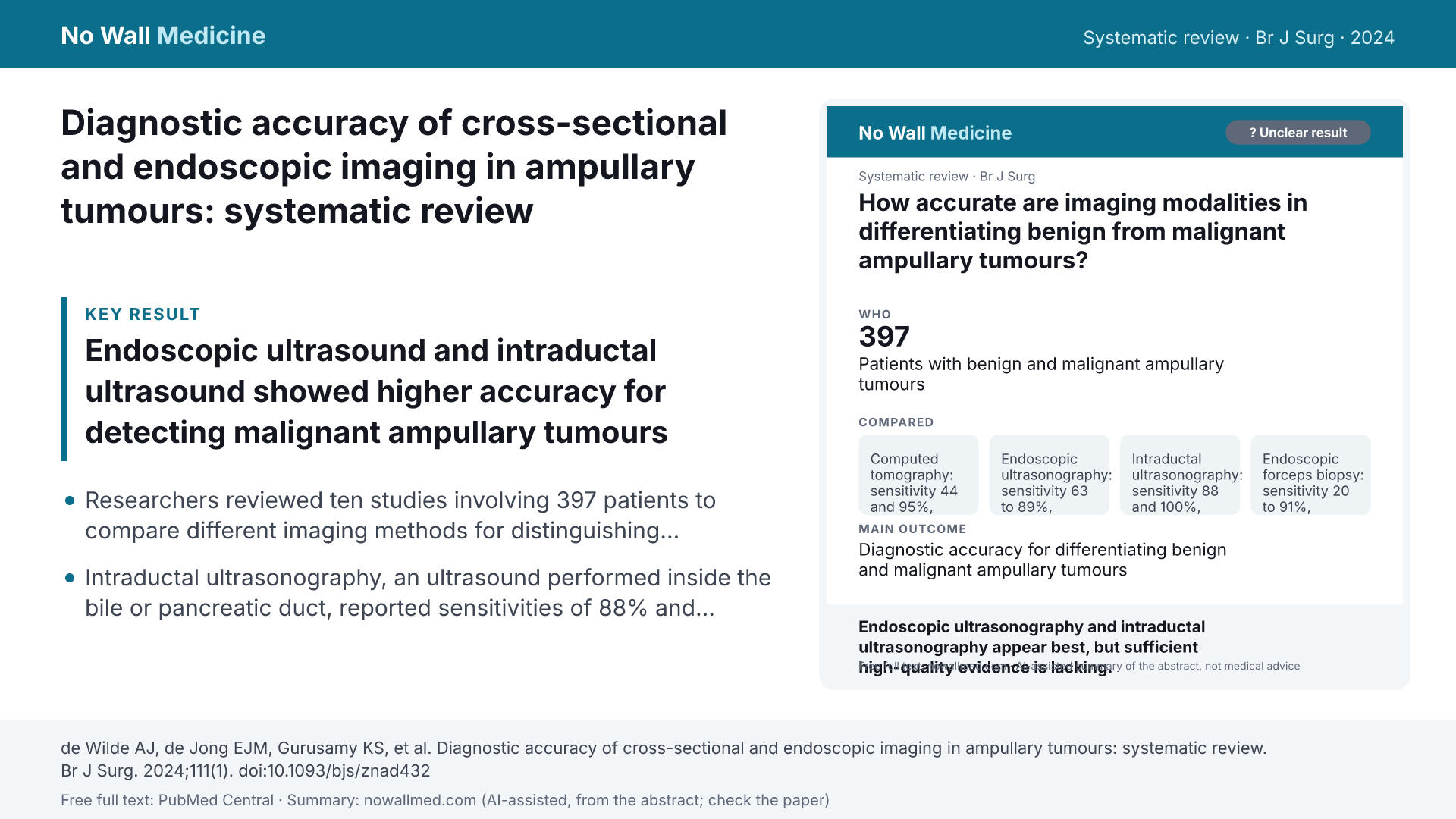
Endoscopic ultrasound and intraductal ultrasound showed higher accuracy for detecting malignant ampullary tumours
Diagnostic accuracy of cross-sectional and endoscopic imaging in ampullary tumours: systematic review
Systematic reviewUnclear result
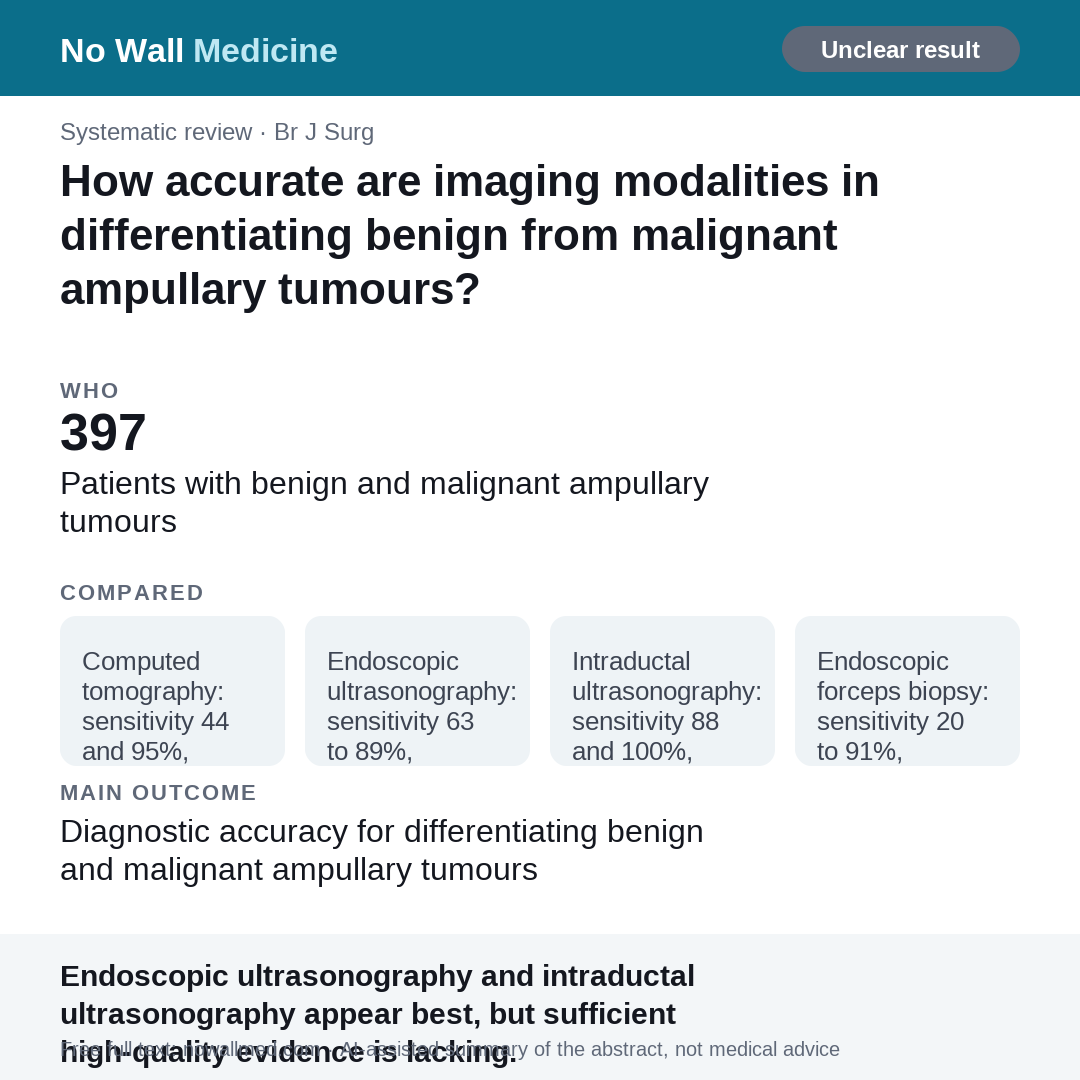
How accurate are imaging modalities in differentiating benign from malignant ampullary tumours?
Who
397
Patients with benign and malignant ampullary tumours
Compared
Computed tomography: sensitivity 44 and 95%, specificity 58 and 60%
Endoscopic ultrasonography: sensitivity 63 to 89%, specificity 50 to 100%
Intraductal ultrasonography: sensitivity 88 and 100%, specificity 75 and 93%
Endoscopic forceps biopsy: sensitivity 20 to 91%, specificity 75 to 86%
Main outcome
Diagnostic accuracy for differentiating benign and malignant ampullary tumours
Bottom line: Endoscopic ultrasonography and intraductal ultrasonography appear best, but sufficient high-quality evidence is lacking.
Limitation: The overall risk of bias was moderate to poor and data were insufficient for meta-analysis.
Br J Surg · 2024-01-10Download image
Clinical question: How accurate are imaging modalities in differentiating benign from malignant ampullary tumours?
Why it matters: It is difficult to differentiate between benign adenomas and malignant carcinomas of the ampulla of Vater to determine proper therapy and prognosis.
Key points
- Researchers reviewed ten studies involving 397 patients to compare different imaging methods for distinguishing benign from malignant tumours of the ampulla of Vater.
- Intraductal ultrasonography, an ultrasound performed inside the bile or pancreatic duct, reported sensitivities of 88% and 100% with specificities of 75% and 93%.
- Endoscopic ultrasonography, an ultrasound using a scope in the digestive tract, showed sensitivities between 63% and 89% and specificities between 50% and 100%.
Limitation the authors note: The overall risk of bias in the included studies was scored as moderate to poor.
Headline and key points written with AI from the paper’s abstract, with every number checked against it. Read the paper before relying on them.
Was this summary helpful?
Subject terms
Headline, design, result, key points, caveat and citation as plain text.
Cite this article
de Wilde AJ, de Jong EJM, Gurusamy KS, et al. Diagnostic accuracy of cross-sectional and endoscopic imaging in ampullary tumours: systematic review. Br J Surg. 2024. doi:10.1093/bjs/znad432
Spotted a mistake? Suggest a correction