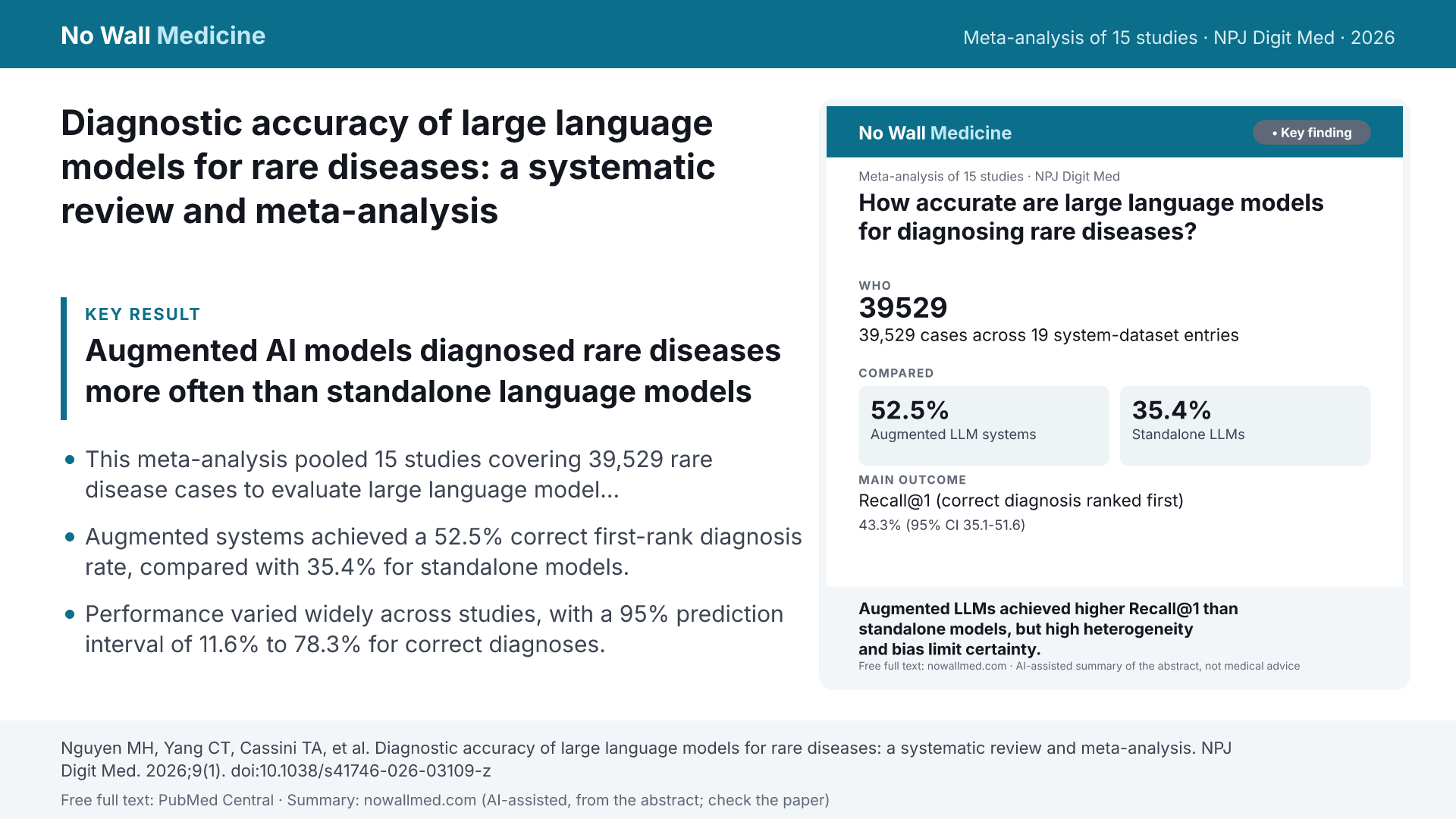
Diagnostic accuracy of large language models for rare diseases: a systematic review and meta-analysis
Meta-analysis of 15 studiesKey finding
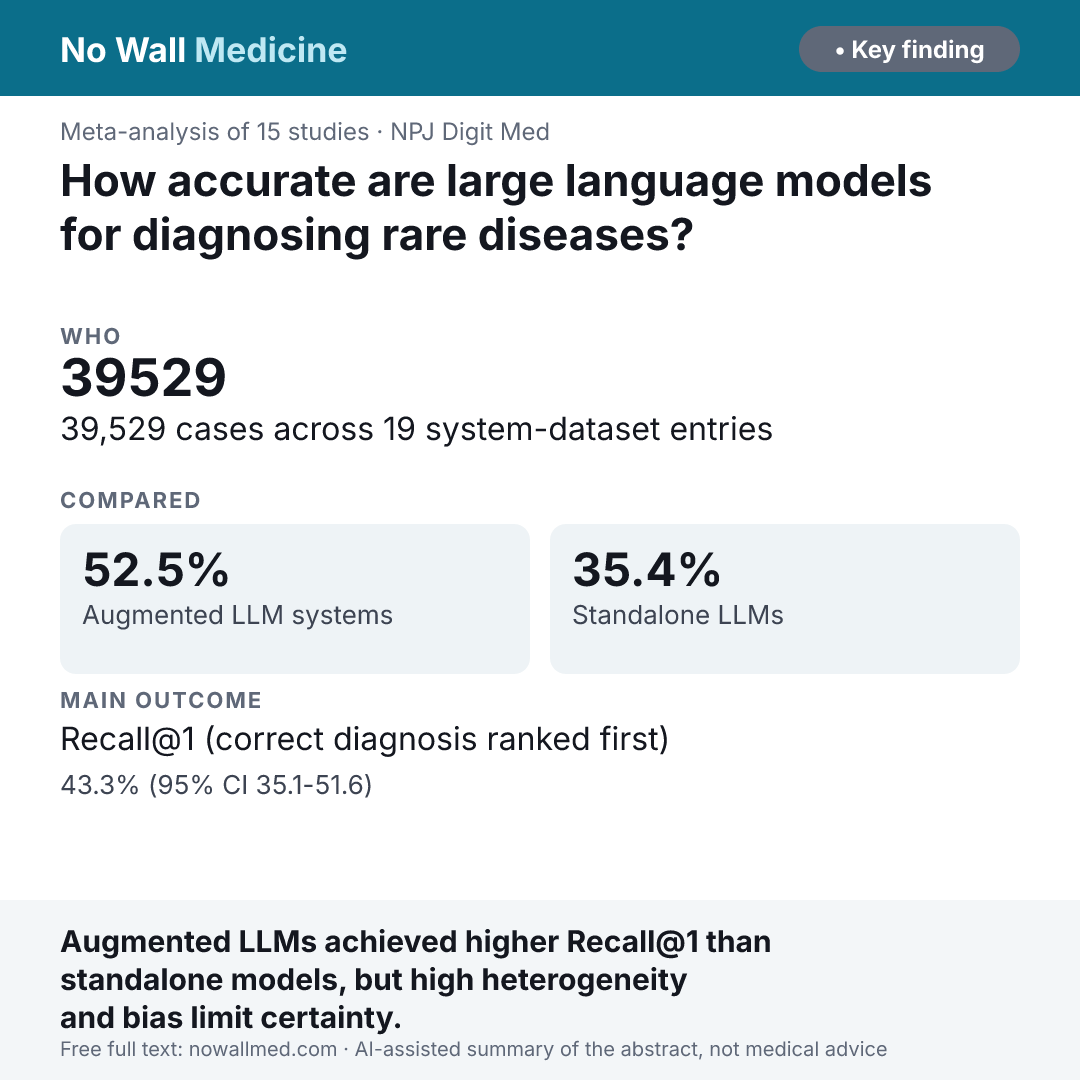
How accurate are large language models for diagnosing rare diseases?
Who
39529
39,529 cases across 19 system-dataset entries
Compared
52.5%Augmented LLM systems (42.0-62.9)
35.4%Standalone LLMs (30.6-40.4)
Main outcome
Recall@1 (correct diagnosis ranked first)
Result: 43.3% (95% CI 35.1-51.6)
Bottom line: Augmented LLMs achieved higher Recall@1 than standalone models, but high heterogeneity and bias limit certainty.
Limitation: High risk of bias due to data leakage with retrospective testing
NPJ Digit Med · 2026-08-12 · Save PNG
Clinical question: How accurate are large language models for diagnosing rare diseases?
Abstract
Large language models (LLMs) have been evaluated as tools to assist rare disease diagnosis, yet evidence on their accuracy remains fragmented. We conducted a systematic review and meta-analysis, searching six databases (PubMed, Embase, Web of Science, Cochrane Library, arXiv, and medRxiv; January 2020-February 2026) to synthesise the diagnostic performance of LLM-based systems for rare diseases. We identified 15 eligible studies contributing 19 system-dataset entries (total N = 39,529 cases). We calculated pooled Recall@1 (R@1; proportion with the correct diagnosis ranked first) was 43.3% (95% CI 35.1-51.6), with extreme heterogeneity I2 = 99.6%, and a 95% prediction interval of 11.6-78.3%, indicating that R@1 in a new evaluation setting could plausibly differ widely from the pooled mean. Augmented LLM systems incorporating retrieval, agent-based reasoning, or fine-tuning (k = 8) achieved R@1 of 52.5% (42.0-62.9) versus 35.4% (30.6-40.4) for standalone LLMs (k = 11; p = 0.004); this subgroup contrast, like the overall pooled estimate, should be interpreted descriptively, as substantial heterogeneity persisted within both subgroups (I2 > 95%). Post-hoc exploratory analysis indicated that evaluation benchmark disease composition was associated with performance differences: R@1 was lower on the Phenopacket Store than on RareBench, p < 0.001. These findings demonstrate the potential of LLM-based diagnostic systems, particularly when augmented with external knowledge, while highlighting that disease-specific information availability-for which disease prevalence serves as one measurable proxy-moderates cross-benchmark performance. However, due to the high risk of bias due to data leakage with retrospective testing, prospective studies are needed to establish clinical utility, and future evaluations should adopt a contamination-aware design.
Headline, design, result, key points, caveat and citation as plain text.
Cite this article
Nguyen MH, Yang CT, Cassini TA, et al. Diagnostic accuracy of large language models for rare diseases: a systematic review and meta-analysis. NPJ Digit Med. 2026;9(1). doi:10.1038/s41746-026-03109-z
Spotted a mistake? Suggest a correction