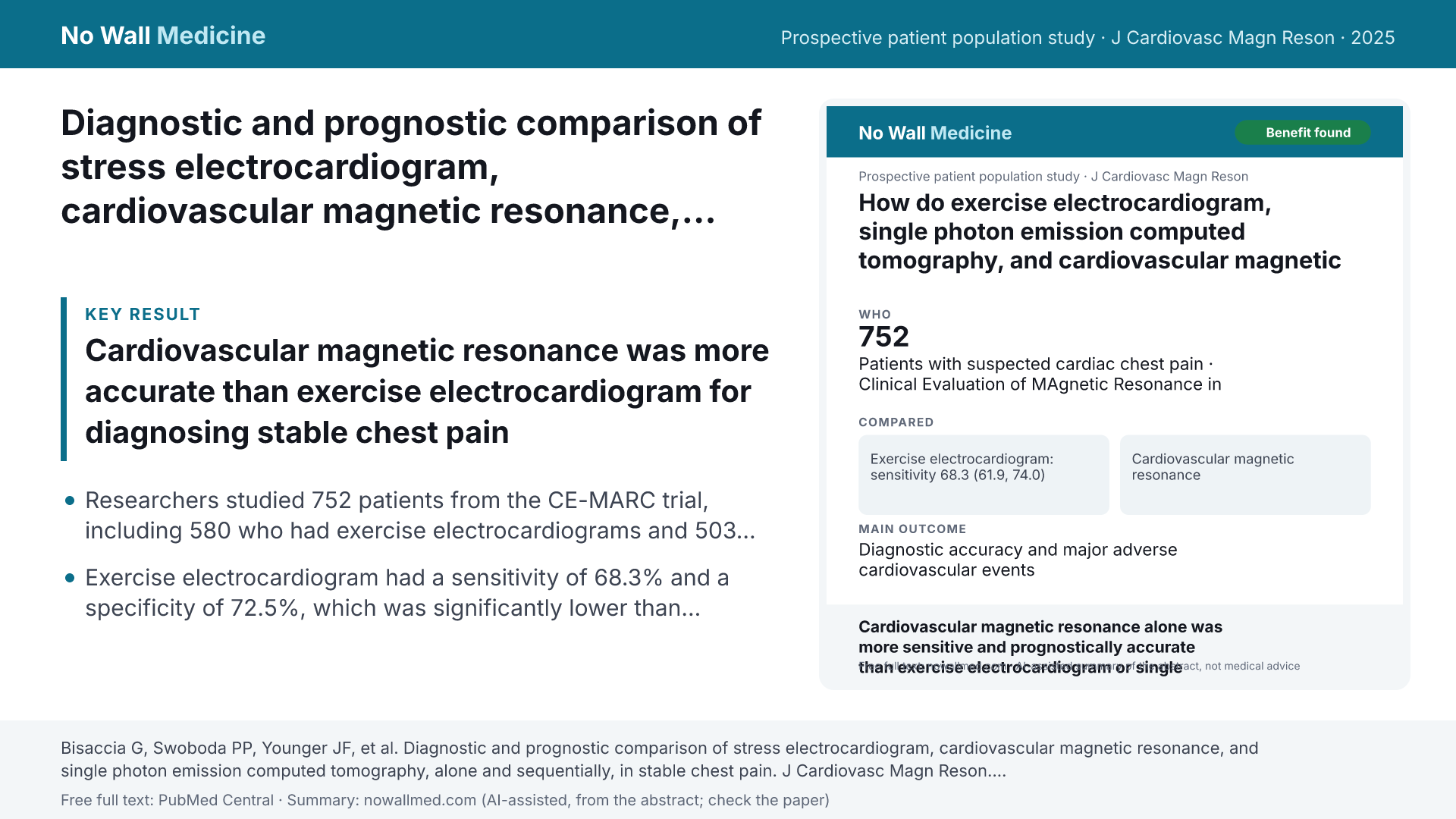
Diagnostic and prognostic comparison of stress electrocardiogram, cardiovascular magnetic resonance, and single photon emission computed tomography, alone and sequentially, in stable chest pain
Key result: Cardiovascular magnetic resonance was more accurate than exercise electrocardiogram for diagnosing stable chest pain
Prospective patient population studyBenefit found
How do exercise electrocardiogram, single photon emission computed tomography, and cardiovascular magnetic resonance compare?
Who
752
Patients with suspected cardiac chest pain · Clinical Evaluation of MAgnetic Resonance in Coronary heart disease trial
Compared
Exercise electrocardiogram: sensitivity 68.3 (61.9, 74.0)
Cardiovascular magnetic resonance
Main outcome
Diagnostic accuracy and major adverse cardiovascular events
Result: hazard ratio 1.14 [0.75, 1.72]
Bottom line: Cardiovascular magnetic resonance alone was more sensitive and prognostically accurate than exercise electrocardiogram or single photon emission computed tomography.
J Cardiovasc Magn Reson · 2025-09-15
Key points
- Researchers studied 752 patients from the CE-MARC trial, including 580 who had exercise electrocardiograms and 503 who also received single photon emission computed tomography and cardiovascular magnetic resonance.
- Exercise electrocardiogram had a sensitivity of 68.3% and a specificity of 72.5%, which was significantly lower than the results for cardiovascular magnetic resonance.
- A positive exercise electrocardiogram result was not predictive of major adverse cardiovascular events, which occurred in 15.7% of patients during follow-up.
Discussion prompts
- Would these patients look like yours? Who was left out?
- Is the main outcome one that matters to patients?
- Is the difference large enough to change what you do?
Cite: Bisaccia G, Swoboda PP, Younger JF, et al. Diagnostic and prognostic comparison of stress electrocardiogram, cardiovascular magnetic resonance, and single photon emission computed tomography, alone and sequentially, in stable chest pain. J Cardiovasc Magn Reson. 2025;27(2):101960. doi:10.1016/j.jocmr.2025.101960
Free full text: PubMed Central · Summary and visual abstract: nowallmed.com/a/diagnostic-and-prognostic-comparison-of-stress-electrocardiogram-399u2g/ (AI-assisted from the abstract; check the paper before relying on it).