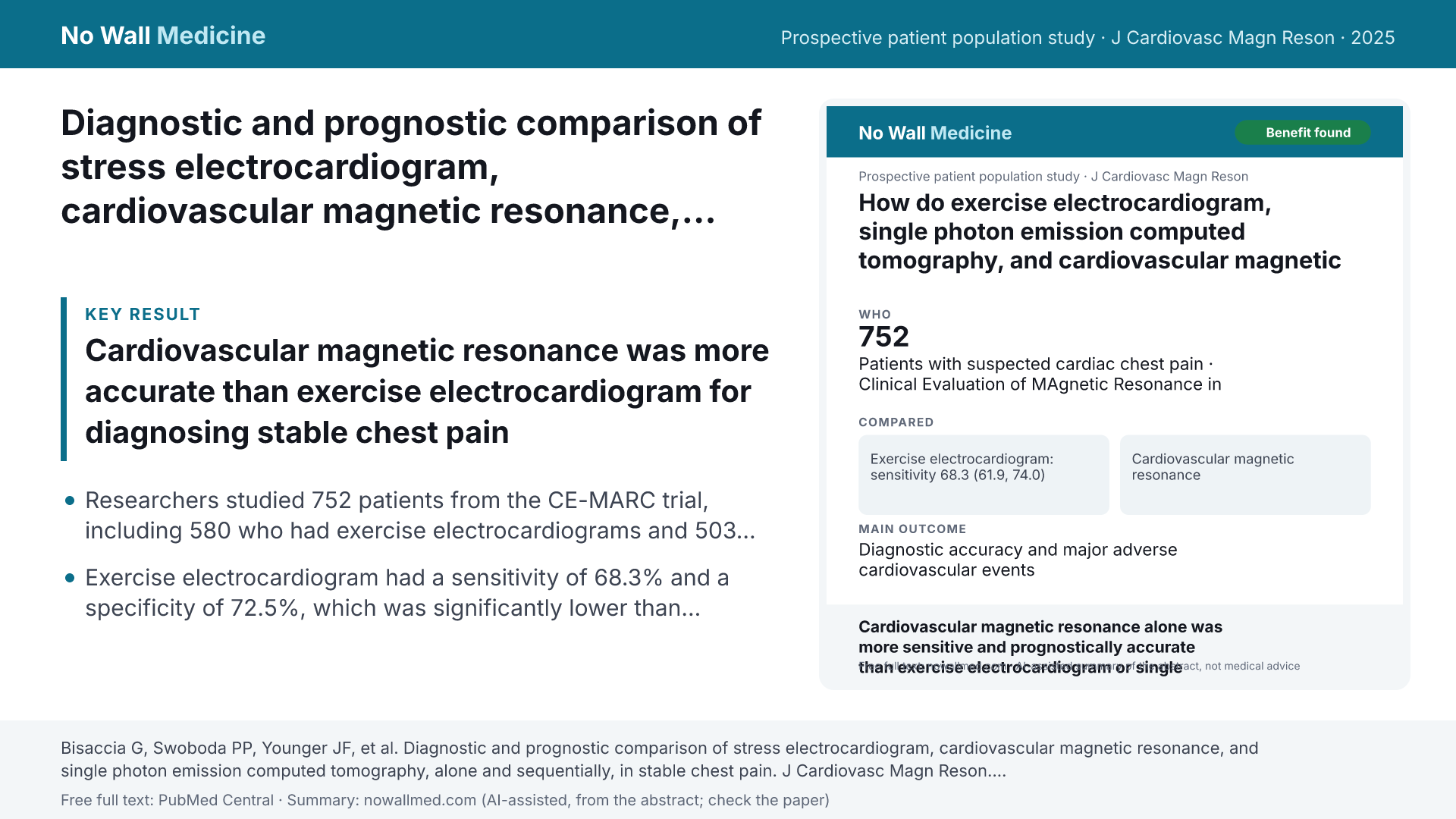
Cardiovascular magnetic resonance was more accurate than exercise electrocardiogram for diagnosing stable chest pain
Diagnostic and prognostic comparison of stress electrocardiogram, cardiovascular magnetic resonance, and single photon emission computed tomography, alone and sequentially, in stable chest pain
Prospective patient population studyBenefit found
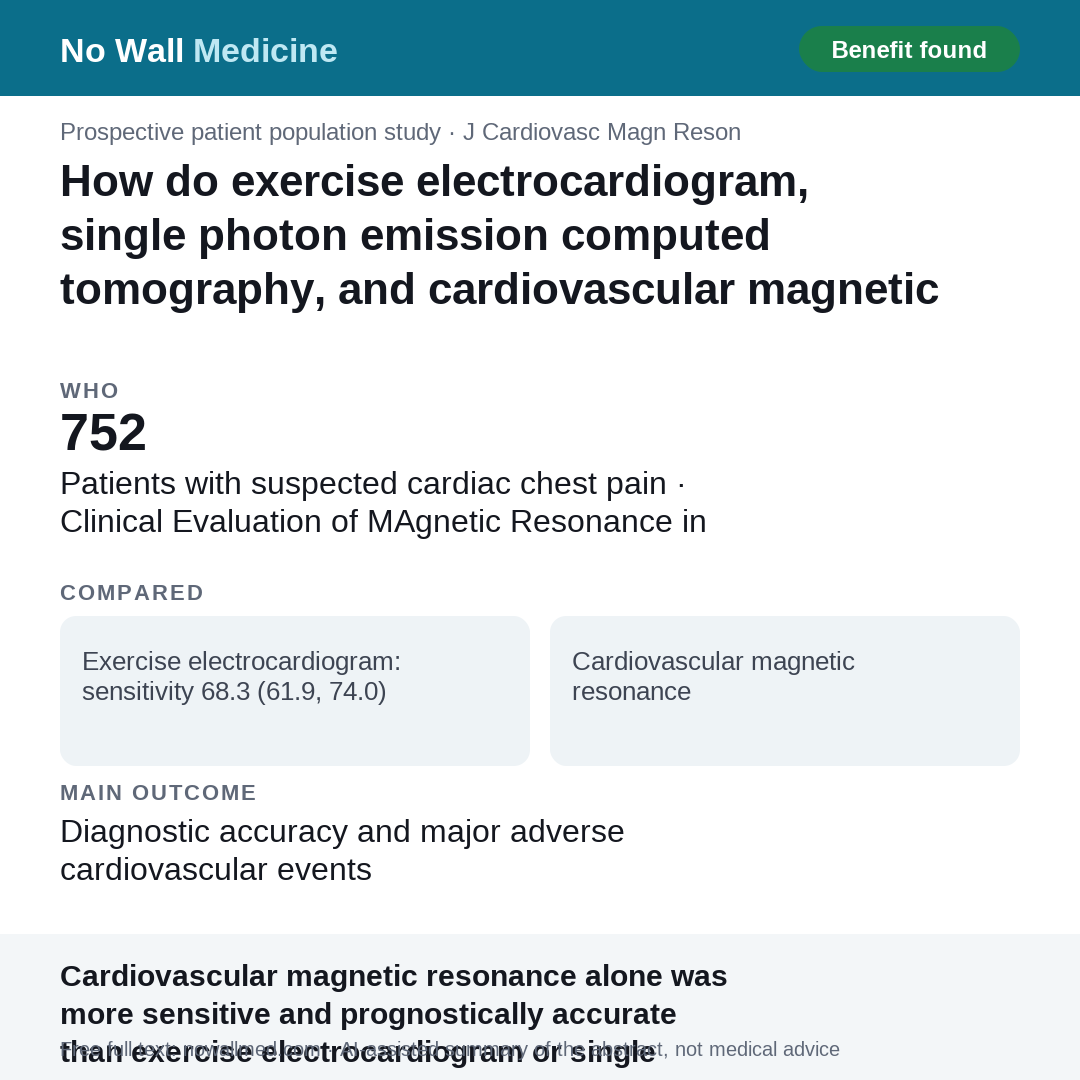
How do exercise electrocardiogram, single photon emission computed tomography, and cardiovascular magnetic resonance compare?
Who
752
Patients with suspected cardiac chest pain · Clinical Evaluation of MAgnetic Resonance in Coronary heart disease trial
Compared
Exercise electrocardiogram: sensitivity 68.3 (61.9, 74.0)
Cardiovascular magnetic resonance
Main outcome
Diagnostic accuracy and major adverse cardiovascular events
Result: hazard ratio 1.14 [0.75, 1.72]
Bottom line: Cardiovascular magnetic resonance alone was more sensitive and prognostically accurate than exercise electrocardiogram or single photon emission computed tomography.
J Cardiovasc Magn Reson · 2025-09-15Download image
Clinical question: How do exercise electrocardiogram, single photon emission computed tomography, and cardiovascular magnetic resonance compare?
Why it matters: It is unclear how exercise electrocardiograms compare to single photon emission computed tomography and cardiovascular magnetic resonance for diagnosing and predicting outcomes in patients with suspected angina.
Key points
- Researchers studied 752 patients from the CE-MARC trial, including 580 who had exercise electrocardiograms and 503 who also received single photon emission computed tomography and cardiovascular magnetic resonance.
- Exercise electrocardiogram had a sensitivity of 68.3% and a specificity of 72.5%, which was significantly lower than the results for cardiovascular magnetic resonance.
- A positive exercise electrocardiogram result was not predictive of major adverse cardiovascular events, which occurred in 15.7% of patients during follow-up.
Headline and key points written with AI from the paper’s abstract, with every number checked against it. Read the paper before relying on them.
Was this summary helpful?
Subject terms
Cite this article
Bisaccia G, Swoboda PP, Younger JF, et al. Diagnostic and prognostic comparison of stress electrocardiogram, cardiovascular magnetic resonance, and single photon emission computed tomography, alone and sequentially, in stable chest pain. J Cardiovasc Magn Reson. 2025. doi:10.1016/j.jocmr.2025.101960
Spotted a mistake? Suggest a correction