Anatomical testing did not improve outcomes over functional testing for coronary artery disease
Outcomes of anatomical versus functional testing for coronary artery disease
Why it matters: In stable chest pain, CT angiography did not improve clinical outcomes over functional stress testing at about two years.
Related landmark trials: SCOT-HEART
Context written by the No Wall Medicine team.
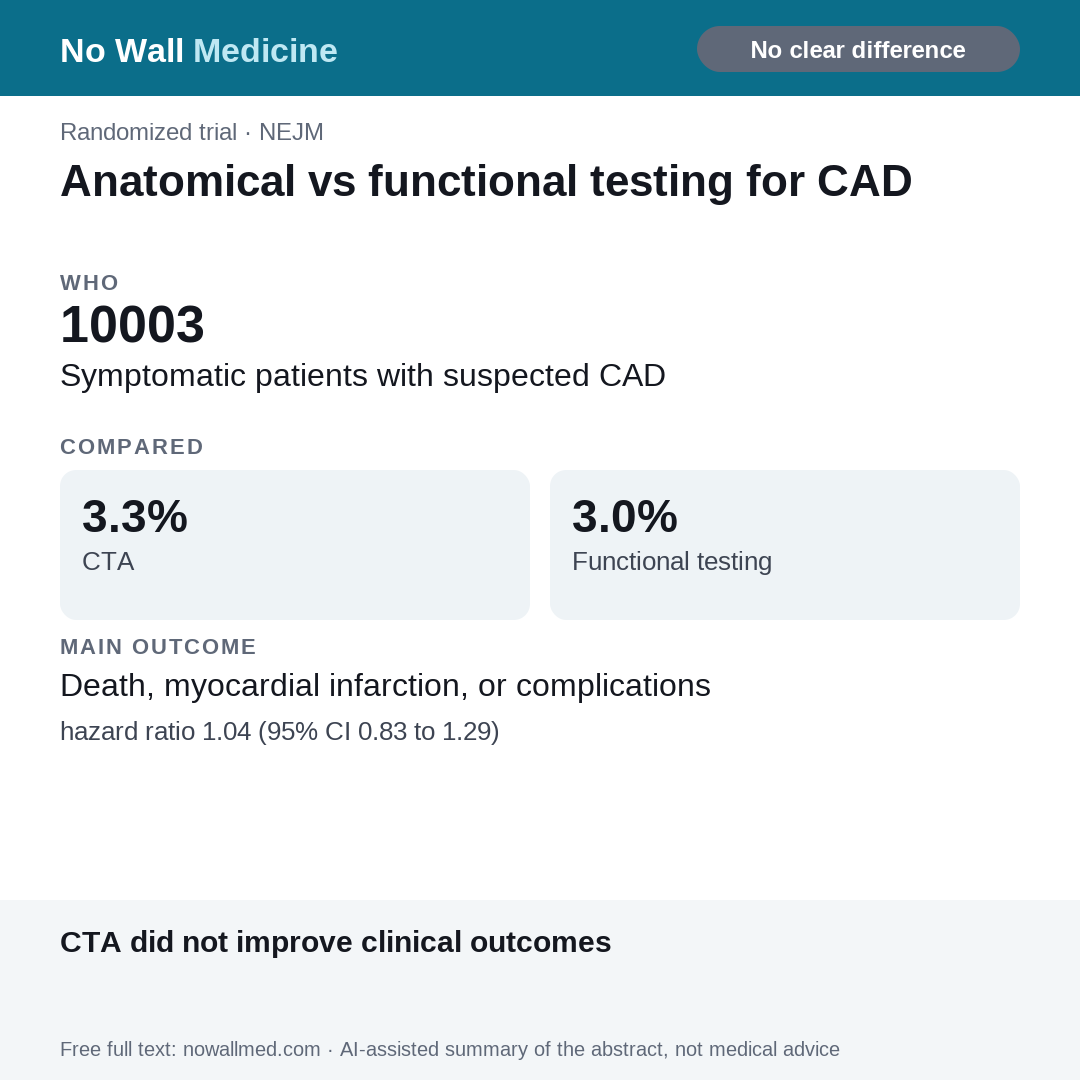
Randomized trialNo clear difference
Anatomical vs functional testing for CAD
Who
10003
Symptomatic patients with suspected CAD
Compared
3.3%CTA (164/4996)
3.0%Functional testing (151/5007)
Main outcome
Death, myocardial infarction, or complications
Result: hazard ratio 1.04 (95% CI 0.83 to 1.29)
Bottom line: CTA did not improve clinical outcomes
Funded by: National Heart, Lung, and Blood Institute
NEJM · 2015-03-14Download image
Trial at a glance
Bottom line: A strategy of initial coronary computed tomographic angiography, as compared with functional testing, did not improve clinical outcomes over a median follow-up of 25 months
Clinical question
Outcomes of anatomical versus functional testing for coronary artery disease
Design
Randomized trial. North America, 193 sites, 2010-2013
Who was studied
10,003 symptomatic patients with suspected coronary artery disease
Key inclusion criteria
- symptomatic outpatients without diagnosed CAD
- age of more than 54 years in men or more than 64 years in women
- nonurgent, noninvasive cardiovascular testing necessary for evaluation of suspected CAD
Key exclusion criteria
- unstable hemodynamic status or arrhythmias requiring urgent evaluation
- history of CAD or evaluation for CAD within the previous 12 months
- clinically significant congenital, valvular, or cardiomyopathic heart disease
Interventions
- CTA group: coronary computed tomographic angiography
- functional-testing group: exercise electrocardiography, nuclear stress testing, or stress echocardiography
Primary outcome
composite of death, myocardial infarction, hospitalization for unstable angina, or major procedural complication. 164 of 4996 patients in the CTA group (3.3%) and 151 of 5007 (3.0%) in the functional-testing group, adjusted hazard ratio 1.04
Secondary outcomes
- invasive cardiac catheterization showing no obstructive CAD: 3.4% vs. 4.3%, P = 0.02
- cumulative radiation exposure: median 10.0 mSv vs. 11.3 mSv
Harms
37 patients with mild safety events in the CTA group and 21 in the functional-testing group
Limitations reported by the authors
- limited data from randomized trials to guide care
- no interim analyses of primary and secondary end points performed
Funding
National Heart, Lung, and Blood Institute
Written with AI from the full paper; every number was checked against it. Read the paper before relying on it.
Key points
- 10,003 symptomatic patients were randomly assigned to anatomical or functional testing.
- 3.3% of anatomical testing patients had a primary end-point event, compared to 3.0% of functional testing patients.
- Anatomical testing was associated with fewer unnecessary catheterizations, but more overall radiation exposure.
Limitation the authors note: The study had a median follow-up period of 25 months, which may not capture long-term outcomes
Headline and key points written with AI from the paper’s abstract, with every number checked against it. Read the paper before relying on them.
Was this summary helpful?
Subject terms
Cite this article
Douglas PS, Hoffmann U, Patel MR, Mark DB, Al-Khalidi HR, Cavanaugh B. Outcomes of anatomical versus functional testing for coronary artery disease. NEJM. 2015. doi:10.1056/NEJMoa1415516
Spotted a mistake? Suggest a correction
Top studies every Monday
The week’s key trials and guidelines in your specialties, plus any topics you follow. By email, free.
Get the weekly digest