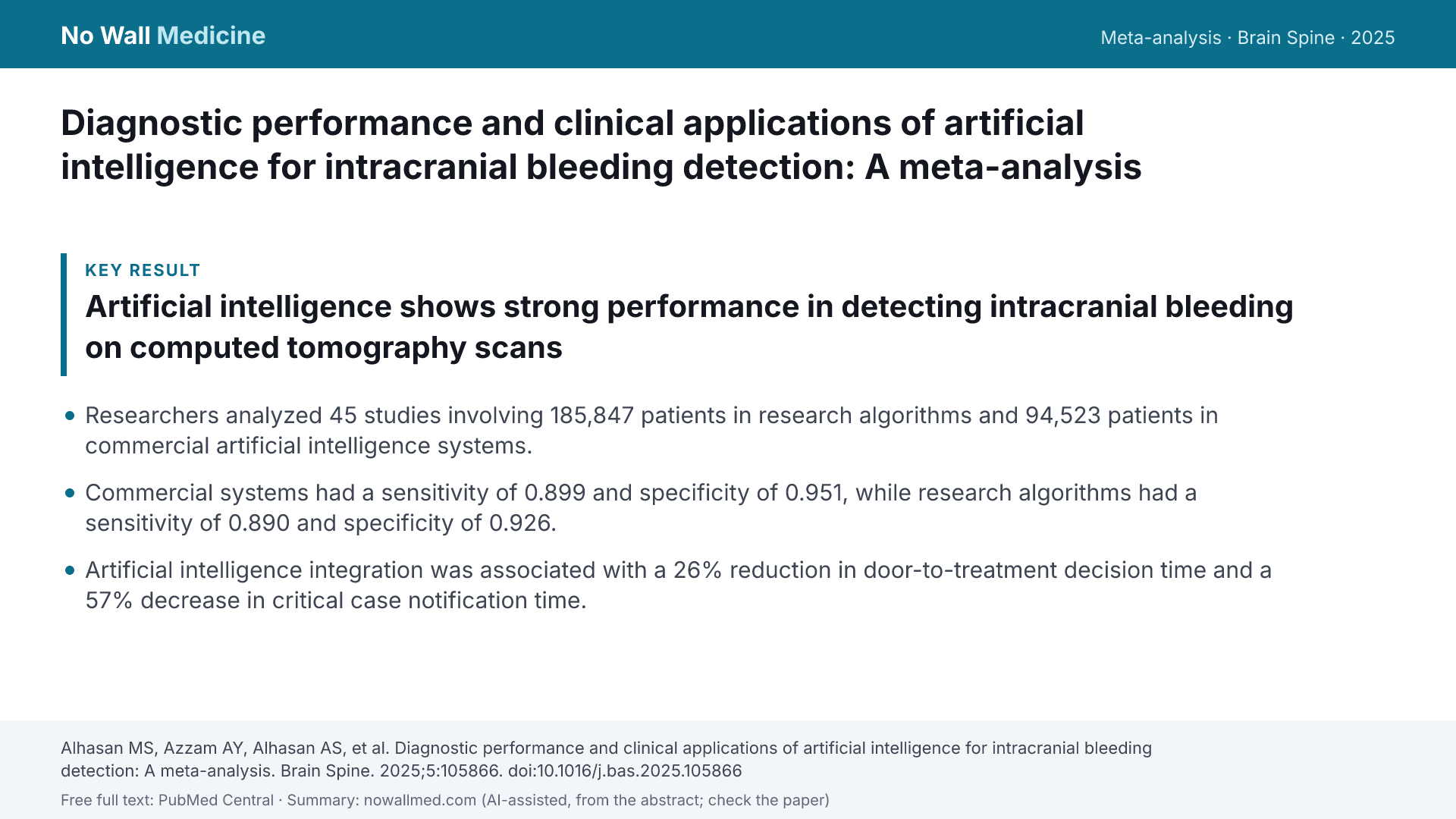
Artificial intelligence shows strong performance in detecting intracranial bleeding on computed tomography scans
Diagnostic performance and clinical applications of artificial intelligence for intracranial bleeding detection: A meta-analysis
Why it matters: Diagnostic accuracy for intracranial hemorrhage varies based on radiologist experience and workload, necessitating evaluation of artificial intelligence tools.
Key points
- Researchers analyzed 45 studies involving 185,847 patients in research algorithms and 94,523 patients in commercial artificial intelligence systems.
- Commercial systems had a sensitivity of 0.899 and specificity of 0.951, while research algorithms had a sensitivity of 0.890 and specificity of 0.926.
- Artificial intelligence integration was associated with a 26% reduction in door-to-treatment decision time and a 57% decrease in critical case notification time.
Headline and key points written with AI from the paper’s abstract, with every number checked against it. Read the paper before relying on them.
Was this summary helpful?
Cite this article
Alhasan MS, Azzam AY, Alhasan AS, et al. Diagnostic performance and clinical applications of artificial intelligence for intracranial bleeding detection: A meta-analysis. Brain Spine. 2025. doi:10.1016/j.bas.2025.105866
Spotted a mistake? Suggest a correction