Diagnostic performance and clinical applications of artificial intelligence for intracranial bleeding detection: A meta-analysis
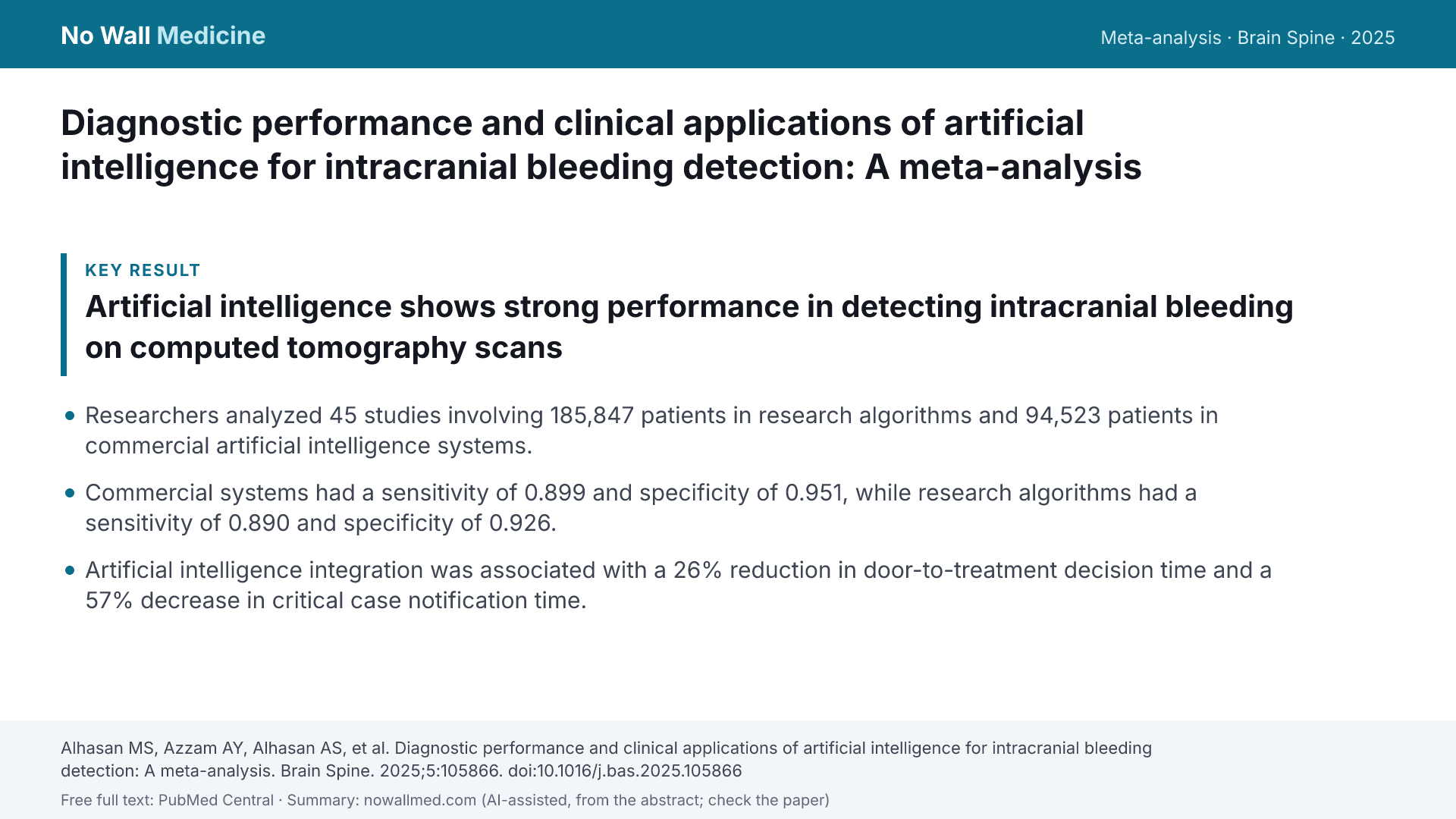
Key result: Artificial intelligence shows strong performance in detecting intracranial bleeding on computed tomography scans
Key points
- Researchers analyzed 45 studies involving 185,847 patients in research algorithms and 94,523 patients in commercial artificial intelligence systems.
- Commercial systems had a sensitivity of 0.899 and specificity of 0.951, while research algorithms had a sensitivity of 0.890 and specificity of 0.926.
- Artificial intelligence integration was associated with a 26% reduction in door-to-treatment decision time and a 57% decrease in critical case notification time.
Why it matters: Diagnostic accuracy for intracranial hemorrhage varies based on radiologist experience and workload, necessitating evaluation of artificial intelligence tools.
Discussion prompts
- Would these patients look like yours? Who was left out?
- Is the main outcome one that matters to patients?
- Is the difference large enough to change what you do?
Cite: Alhasan MS, Azzam AY, Alhasan AS, et al. Diagnostic performance and clinical applications of artificial intelligence for intracranial bleeding detection: A meta-analysis. Brain Spine. 2025;5:105866. doi:10.1016/j.bas.2025.105866
Free full text: PubMed Central · Summary and visual abstract: nowallmed.com/a/diagnostic-performance-and-clinical-applications-of-artificial-12nsm58/ (AI-assisted from the abstract; check the paper before relying on it).