Robotic-assisted bronchoscopy shows 86.6% diagnostic yield for pulmonary nodules in meta-analysis
Diagnostic performance and safety for robotic-assisted bronchoscopy in pulmonary nodules: a systematic review and meta-analysis
Systematic review and meta-analysisBenefit found
What is the diagnostic performance and safety of robotic-assisted bronchoscopy for pulmonary nodules?
Who
Patients with pulmonary nodules
Compared
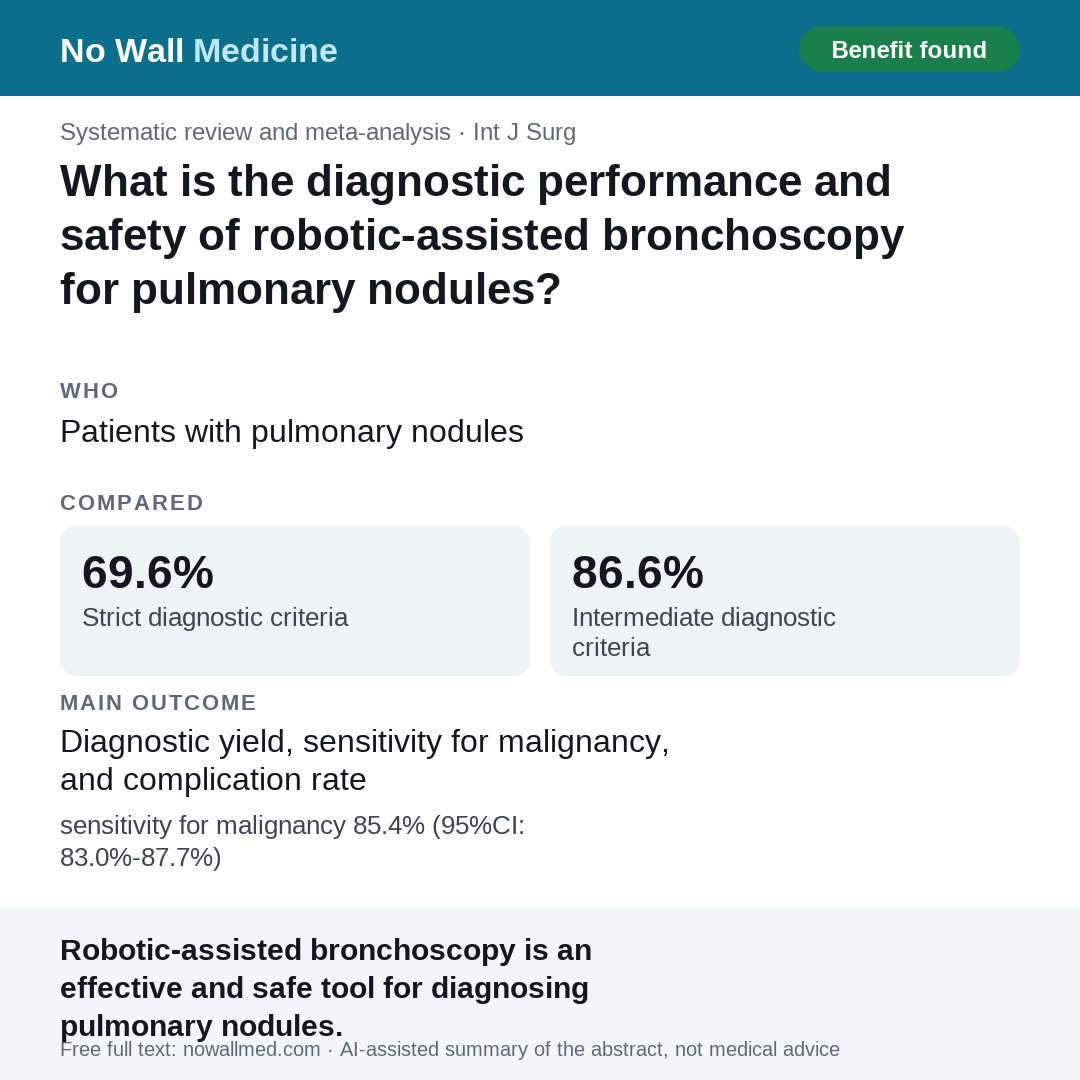
69.6%Strict diagnostic criteria (95%CI: 61.8%-76.8%)
86.6%Intermediate diagnostic criteria (95%CI: 83.7%-89.2%)
Main outcome
Diagnostic yield, sensitivity for malignancy, and complication rate
Result: sensitivity for malignancy 85.4% (95%CI: 83.0%-87.7%)
Bottom line: Robotic-assisted bronchoscopy is an effective and safe tool for diagnosing pulmonary nodules.
Int J Surg · 2025-05-12Download image
Clinical question: What is the diagnostic performance and safety of robotic-assisted bronchoscopy for pulmonary nodules?
Why it matters: The performance and safety of robotic-assisted bronchoscopy for diagnosing pulmonary nodules needed a comprehensive evaluation.
Key points
- Researchers analyzed 27 cohort studies to evaluate the performance and safety of robotic-assisted bronchoscopy, a tool combining robotics and bronchoscopy, for diagnosing lung nodules.
- The pooled diagnostic yield was 69.6% using strict criteria and 86.6% using intermediate criteria, with an 85.4% sensitivity for detecting malignancy.
- The pooled complication rate was 3.0%, including 2.0% for total pneumothorax (collapsed lung), 0.5% for pneumothorax requiring intervention, and 0.1% for bleeding.
Headline and key points written with AI from the paper’s abstract, with every number checked against it. Read the paper before relying on them.
Topics
Cite this article
Li X, Bai J, Zhou X, Wang T, Zhang Y, Hu Y. Diagnostic performance and safety for robotic-assisted bronchoscopy in pulmonary nodules: a systematic review and meta-analysis. Int J Surg. 2025. doi:10.1097/JS9.0000000000002423
Spotted a mistake? Suggest a correction