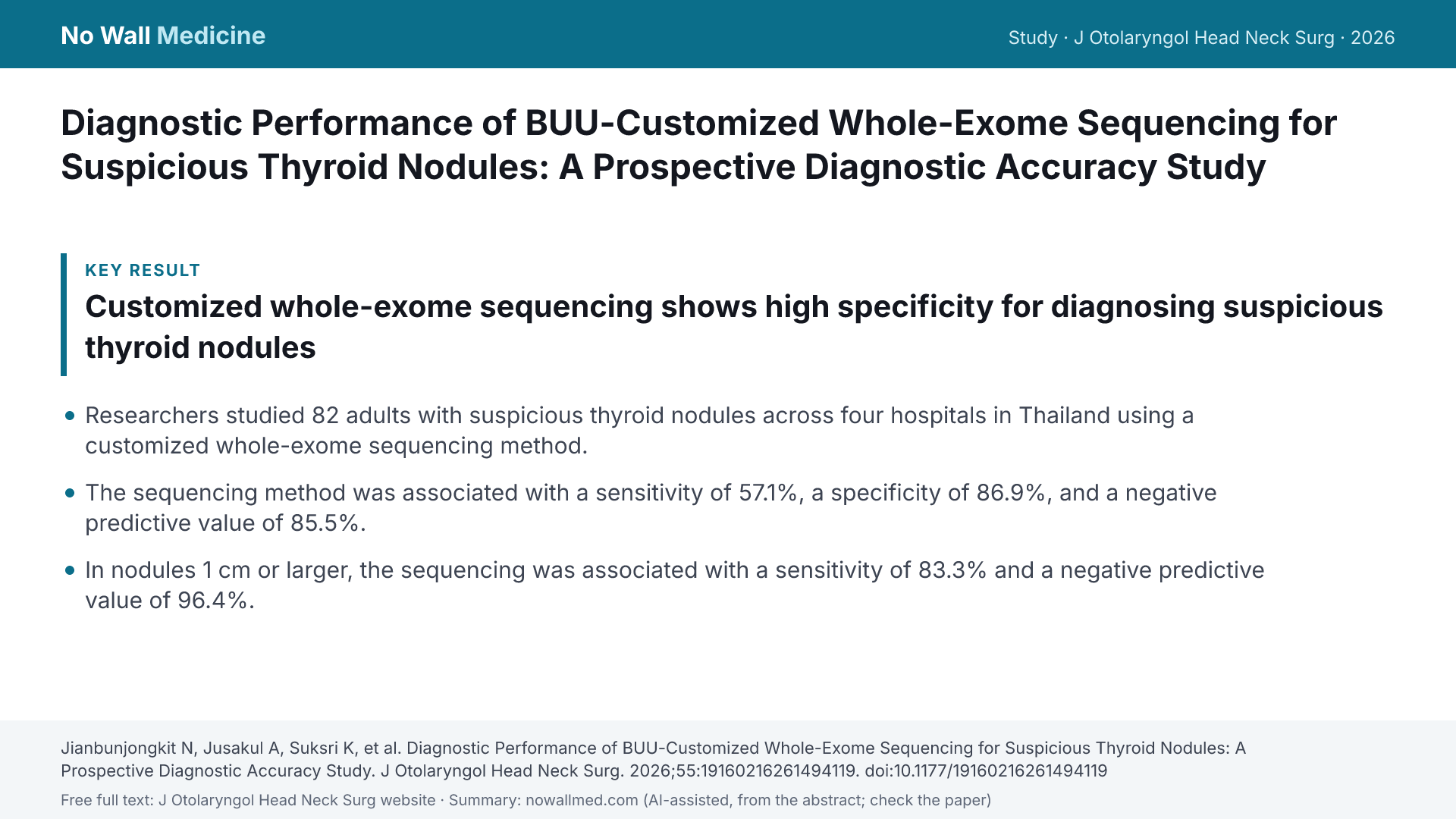
Customized whole-exome sequencing shows high specificity for diagnosing suspicious thyroid nodules
Diagnostic Performance of BUU-Customized Whole-Exome Sequencing for Suspicious Thyroid Nodules: A Prospective Diagnostic Accuracy Study
Why it matters: Suspicious thyroid nodules often lead to unnecessary surgeries because current diagnostic methods create uncertainty about whether a nodule is cancerous.
Key points
- Researchers studied 82 adults with suspicious thyroid nodules across four hospitals in Thailand using a customized whole-exome sequencing method.
- The sequencing method was associated with a sensitivity of 57.1%, a specificity of 86.9%, and a negative predictive value of 85.5%.
- In nodules 1 cm or larger, the sequencing was associated with a sensitivity of 83.3% and a negative predictive value of 96.4%.
Headline and key points written with AI from the paper’s abstract, with every number checked against it. Read the paper before relying on them.
Was this summary helpful?
Subject terms
Cite this article
Jianbunjongkit N, Jusakul A, Suksri K, Wongsuttilert A, Amornpinyokiat N, Teeramatwanich W. Diagnostic Performance of BUU-Customized Whole-Exome Sequencing for Suspicious Thyroid Nodules: A Prospective Diagnostic Accuracy Study. J Otolaryngol Head Neck Surg. 2026. doi:10.1177/19160216261494119
Spotted a mistake? Suggest a correction
Top studies every Monday
The week’s key trials and guidelines in your specialties, plus any topics you follow. By email, free.
Get the weekly digest