Diagnostic Performance of BUU-Customized Whole-Exome Sequencing for Suspicious Thyroid Nodules: A Prospective Diagnostic Accuracy Study
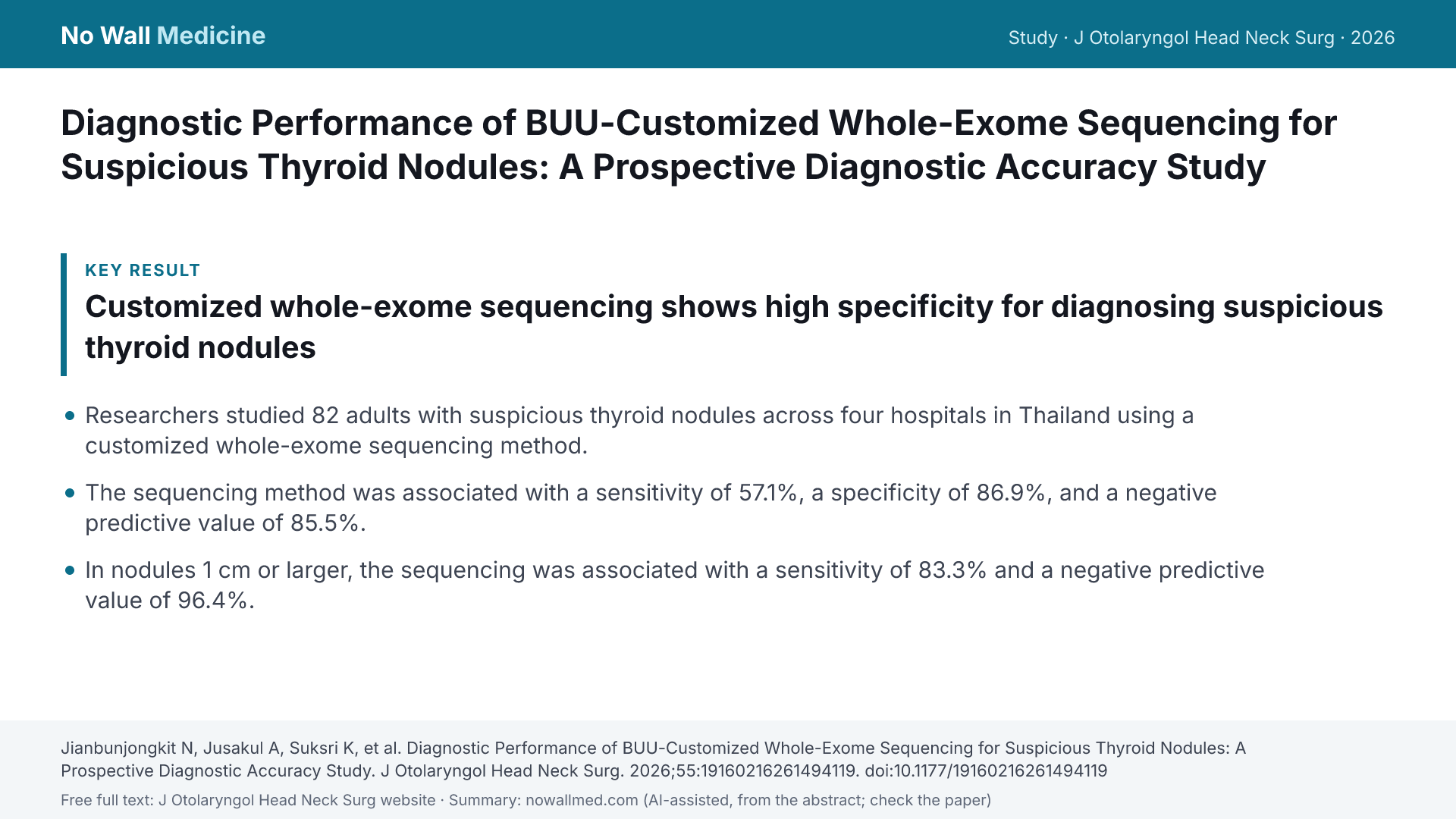
Key result: Customized whole-exome sequencing shows high specificity for diagnosing suspicious thyroid nodules
Key points
- Researchers studied 82 adults with suspicious thyroid nodules across four hospitals in Thailand using a customized whole-exome sequencing method.
- The sequencing method was associated with a sensitivity of 57.1%, a specificity of 86.9%, and a negative predictive value of 85.5%.
- In nodules 1 cm or larger, the sequencing was associated with a sensitivity of 83.3% and a negative predictive value of 96.4%.
Why it matters: Suspicious thyroid nodules often lead to unnecessary surgeries because current diagnostic methods create uncertainty about whether a nodule is cancerous.
Discussion prompts
- Would these patients look like yours? Who was left out?
- Is the main outcome one that matters to patients?
- Is the difference large enough to change what you do?
Cite: Jianbunjongkit N, Jusakul A, Suksri K, et al. Diagnostic Performance of BUU-Customized Whole-Exome Sequencing for Suspicious Thyroid Nodules: A Prospective Diagnostic Accuracy Study. J Otolaryngol Head Neck Surg. 2026;55:19160216261494119. doi:10.1177/19160216261494119
Free full text: J Otolaryngol Head Neck Surg website · Summary and visual abstract: nowallmed.com/a/diagnostic-performance-of-buu-customized-whole-exome-sequencing-for-y47mdk/ (AI-assisted from the abstract; check the paper before relying on it).