Electronic noses showed high diagnostic accuracy for detecting cancer in exhaled breath samples
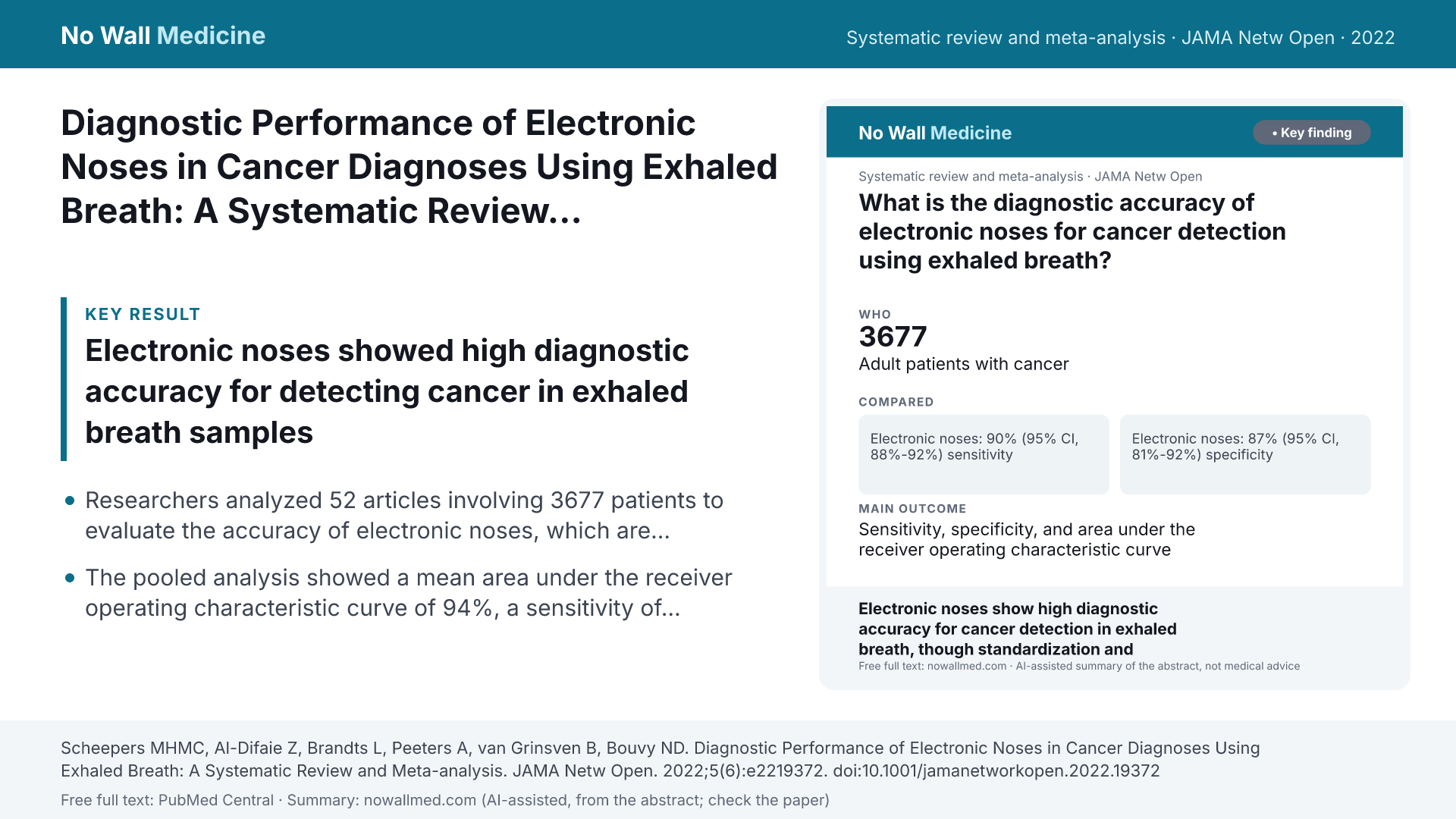
Diagnostic Performance of Electronic Noses in Cancer Diagnoses Using Exhaled Breath: A Systematic Review and Meta-analysis
Systematic review and meta-analysisKey finding
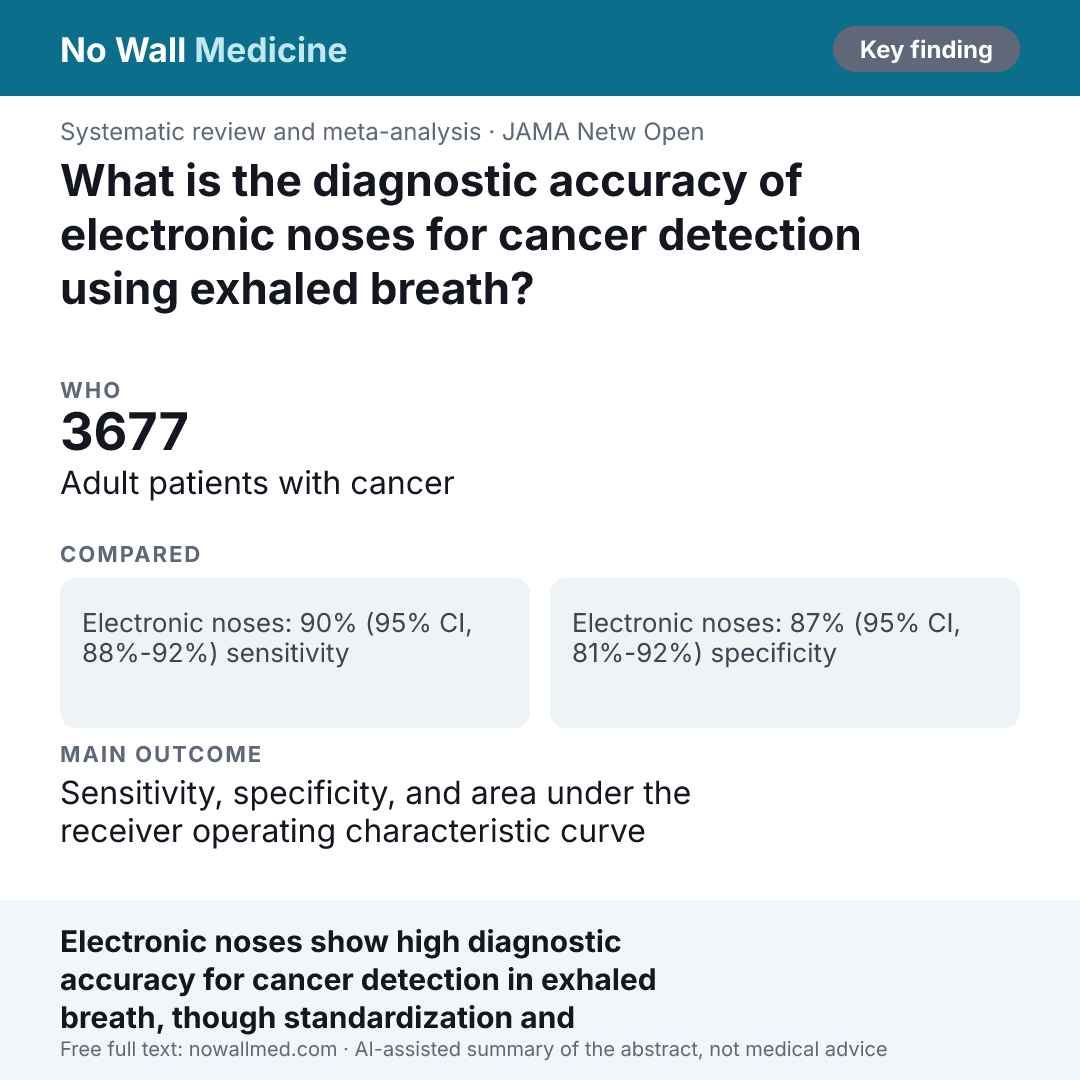
What is the diagnostic accuracy of electronic noses for cancer detection using exhaled breath?
Who
3677
Adult patients with cancer
Compared
Electronic noses: 90% (95% CI, 88%-92%) sensitivity
Electronic noses: 87% (95% CI, 81%-92%) specificity
Main outcome
Sensitivity, specificity, and area under the receiver operating characteristic curve
Result: mean area under the receiver operating characteristic curve 94% (95% CI, 92%-96%)
Bottom line: Electronic noses show high diagnostic accuracy for cancer detection in exhaled breath, though standardization and reproducibility are needed.
Limitation: Most studies were feasibility studies with small sample sizes, lack of standardization, and high risk of bias.
JAMA Netw Open · 2022-06-01 · Save PNG
Clinical question: What is the diagnostic accuracy of electronic noses for cancer detection using exhaled breath?
Key points
- Researchers analyzed 52 articles involving 3677 patients to evaluate the accuracy of electronic noses, which are devices that detect chemical compounds in breath.
- The pooled analysis showed a mean area under the receiver operating characteristic curve of 94%, a sensitivity of 90%, and a specificity of 87%.
- Individual study sensitivity ranged from 48.3% to 95.8%, while specificity ranged from 10.0% to 100.0%.
Limitation the authors note: Most included studies were feasibility studies with small sample sizes, a lack of standardization, and a high risk of bias.
Headline and key points written with AI from the paper’s abstract, with every number checked against it. Read the paper before relying on them.
Was this summary helpful?
Subject terms
Headline, design, result, key points, caveat and citation as plain text.
Cite this article
Scheepers MHMC, Al-Difaie Z, Brandts L, Peeters A, van Grinsven B, Bouvy ND. Diagnostic Performance of Electronic Noses in Cancer Diagnoses Using Exhaled Breath: A Systematic Review and Meta-analysis. JAMA Netw Open. 2022. doi:10.1001/jamanetworkopen.2022.19372
Spotted a mistake? Suggest a correction