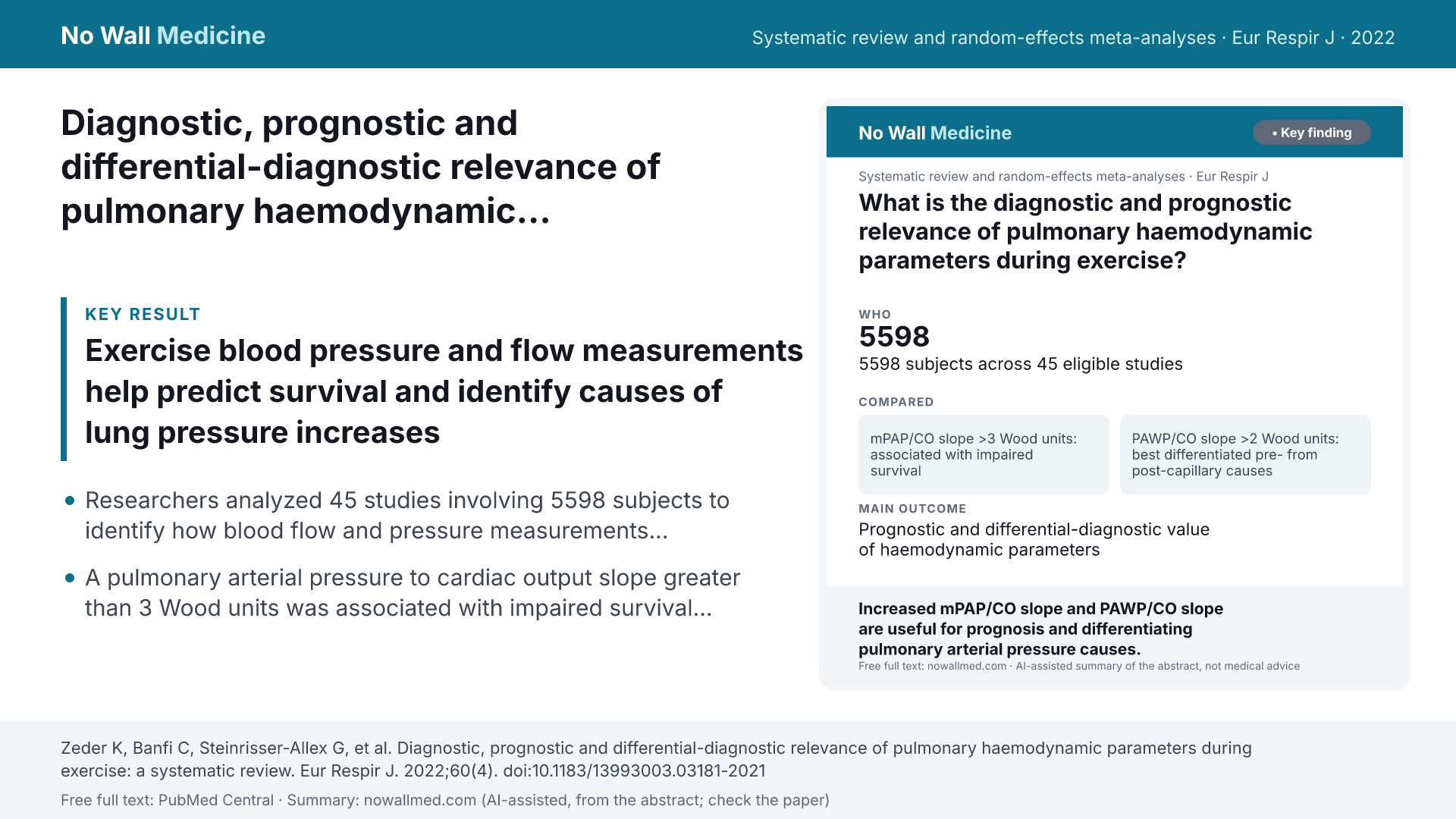
Exercise blood pressure and flow measurements help predict survival and identify causes of lung pressure increases
Diagnostic, prognostic and differential-diagnostic relevance of pulmonary haemodynamic parameters during exercise: a systematic review
Systematic review and random-effects meta-analysesBenefit found
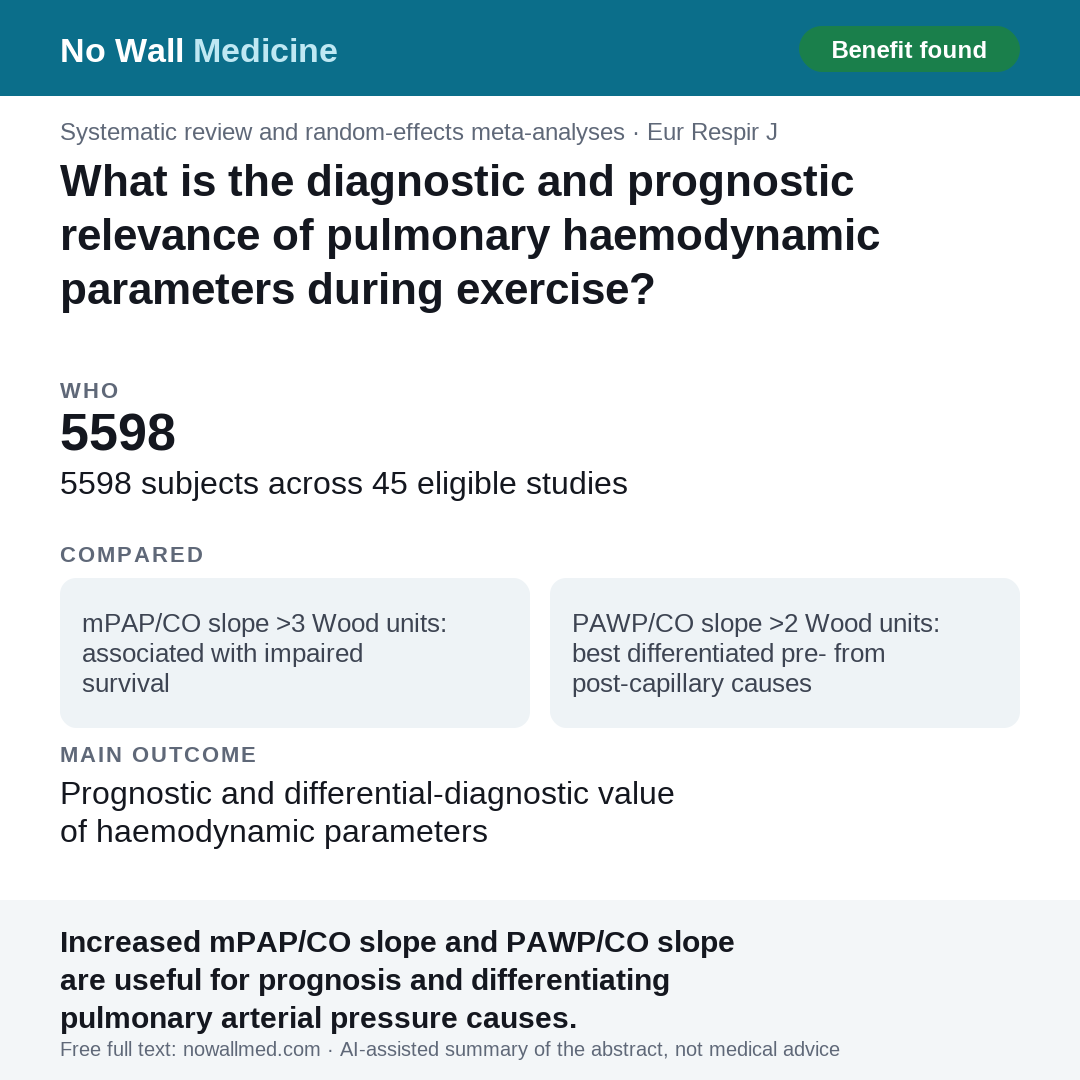
What is the diagnostic and prognostic relevance of pulmonary haemodynamic parameters during exercise?
Who
5598
5598 subjects across 45 eligible studies
Compared
mPAP/CO slope >3 Wood units: associated with impaired survival
PAWP/CO slope >2 Wood units: best differentiated pre- from post-capillary causes
Main outcome
Prognostic and differential-diagnostic value of haemodynamic parameters
Bottom line: Increased mPAP/CO slope and PAWP/CO slope are useful for prognosis and differentiating pulmonary arterial pressure causes.
Eur Respir J · 2022-10-13Download image
Clinical question: What is the diagnostic and prognostic relevance of pulmonary haemodynamic parameters during exercise?
Why it matters: A standardized approach to interpreting how blood pressure and flow change during exercise is currently lacking.
Key points
- Researchers analyzed 45 studies involving 5598 subjects to identify how blood flow and pressure measurements during exercise relate to health outcomes.
- A pulmonary arterial pressure to cardiac output slope greater than 3 Wood units was associated with impaired survival and cardiovascular events.
- A pulmonary arterial wedge pressure to cardiac output slope greater than 2 Wood units was associated with differentiating between different causes of elevated pulmonary arterial pressure.
Headline and key points written with AI from the paper’s abstract, with every number checked against it. Read the paper before relying on them.
Was this summary helpful?
Subject terms
Cite this article
Zeder K, Banfi C, Steinrisser-Allex G, et al. Diagnostic, prognostic and differential-diagnostic relevance of pulmonary haemodynamic parameters during exercise: a systematic review. Eur Respir J. 2022. doi:10.1183/13993003.03181-2021
Spotted a mistake? Suggest a correction