Diagnostic, prognostic and differential-diagnostic relevance of pulmonary haemodynamic parameters during exercise: a systematic review
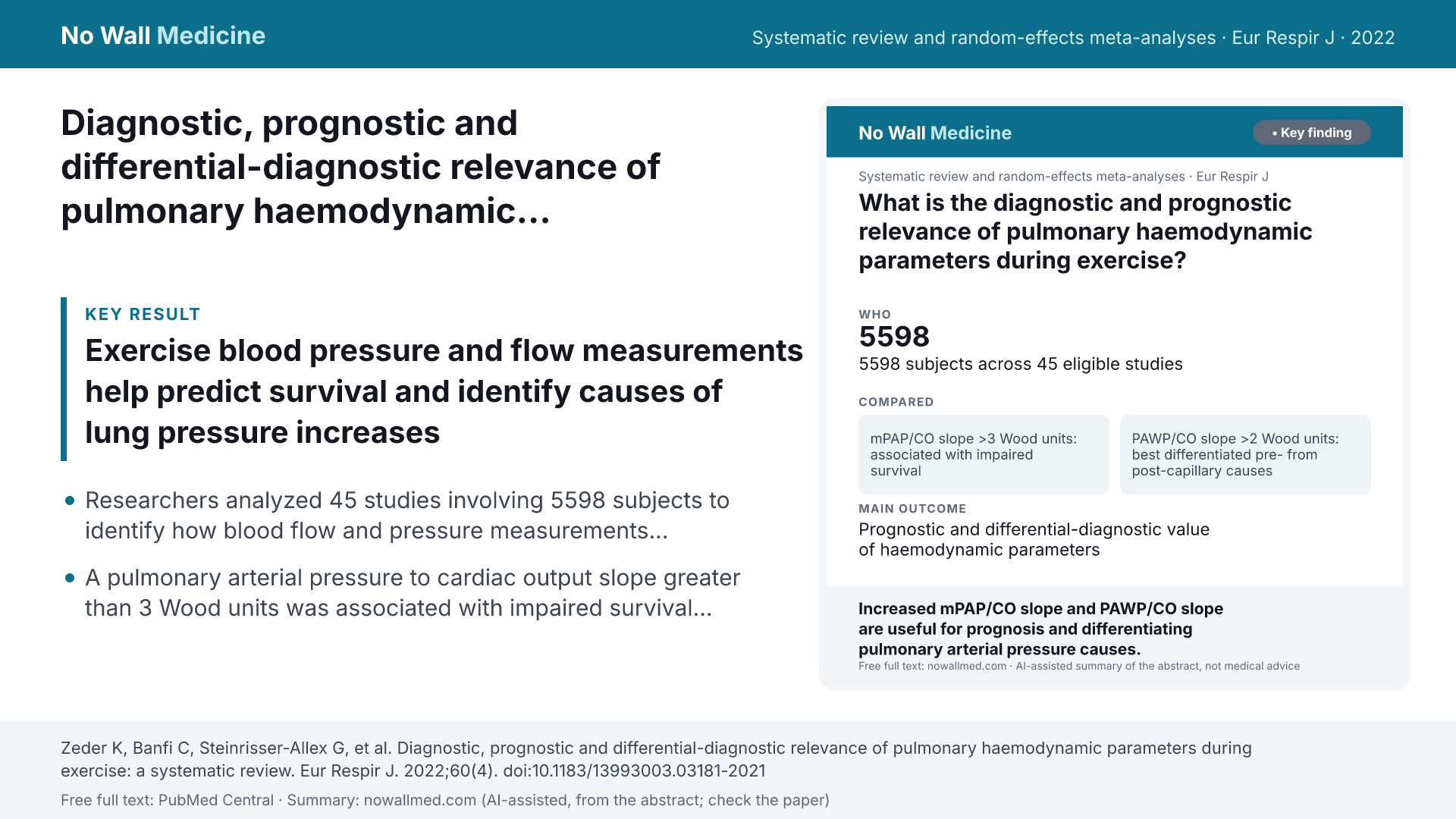
Key result: Exercise blood pressure and flow measurements help predict survival and identify causes of lung pressure increases
Systematic review and random-effects meta-analysesKey finding
What is the diagnostic and prognostic relevance of pulmonary haemodynamic parameters during exercise?
Who
5598
5598 subjects across 45 eligible studies
Compared
mPAP/CO slope >3 Wood units: associated with impaired survival
PAWP/CO slope >2 Wood units: best differentiated pre- from post-capillary causes
Main outcome
Prognostic and differential-diagnostic value of haemodynamic parameters
Bottom line: Increased mPAP/CO slope and PAWP/CO slope are useful for prognosis and differentiating pulmonary arterial pressure causes.
Eur Respir J · 2022-10-13
Key points
- Researchers analyzed 45 studies involving 5598 subjects to identify how blood flow and pressure measurements during exercise relate to health outcomes.
- A pulmonary arterial pressure to cardiac output slope greater than 3 Wood units was associated with impaired survival and cardiovascular events.
- A pulmonary arterial wedge pressure to cardiac output slope greater than 2 Wood units was associated with differentiating between different causes of elevated pulmonary arterial pressure.
Why it matters: A standardized approach to interpreting how blood pressure and flow change during exercise is currently lacking.
Discussion prompts
- Would these patients look like yours? Who was left out?
- Is the main outcome one that matters to patients?
- Is the difference large enough to change what you do?
Cite: Zeder K, Banfi C, Steinrisser-Allex G, et al. Diagnostic, prognostic and differential-diagnostic relevance of pulmonary haemodynamic parameters during exercise: a systematic review. Eur Respir J. 2022;60(4). doi:10.1183/13993003.03181-2021
Free full text: PubMed Central · Summary and visual abstract: nowallmed.com/a/diagnostic-prognostic-and-differential-diagnostic-relevance-of-1ulccwl/ (AI-assisted from the abstract; check the paper before relying on it).