High dietary fat intake was associated with an increased risk of inflammatory bowel disease onset
Dietary fat is associated with increased inflammatory bowel disease onset risk: a systematic review and dose-response meta-analysis
Systematic review and dose-response meta-analysisHarm found
Is dietary fat intake associated with inflammatory bowel disease onset risk?
Who
Populations studied in PubMed, Embase and Web of Science
Compared
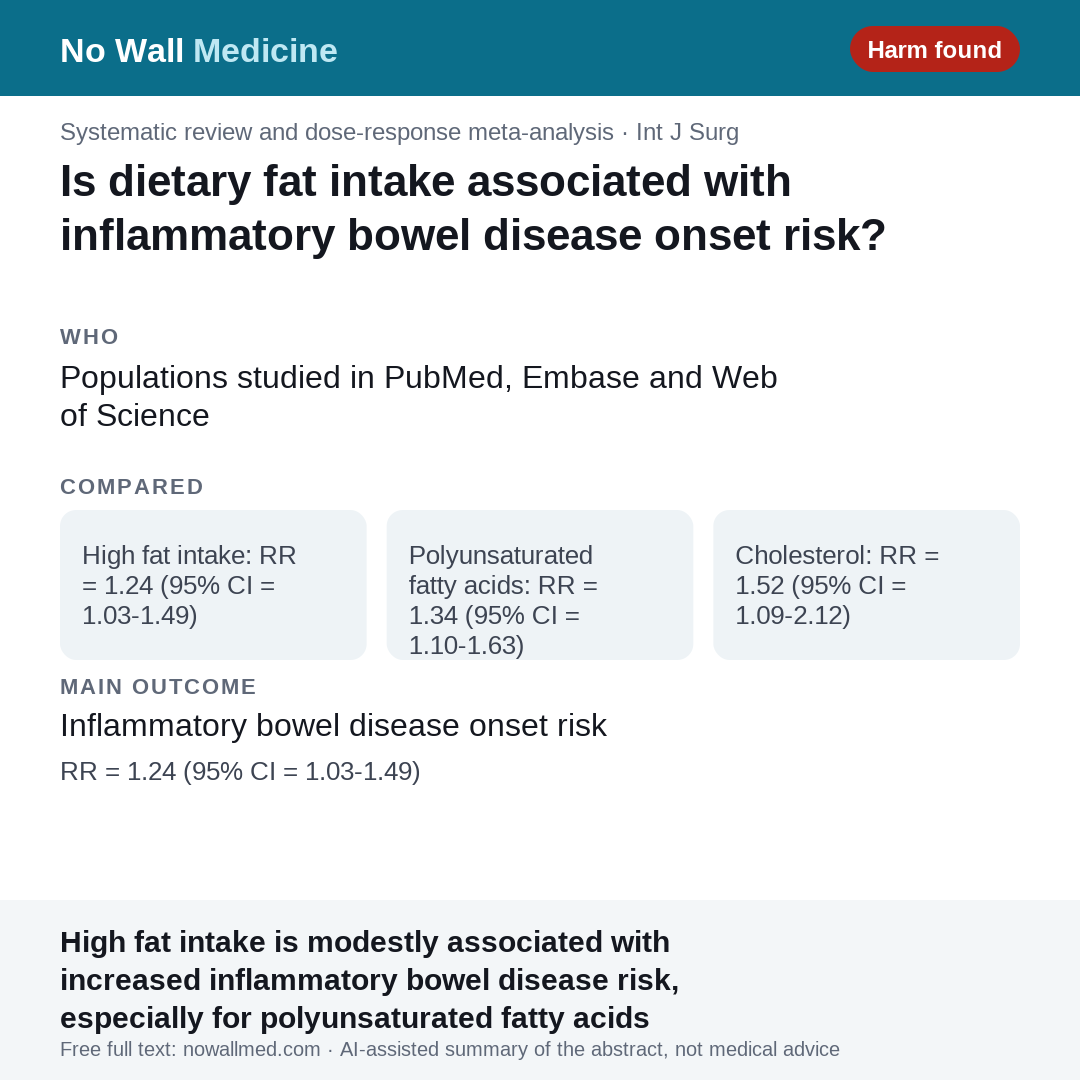
High fat intake: RR = 1.24 (95% CI = 1.03-1.49)
Polyunsaturated fatty acids: RR = 1.34 (95% CI = 1.10-1.63)
Cholesterol: RR = 1.52 (95% CI = 1.09-2.12)
Main outcome
Inflammatory bowel disease onset risk
Result: RR = 1.24 (95% CI = 1.03-1.49)
Bottom line: High fat intake is modestly associated with increased inflammatory bowel disease risk, especially for polyunsaturated fatty acids and cholesterol.
Int J Surg · 2025-08-07Download image
Clinical question: Is dietary fat intake associated with inflammatory bowel disease onset risk?
Why it matters: The association between dietary fat and the risk of developing inflammatory bowel disease, particularly regarding specific fatty acids, remains controversial.
Key points
- Researchers conducted a systematic review and meta-analysis of studies published up to January 2025 to examine the link between dietary fat and inflammatory bowel disease.
- High fat intake was associated with an increased risk (RR = 1.24, 95% CI = 1.03-1.49), with higher risks seen in Asian, young, and male-heavy populations.
- Polyunsaturated fatty acids (RR = 1.34, 95% CI = 1.10-1.63) and cholesterol (RR = 1.52, 95% CI = 1.09-2.12) were associated with increased risk, while long-chain n-3 polyunsaturated fatty acids were associated with decreased risk.
Headline and key points written with AI from the paper’s abstract, with every number checked against it. Read the paper before relying on them.
Was this summary helpful?
Subject terms
Cite this article
Zhang S, Sui X, Wei J, Liu M, Zhang H, Zhao Y. Dietary fat is associated with increased inflammatory bowel disease onset risk: a systematic review and dose-response meta-analysis. Int J Surg. 2025. doi:10.1097/JS9.0000000000003019
Spotted a mistake? Suggest a correction
Top studies every Monday
The week’s key trials and guidelines in your specialties, plus any topics you follow. By email, free.
Get the weekly digest