Higher energy intake was linked to higher carbohydrate and polyunsaturated fat densities in postmenopausal women
Energy intake is associated with dietary macronutrient densities: inversely with protein and monounsaturated fat and positively with polyunsaturated fat and carbohydrate among postmenopausal females
Observational study using biomarker equationsMixed results
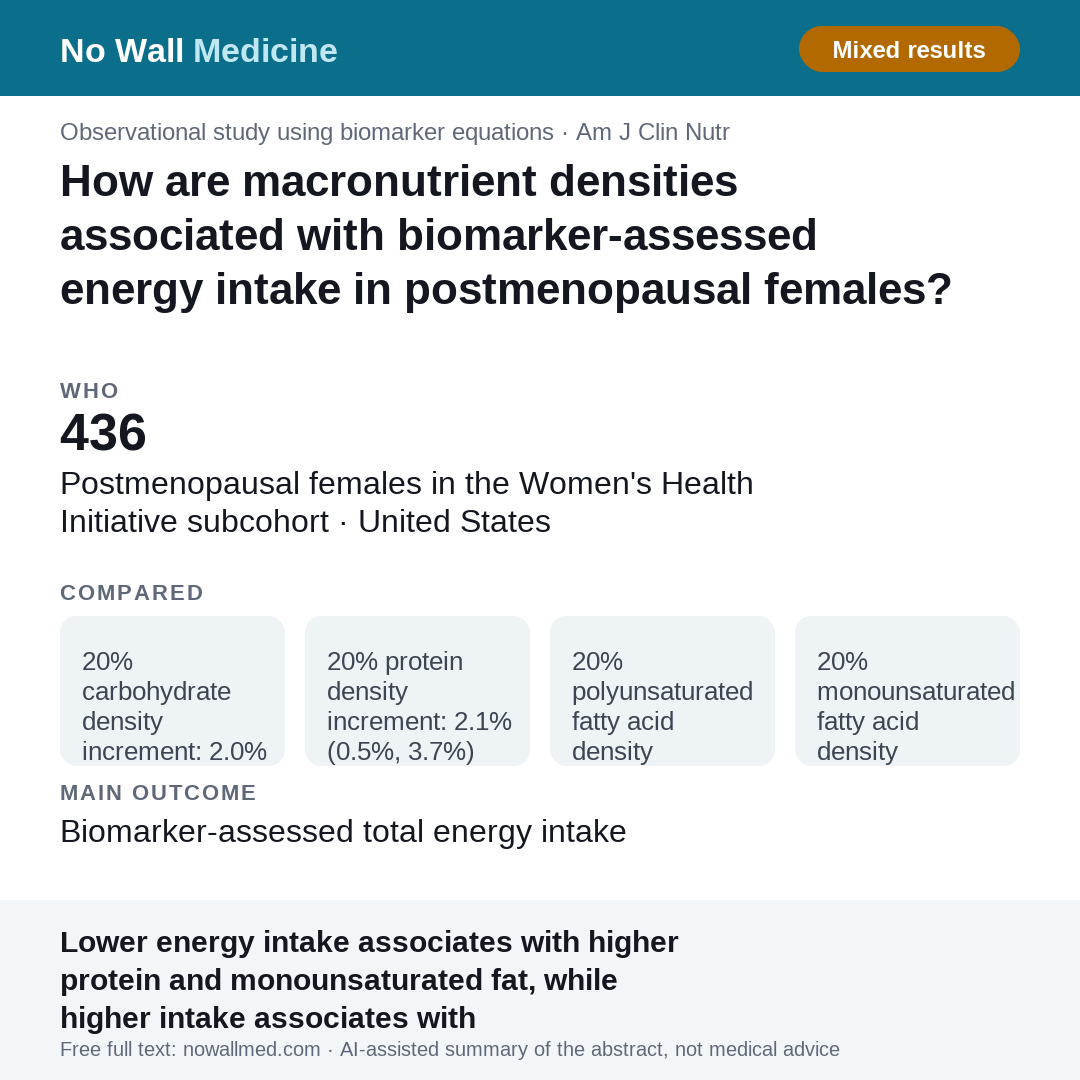
How are macronutrient densities associated with biomarker-assessed energy intake in postmenopausal females?
Who
436
Postmenopausal females in the Women's Health Initiative subcohort · United States
Compared
20% carbohydrate density increment: 2.0% (0.1%, 3.9%) higher
20% protein density increment: 2.1% (0.5%, 3.7%) lower
20% polyunsaturated fatty acid density increment: 1.4% (0.3%, 2.6%) higher
20% monounsaturated fatty acid density increment: 1.5% (0.1%, 2.9%) lower
Main outcome
Biomarker-assessed total energy intake
Bottom line: Lower energy intake associates with higher protein and monounsaturated fat, while higher intake associates with polyunsaturated fat and added sugars.
Am J Clin Nutr · 2025-03-13Download image
Clinical question: How are macronutrient densities associated with biomarker-assessed energy intake in postmenopausal females?
Why it matters: The associations between total energy intake and the density of macronutrients, as well as the relationship with self-reported energy underreporting, were uncertain.
Key points
- Researchers studied 436 postmenopausal women in the United States using doubly labeled water to measure energy intake and macronutrient densities.
- A 20% increase in carbohydrate density was linked to a 2.0% (0.1%, 3.9%) higher energy intake, while a 20% increase in protein density was linked to a 2.1% (0.5%, 3.7%) lower energy intake.
- Higher energy intake was also linked to a 1.4% (0.3%, 2.6%) increase in polyunsaturated fat density and a 1.5% (0.1%, 2.9%) decrease in monounsaturated fat density.
Headline and key points written with AI from the paper’s abstract, with every number checked against it. Read the paper before relying on them.
Topics
Cite this article
Prentice RL, Aragaki AK, Zheng C, Manson JE, Tinker LF, Schoeller DA. Energy intake is associated with dietary macronutrient densities: inversely with protein and monounsaturated fat and positively with polyunsaturated fat and carbohydrate among postmenopausal females. Am J Clin Nutr. 2025. doi:10.1016/j.ajcnut.2025.03.011
Spotted a mistake? Suggest a correction
Top studies every Monday
The week’s key trials and guidelines in your specialties, by email. Free.
Get the weekly digest