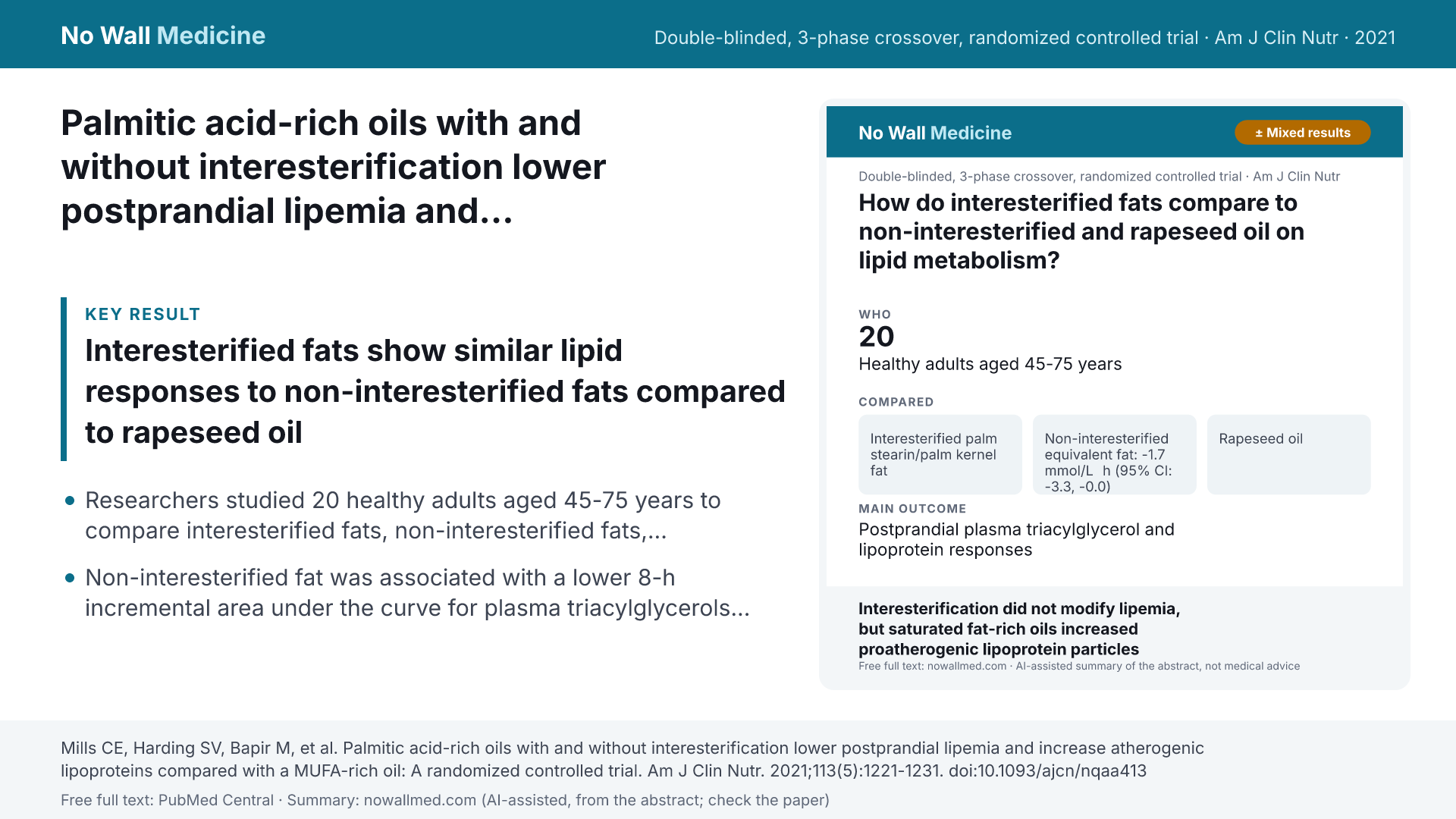
Interesterified fats show similar lipid responses to non-interesterified fats compared to rapeseed oil
Palmitic acid-rich oils with and without interesterification lower postprandial lipemia and increase atherogenic lipoproteins compared with a MUFA-rich oil: A randomized controlled trial
Double-blinded, 3-phase crossover, randomized controlled trialMixed results
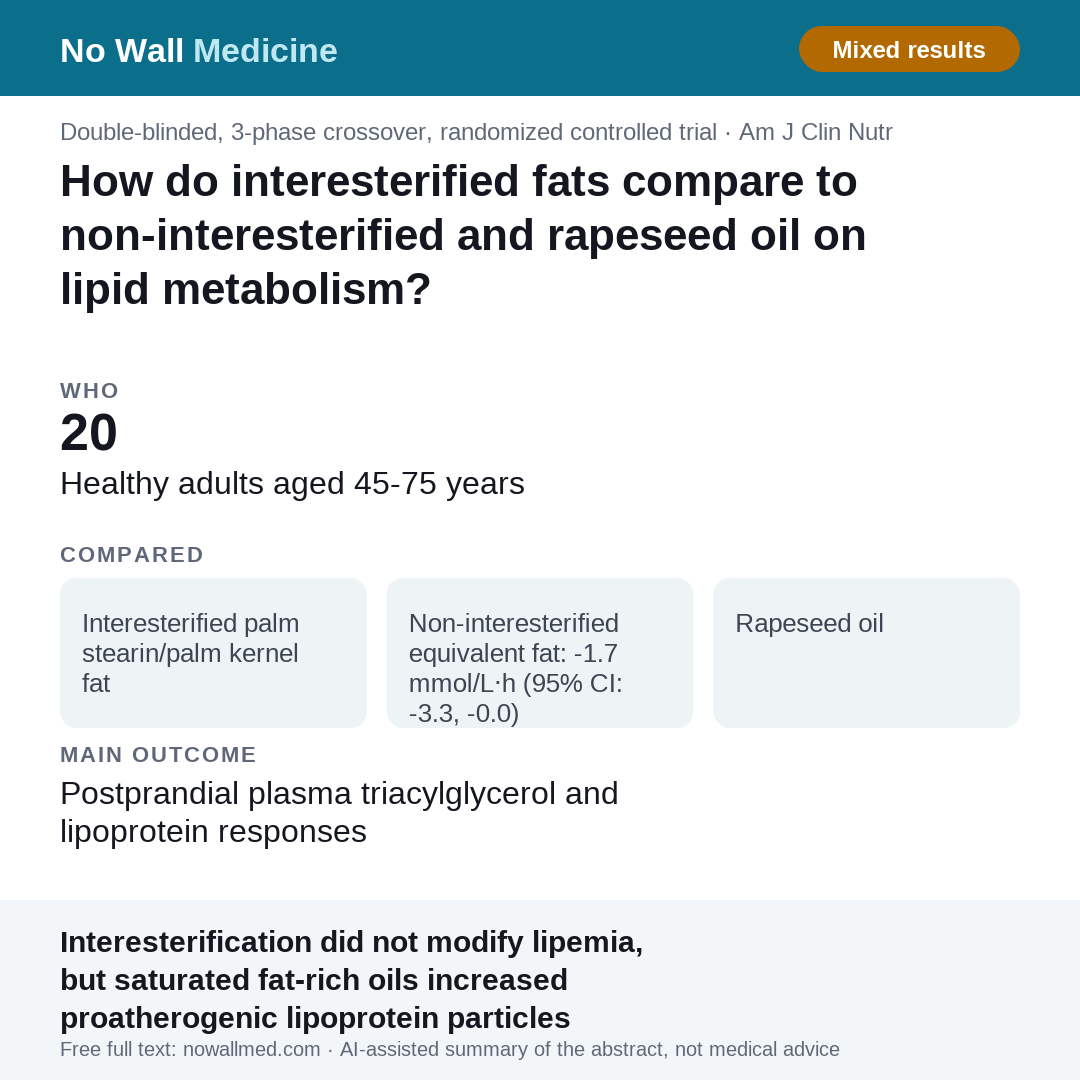
How do interesterified fats compare to non-interesterified and rapeseed oil on lipid metabolism?
Who
20
Healthy adults aged 45-75 years
Compared
Interesterified palm stearin/palm kernel fat
Non-interesterified equivalent fat: -1.7 mmol/L⋅h (95% CI: -3.3, -0.0)
Rapeseed oil
Main outcome
Postprandial plasma triacylglycerol and lipoprotein responses
Bottom line: Interesterification did not modify lipemia, but saturated fat-rich oils increased proatherogenic lipoprotein particles compared to rapeseed oil.
Am J Clin Nutr · 2021-03-07Download image
Clinical question: How do interesterified fats compare to non-interesterified and rapeseed oil on lipid metabolism?
Why it matters: The metabolism of interesterified fats, which are used to replace trans fats, is not well understood.
Key points
- Researchers studied 20 healthy adults aged 45-75 years to compare interesterified fats, non-interesterified fats, and rapeseed oil.
- Non-interesterified fat was associated with a lower 8-h incremental area under the curve for plasma triacylglycerols by -1.7 mmol/L⋅h compared to rapeseed oil.
- Both interesterified and non-interesterified fats were associated with smaller low-density lipoprotein particles and higher concentrations of large very-low-density lipoprotein particles compared to rapeseed oil.
Headline and key points written with AI from the paper’s abstract, with every number checked against it. Read the paper before relying on them.
Was this summary helpful?
Subject terms
Cite this article
Mills CE, Harding SV, Bapir M, Mandalari G, Salt LJ, Gray R. Palmitic acid-rich oils with and without interesterification lower postprandial lipemia and increase atherogenic lipoproteins compared with a MUFA-rich oil: A randomized controlled trial. Am J Clin Nutr. 2021. doi:10.1093/ajcn/nqaa413
Spotted a mistake? Suggest a correction