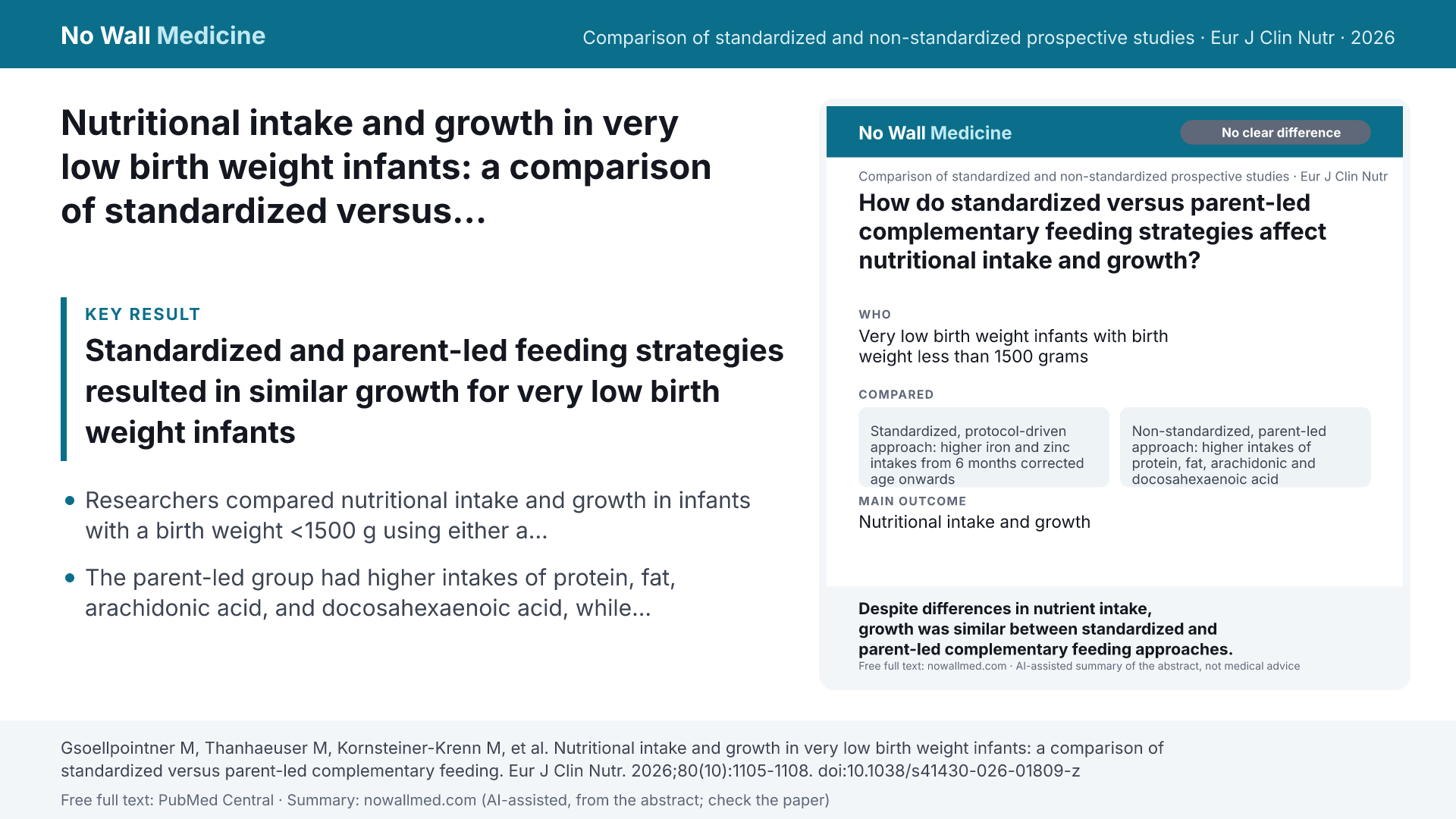
Standardized and parent-led feeding strategies resulted in similar growth for very low birth weight infants
Nutritional intake and growth in very low birth weight infants: a comparison of standardized versus parent-led complementary feeding
Comparison of standardized and non-standardized prospective studiesNo clear difference
How do standardized versus parent-led complementary feeding strategies affect nutritional intake and growth?
Who
Very low birth weight infants with birth weight less than 1500 grams
Compared
Standardized, protocol-driven approach: higher iron and zinc intakes from 6 months corrected age onwards
Non-standardized, parent-led approach: higher intakes of protein, fat, arachidonic and docosahexaenoic acid
Main outcome
Nutritional intake and growth
Bottom line: Despite differences in nutrient intake, growth was similar between standardized and parent-led complementary feeding approaches.
Eur J Clin Nutr · 2026-08-08Download image
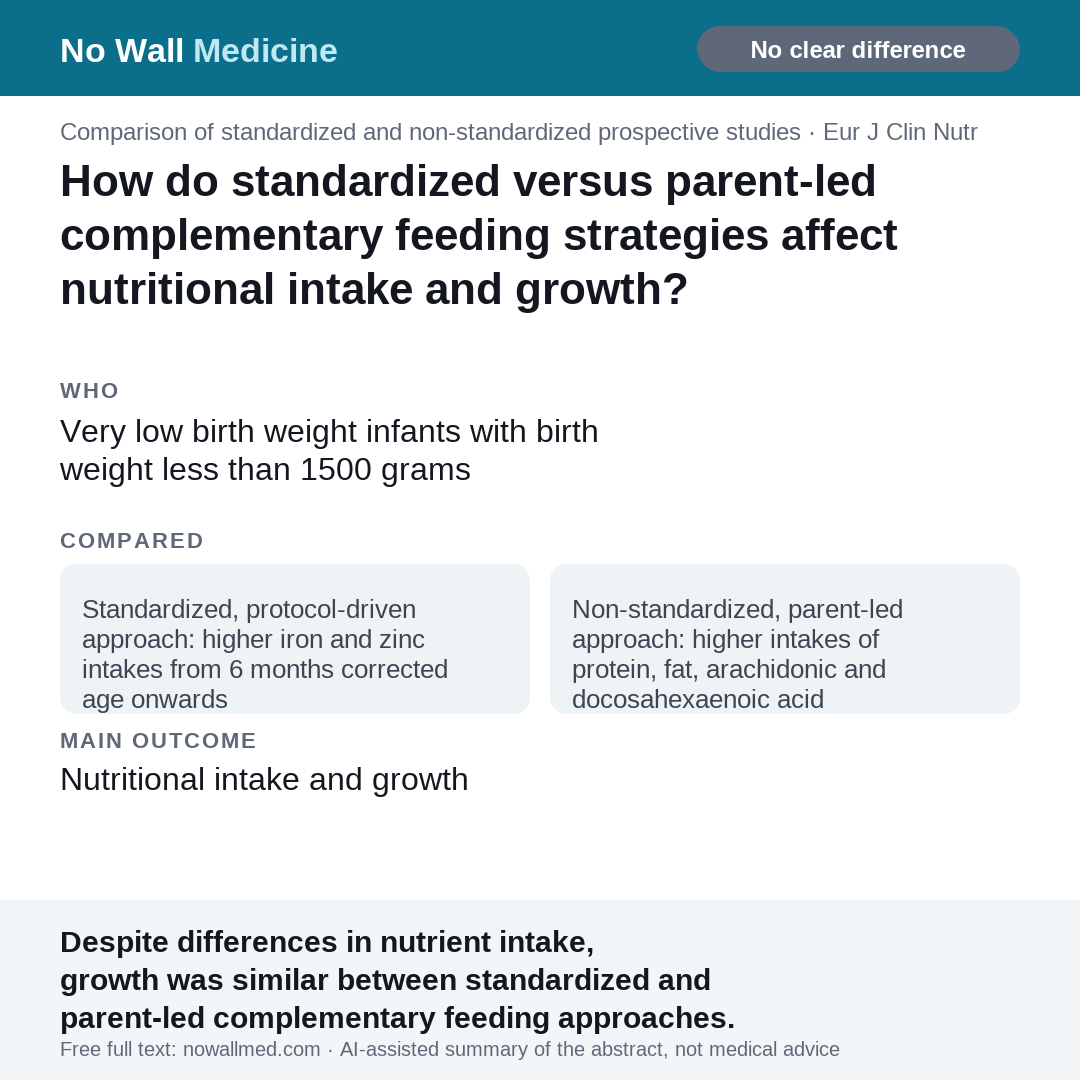
Clinical question: How do standardized versus parent-led complementary feeding strategies affect nutritional intake and growth?
Why it matters: The complementary feeding period is critical for ensuring adequate nutrient intake to support optimal growth in very low birth weight infants.
Key points
- Researchers compared nutritional intake and growth in infants with a birth weight <1500 g using either a standardized protocol or a parent-led approach.
- The parent-led group had higher intakes of protein, fat, arachidonic acid, and docosahexaenoic acid, while the standardized group had higher iron and zinc intakes.
- Despite these differences in nutrient intake, growth was similar between the two cohorts.
Headline and key points written with AI from the paper’s abstract, with every number checked against it. Read the paper before relying on them.
Was this summary helpful?
Subject terms
Cite this article
Gsoellpointner M, Thanhaeuser M, Kornsteiner-Krenn M, et al. Nutritional intake and growth in very low birth weight infants: a comparison of standardized versus parent-led complementary feeding. Eur J Clin Nutr. 2026. doi:10.1038/s41430-026-01809-z
Spotted a mistake? Suggest a correction