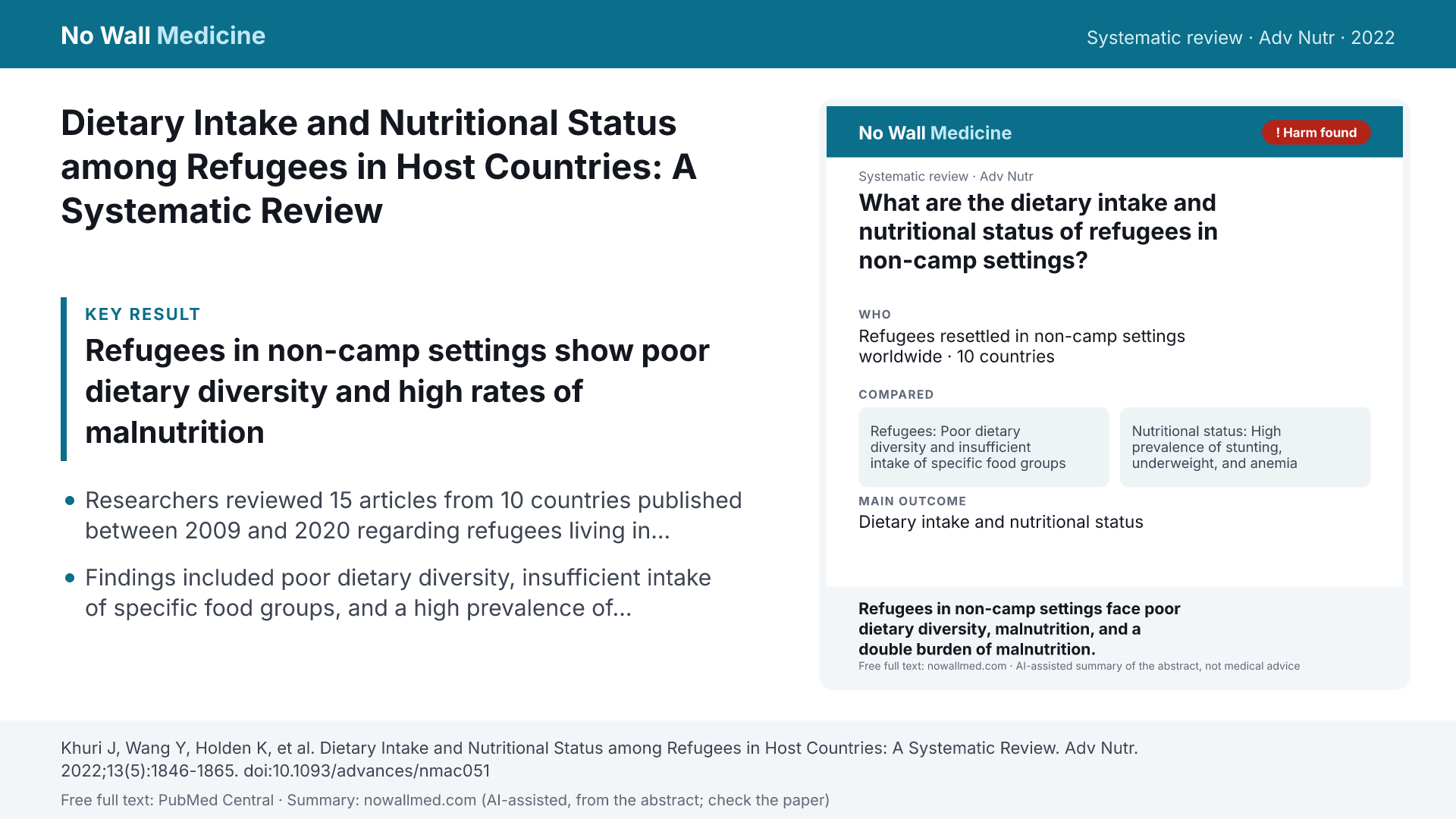
Dietary Intake and Nutritional Status among Refugees in Host Countries: A Systematic Review
Key result: Refugees in non-camp settings show poor dietary diversity and high rates of malnutrition
Systematic reviewHarm found
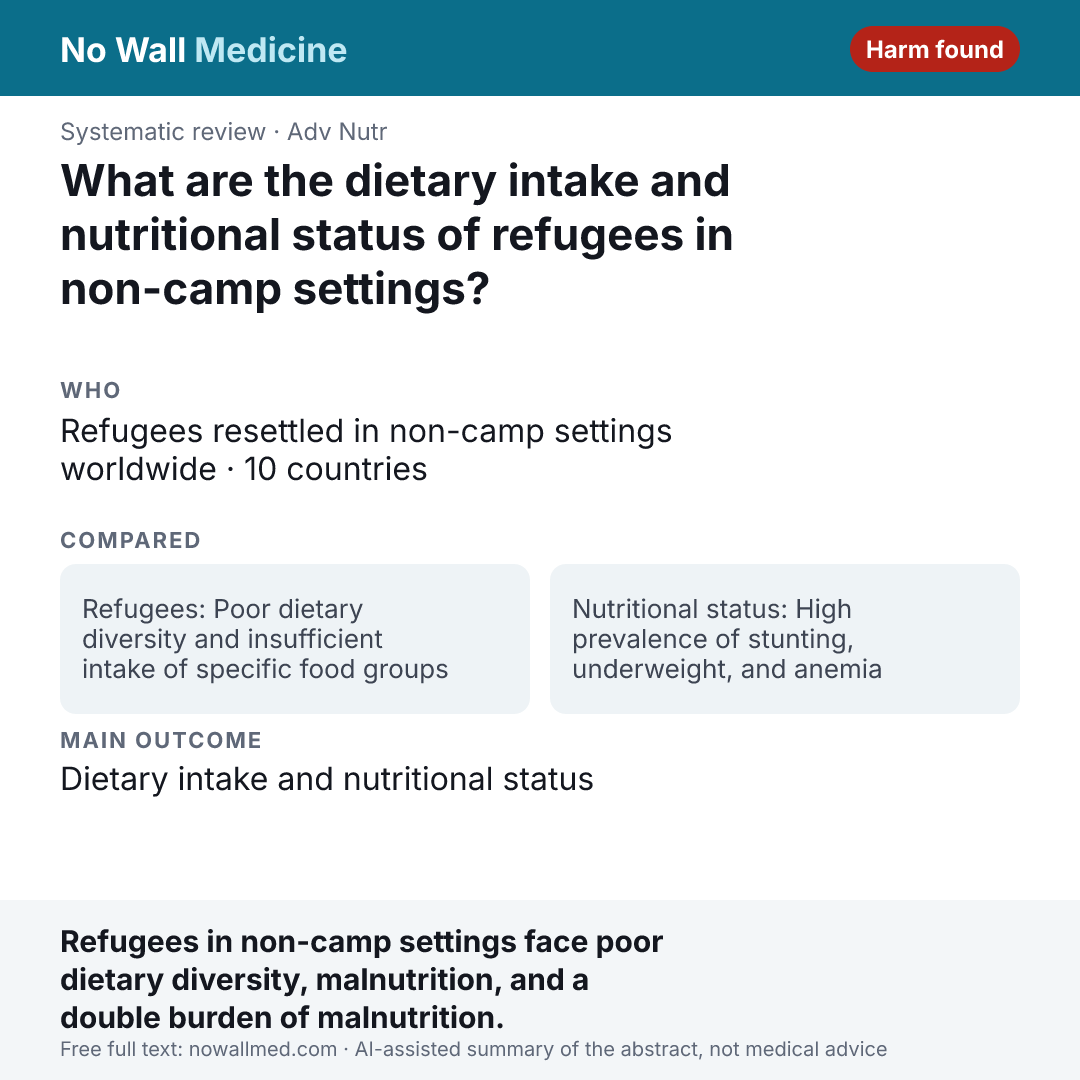
What are the dietary intake and nutritional status of refugees in non-camp settings?
Who
Refugees resettled in non-camp settings worldwide · 10 countries
Compared
Refugees: Poor dietary diversity and insufficient intake of specific food groups
Nutritional status: High prevalence of stunting, underweight, and anemia
Main outcome
Dietary intake and nutritional status
Bottom line: Refugees in non-camp settings face poor dietary diversity, malnutrition, and a double burden of malnutrition.
Adv Nutr · 2022-05-14 · Save PNG
Key points
- Researchers reviewed 15 articles from 10 countries published between 2009 and 2020 regarding refugees living in non-camp settings.
- Findings included poor dietary diversity, insufficient intake of specific food groups, and a high prevalence of stunting, underweight, and anemia, especially in children.
- A double burden of malnutrition was observed, with nutritional status being influenced by pre-resettlement experiences and host country resources.
Discussion prompts
- Would these patients look like yours? Who was left out?
- Is the main outcome one that matters to patients?
- Is the difference large enough to change what you do?
Cite: Khuri J, Wang Y, Holden K, et al. Dietary Intake and Nutritional Status among Refugees in Host Countries: A Systematic Review. Adv Nutr. 2022;13(5):1846-1865. doi:10.1093/advances/nmac051
Free full text: PubMed Central · Summary and visual abstract: nowallmed.com/a/dietary-intake-and-nutritional-status-among-refugees-in-host-1mcp891/ (AI-assisted from the abstract; check the paper before relying on it).