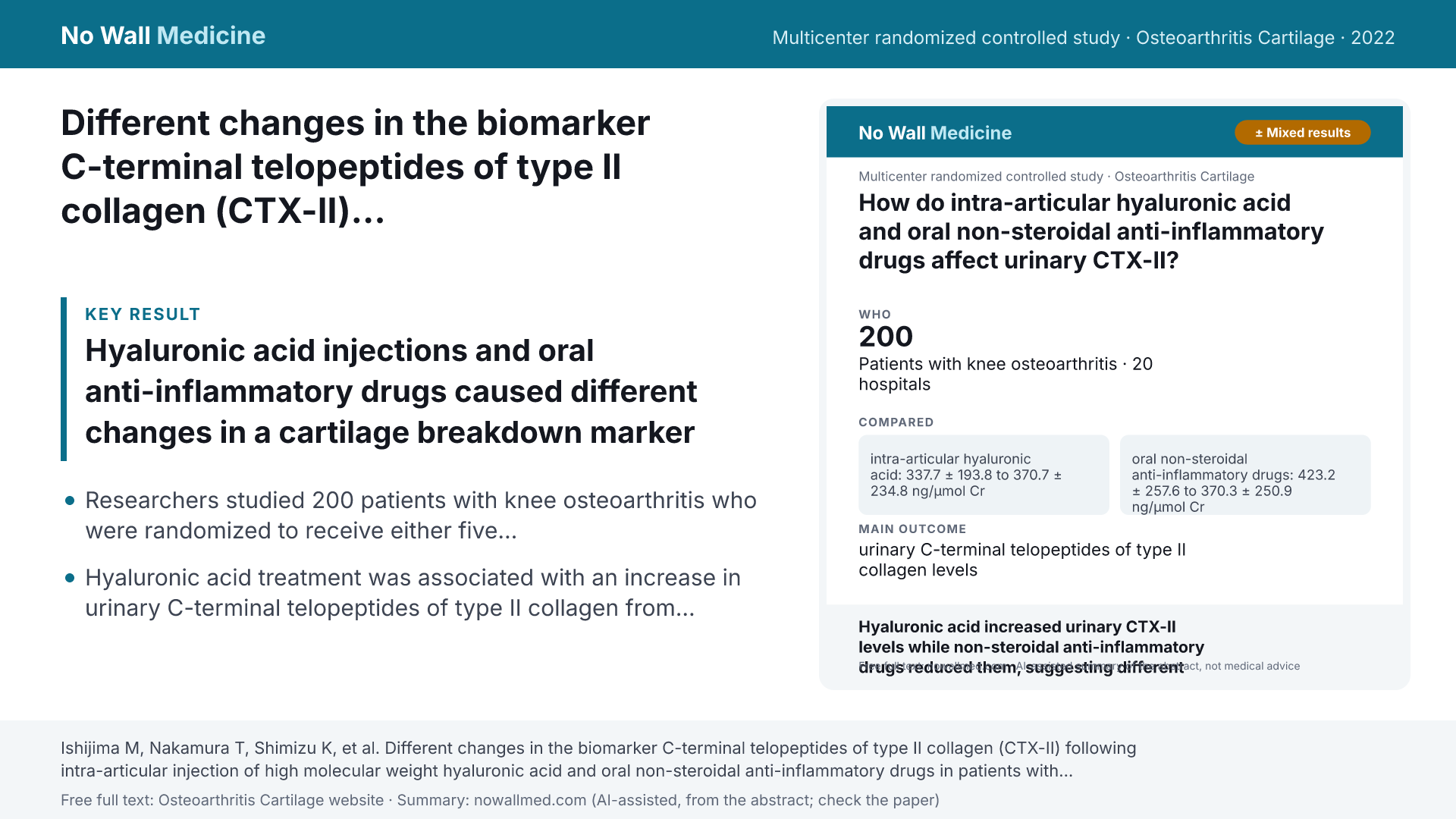
Hyaluronic acid injections and oral anti-inflammatory drugs caused different changes in a cartilage breakdown marker
Different changes in the biomarker C-terminal telopeptides of type II collagen (CTX-II) following intra-articular injection of high molecular weight hyaluronic acid and oral non-steroidal anti-inflammatory drugs in patients with knee osteoarthritis: a multi-center randomized controlled study
Multicenter randomized controlled studyMixed results
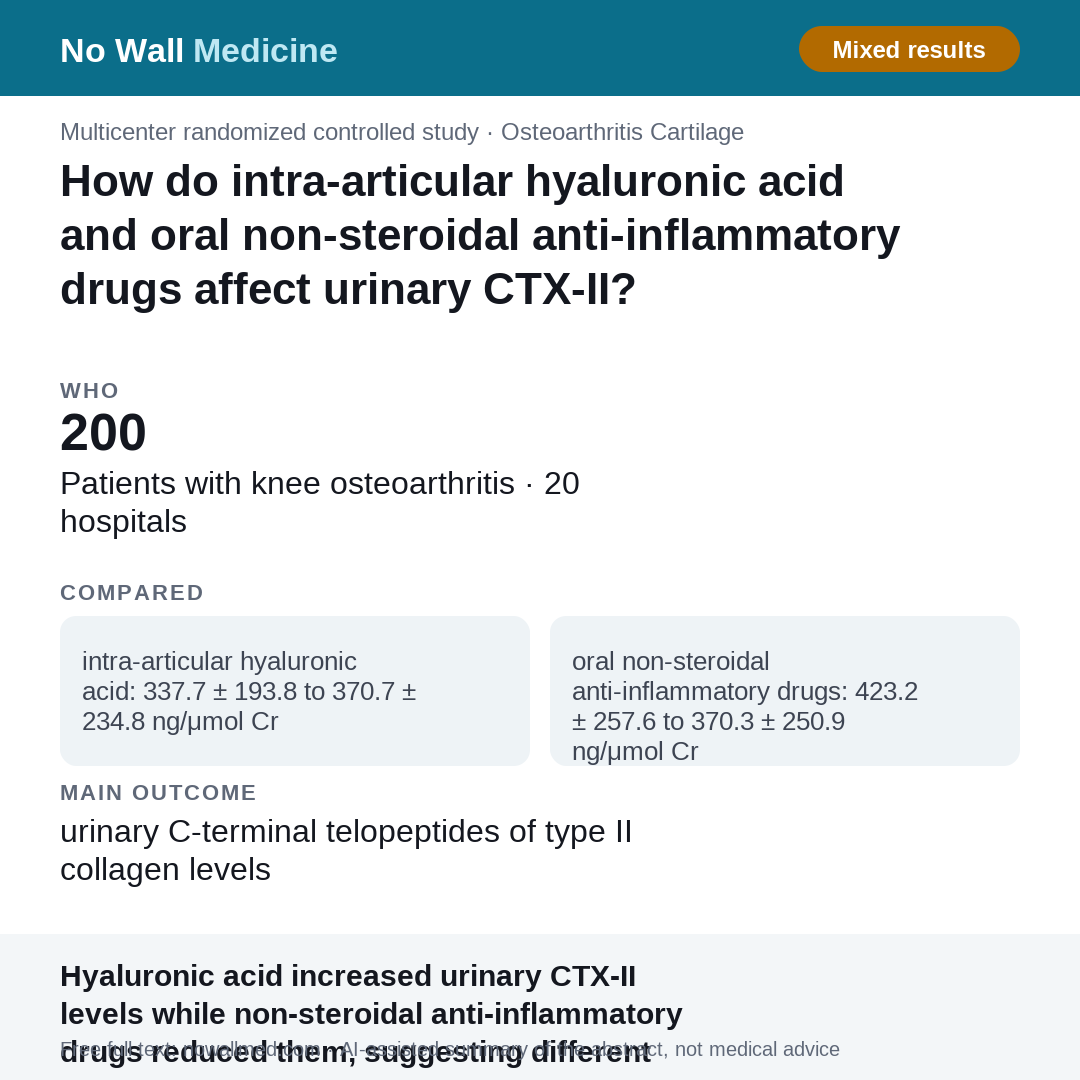
How do intra-articular hyaluronic acid and oral non-steroidal anti-inflammatory drugs affect urinary CTX-II?
Who
200
Patients with knee osteoarthritis · 20 hospitals
Compared
intra-articular hyaluronic acid: 337.7 ± 193.8 to 370.7 ± 234.8 ng/μmol Cr
oral non-steroidal anti-inflammatory drugs: 423.2 ± 257.6 to 370.3 ± 250.9 ng/μmol Cr
Main outcome
urinary C-terminal telopeptides of type II collagen levels
Result: between-group difference: 20.6, 95% confidence intervals: 10.6 to 30.6
Bottom line: Hyaluronic acid increased urinary CTX-II levels while non-steroidal anti-inflammatory drugs reduced them, suggesting different modes of action.
Osteoarthritis Cartilage · 2022-03-22Download image
Clinical question: How do intra-articular hyaluronic acid and oral non-steroidal anti-inflammatory drugs affect urinary CTX-II?
Why it matters: The molecular effects on the pathophysiology of knee osteoarthritis remain unclear despite both treatments improving symptoms.
Key points
- Researchers studied 200 patients with knee osteoarthritis who were randomized to receive either five intra-articular injections of hyaluronic acid or daily oral loxoprofen sodium for 5 weeks.
- Hyaluronic acid treatment was associated with an increase in urinary C-terminal telopeptides of type II collagen from 337.7 ± 193.8 to 370.7 ± 234.8 ng/μmol Cr.
- Oral non-steroidal anti-inflammatory drug treatment was associated with a decrease in urinary C-terminal telopeptides of type II collagen from 423.2 ± 257.6 to 370.3 ± 250.9 ng/μmol Cr.
Headline and key points written with AI from the paper’s abstract, with every number checked against it. Read the paper before relying on them.
Was this summary helpful?
Abstract
Objectives
We previously reported, based on a multicenter randomized-control study, that the efficacy of intra-articular injections of hyaluronic acid (IA-HA) was not inferior to that of oral non-steroidal anti-inflammatory drugs (NSAIDs) in patients with knee osteoarthritis (OA). However, the molecular effects on the pathophysiology of knee OA remain unclear. C-terminal telopeptides of type II collagen (CTX-II) is reported to primarily originate from the interface between articular cartilage and subchondral bone, which is a site of potential remodeling in OA. We performed a predefined sub-analysis of the previous study to compare the changes of urinary CTX-II (uCTX-II) in response to IA-HA to those in response to NSAID for knee OA.Design
A total of 200 knee OA patients were registered from 20 hospitals and randomized to receive IA-HA (2,700 kDa HA, 5 times at 1-week intervals) or NSAID (loxoprofen sodium, 180 mg/day) for 5 weeks. The uCTX-II levels were measured before and after treatment.Results
The uCTX-II levels were significantly increased by IA-HA treatment (337.7 ± 193.8 to 370.7 ± 234.8 ng/μmol Cr) and were significantly reduced by NSAID treatment (423.2 ± 257.6 to 370.3 ± 250.9 ng/μmol Cr). The %changes of uCTX-II induced by IA-HA (11.6 ± 29.5%) and NSAID (-9.0 ± 26.7%) was significantly different (between-group difference: 20.6, 95% confidence intervals: 10.6 to 30.6).Conclusions
While both IA-HA and NSAID improved symptoms of knee OA, uCTX-II levels were increased by IA-HA and reduced by NSAIDs treatment, suggesting these treatments may improve symptoms of knee OA through different modes of action.
Abstract reproduced under the article’s CC BY-NC-ND licence.
Subject terms
Cite this article
Ishijima M, Nakamura T, Shimizu K, Hayashi K, Kikuchi H, Soen S. Different changes in the biomarker C-terminal telopeptides of type II collagen (CTX-II) following intra-articular injection of high molecular weight hyaluronic acid and oral non-steroidal anti-inflammatory drugs in patients with knee osteoarthritis: a multi-center randomized controlled study. Osteoarthritis Cartilage. 2022. doi:10.1016/j.joca.2022.03.003
Spotted a mistake? Suggest a correction