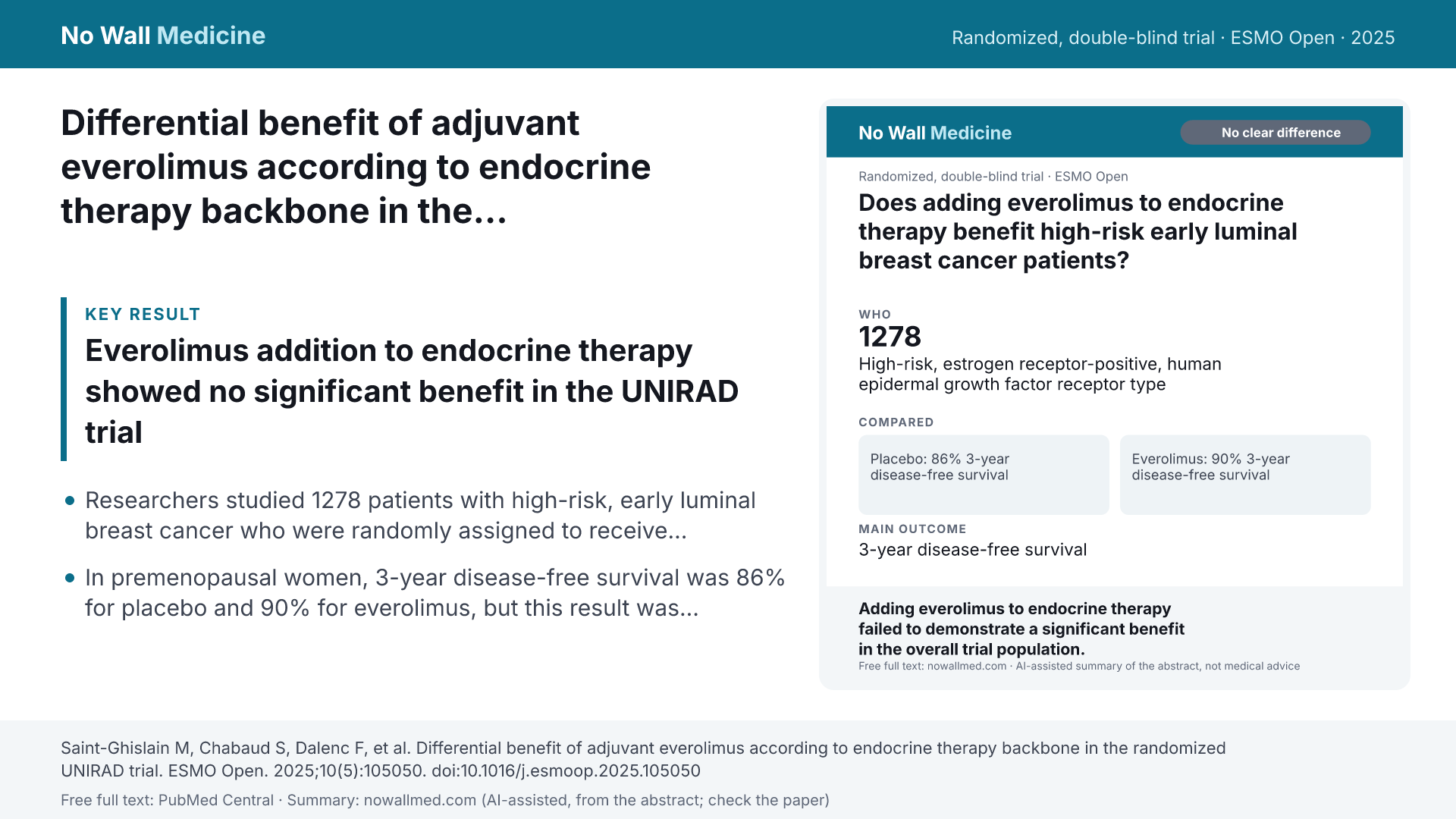
Everolimus addition to endocrine therapy showed no significant benefit in the UNIRAD trial
Differential benefit of adjuvant everolimus according to endocrine therapy backbone in the randomized UNIRAD trial
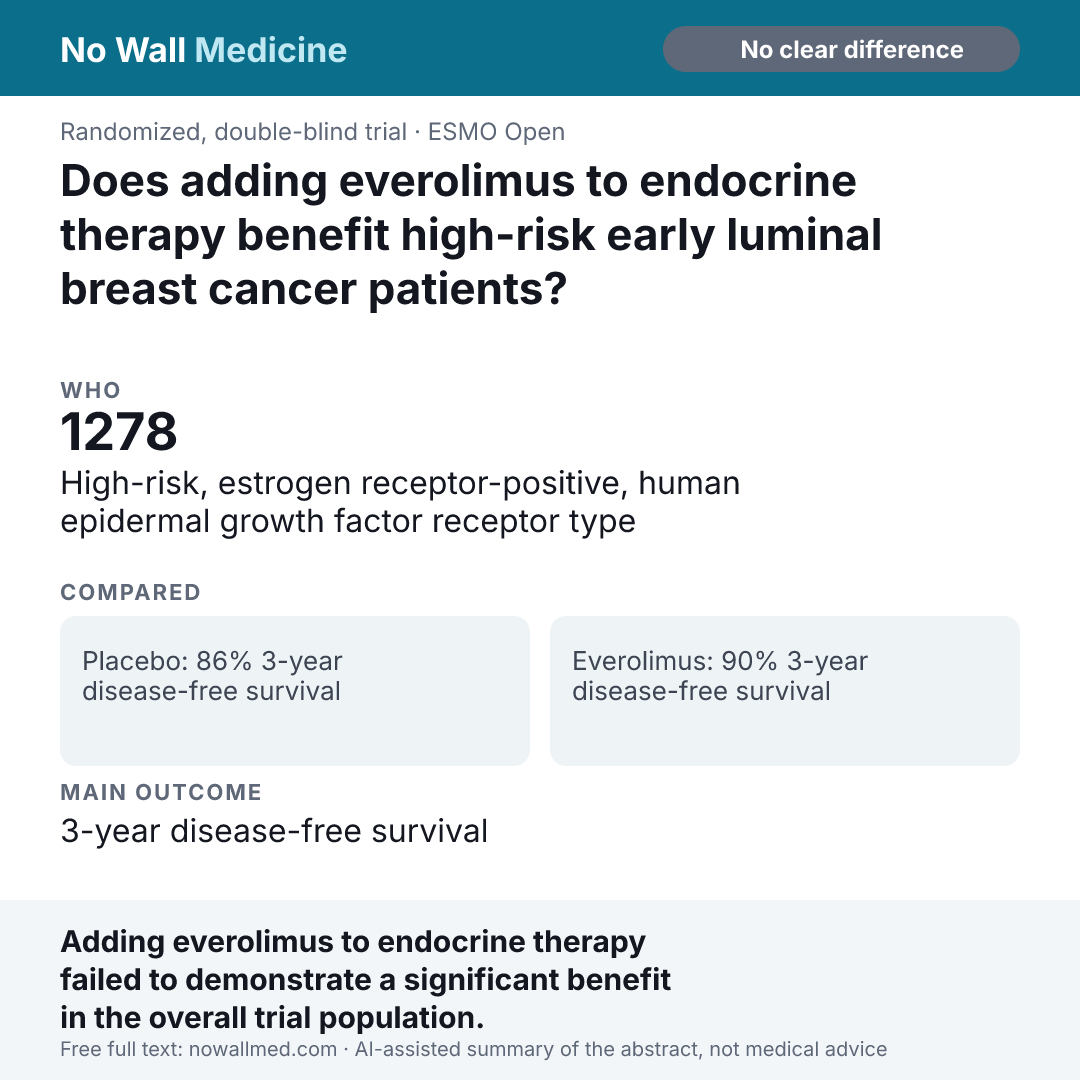
Randomized, double-blind trialNo clear difference
Does adding everolimus to endocrine therapy benefit high-risk early luminal breast cancer patients?
Who
1278
High-risk, estrogen receptor-positive, human epidermal growth factor receptor type 2-negative early breast cancer patients
Compared
Placebo: 86% 3-year disease-free survival
Everolimus: 90% 3-year disease-free survival
Main outcome
3-year disease-free survival
Result: hazard ratio 0.76 (95% confidence interval 0.43-1.34)
Bottom line: Adding everolimus to endocrine therapy failed to demonstrate a significant benefit in the overall trial population.
Limitation: The reported benefits in premenopausal patients were based on post hoc analyses.
ESMO Open · 2025-04-15 · Save PNG
Clinical question: Does adding everolimus to endocrine therapy benefit high-risk early luminal breast cancer patients?
Why it matters: The UNIRAD trial failed to show a benefit for adding everolimus to endocrine therapy, prompting subgroup analyses to see if specific patient types might respond differently.
Key points
- Researchers studied 1278 patients with high-risk, early luminal breast cancer who were randomly assigned to receive either placebo or everolimus added to endocrine therapy.
- In premenopausal women, 3-year disease-free survival was 86% for placebo and 90% for everolimus, but this result was not statistically significant.
- Among premenopausal patients treated with tamoxifen, 3-year disease-free survival was 84% for placebo and 91% for everolimus, though this also lacked statistical significance.
Limitation the authors note: The subgroup analyses were post hoc, meaning they were performed after the initial study results were evaluated.
Headline and key points written with AI from the paper’s abstract, with every number checked against it. Read the paper before relying on them.
Was this summary helpful?
Subject terms
Headline, design, result, key points, caveat and citation as plain text.
Cite this article
Saint-Ghislain M, Chabaud S, Dalenc F, et al. Differential benefit of adjuvant everolimus according to endocrine therapy backbone in the randomized UNIRAD trial. ESMO Open. 2025;10(5):105050. doi:10.1016/j.esmoop.2025.105050
Spotted a mistake? Suggest a correction