Aortic valve replacement causes small but opposite changes in coronary pressure measurements
Differential Effect of Aortic Valve Replacement for Severe Aortic Stenosis on Hyperemic and Resting Epicardial Coronary Pressure Indices
Meta-analysis of 6 studiesMixed results
What are the immediate and long-term effects of transcatheter aortic valve replacement on coronary pressure indices?
Who
Patients with severe aortic stenosis and coronary lesions
Compared
Immediate FFR change: -0.0130±0.0406 SD
Immediate NHPR change: 0.0003±0.0675
Long-term FFR change: -0.0230±0.0747
Long-term NHPR change: 0.0166±0.0699
Main outcome
Fractional flow reserve and nonhyperemic pressure ratios
Bottom line: Transcatheter aortic valve replacement causes small, opposite changes in fractional flow reserve and nonhyperemic pressure ratios.
J Am Heart Assoc · 2024-05-18Download image
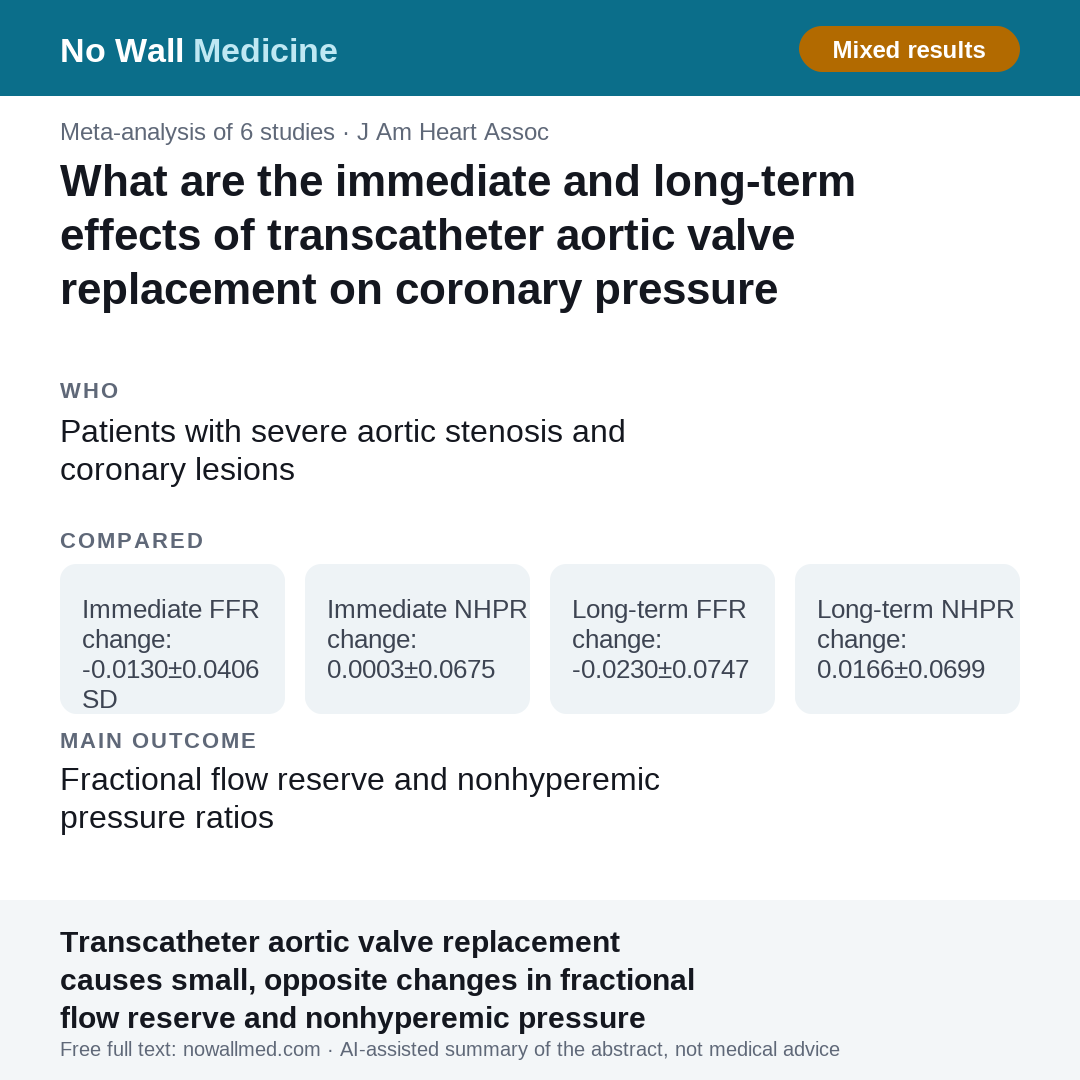
Clinical question: What are the immediate and long-term effects of transcatheter aortic valve replacement on coronary pressure indices?
Why it matters: Conflicting results from studies with varying sample sizes make it unclear how transcatheter aortic valve replacement affects coronary pressure indices used to assess coronary artery disease.
Key points
- Researchers analyzed 147 lesions for immediate changes and 93 lesions for long-term changes in fractional flow reserve, a measure of blood flow through arteries.
- Immediately after transcatheter aortic valve replacement, fractional flow reserve decreased by -0.0130±0.0406 SD, while nonhyperemic pressure ratios remained stable at 0.0003±0.0675.
- Long-term fractional flow reserve decreased by -0.0230±0.0747, while nonhyperemic pressure ratios increased by 0.0166±0.0699, though this increase was not statistically significant.
Headline and key points written with AI from the paper’s abstract, with every number checked against it. Read the paper before relying on them.
Topics
Cite this article
Minten L, Bennett J, Otsuki H, Takahashi K, Fearon WF, Dubois C. Differential Effect of Aortic Valve Replacement for Severe Aortic Stenosis on Hyperemic and Resting Epicardial Coronary Pressure Indices. J Am Heart Assoc. 2024. doi:10.1161/JAHA.124.034401
Spotted a mistake? Suggest a correction
Top studies every Monday
The week’s key trials and guidelines in your specialties, plus any topics you follow. By email, free.
Get the weekly digest