Digital adherence technology did not improve tuberculosis treatment success in a Ugandan trial
Digital adherence technology for tuberculosis treatment supervision: A stepped-wedge cluster-randomized trial in Uganda
Stepped-wedge cluster-randomized trialNo clear difference
Does 99DOTS digital adherence technology improve tuberculosis treatment completion?
Who
1913
Adults treated for drug-susceptible pulmonary tuberculosis · 18 health facilities in Uganda
Compared
Routine supervision (control period)
99DOTS-based supervision (intervention period)
Main outcome
Tuberculosis treatment completion
Result: adjusted odds ratio 1.04 (95% CI 0.68-1.58)
Bottom line: In an intention-to-treat analysis, 99DOTS-based treatment supervision did not improve tuberculosis treatment completion outcomes.
Limitation: Likelihood of selection bias in per protocol analysis and inability to verify medication dosing.
PLOS Med · 2021-05-06Download image
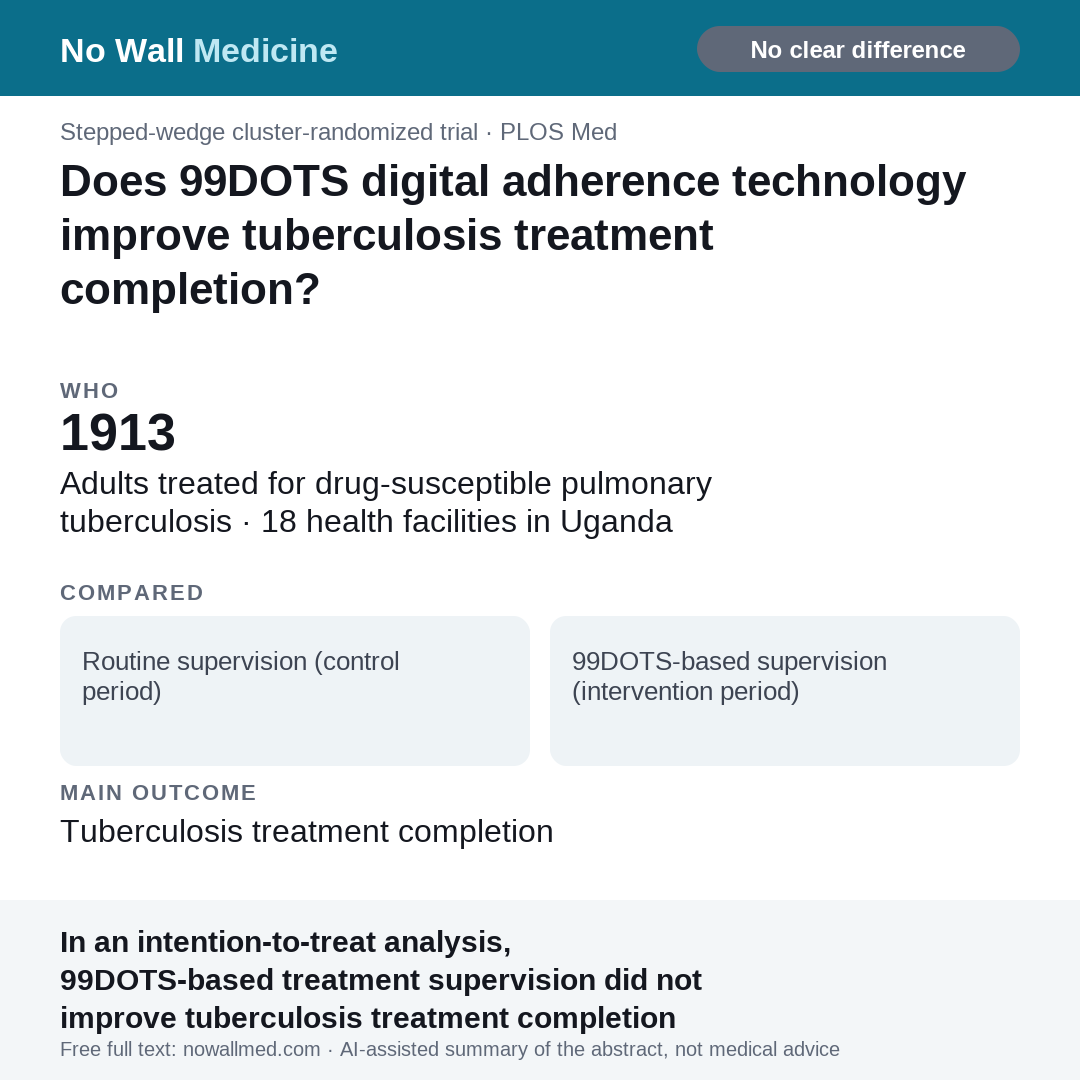
Clinical question: Does 99DOTS digital adherence technology improve tuberculosis treatment completion?
Why it matters: It is unknown if 99DOTS, a low-cost digital adherence technology, can increase tuberculosis treatment completion compared to routine supervision.
Key points
- Researchers studied 1,913 adults treated for drug-susceptible pulmonary tuberculosis across 18 health facilities in Uganda.
- In the intention-to-treat analysis, the odds of treatment success were similar between the 99DOTS digital technology period and the routine supervision period (aOR 1.04, 95% CI 0.68-1.58, p = 0.87).
- The per protocol analysis showed increased odds of treatment success with the digital technology (aOR 2.89, 95% CI 1.57-5.33, p = 0.001).
Limitation the authors note: The authors noted the likelihood of selection bias in the per protocol analysis, an inability to verify medication dosing, and incomplete implementation of some intervention components.
Headline and key points written with AI from the paper’s abstract, with every number checked against it. Read the paper before relying on them.
Was this summary helpful?
Subject terms
Cite this article
Cattamanchi A, Crowder R, Kityamuwesi A, Kiwanuka N, Lamunu M, Namale C. Digital adherence technology for tuberculosis treatment supervision: A stepped-wedge cluster-randomized trial in Uganda. PLOS Med. 2021. doi:10.1371/journal.pmed.1003628
Spotted a mistake? Suggest a correction
Top studies every Monday
The week’s key trials and guidelines in your specialties, plus any topics you follow. By email, free.
Get the weekly digest